



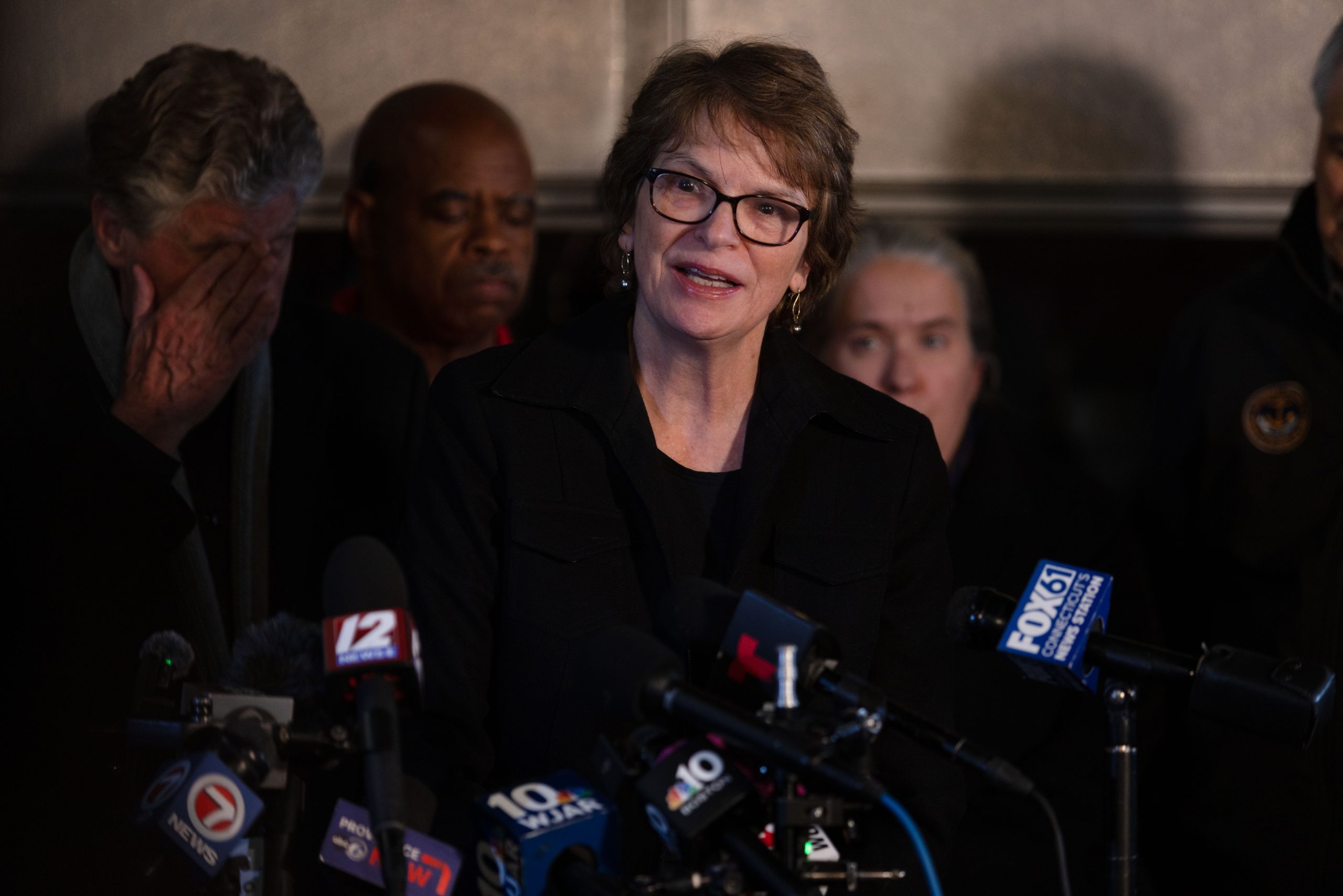
Christina Paxson’s 1,000-word message to the ‘Brown community’ came after the shooter, Claudio Manuel Neves Valente, killed one other person and himself before he was found
Brown University president Christina Paxson sent a lengthy statement to the “Brown community” addressing the Saturday shooting that left two students dead. She condemned “gun violence,” lamented “harmful doxxing activity,” and praised local law enforcement. She did not address the school’s handling of the shooting and its aftermath, which prompted serious questions about how the Ivy League school let the gunman leave campus and kill another individual—a professor at the Massachusetts Institute of Technology—before he was found dead.
“Nothing can fully bring closure to the lives that have been shattered by last weekend’s gun violence,” Paxson wrote in her Friday message. “Now, however, our community has the opportunity to move forward and begin a path of repair, recovery and healing. I want to thank the dedicated city, state and federal law enforcement agencies that worked tirelessly on this case. We hope this brings an increased sense of safety for our community.”
“In the aftermath of the shooting, we have seen harmful doxxing activity directed toward several students, faculty and staff, and multiple offices have been committed to providing support,” Paxson continued. “We also have worked aggressively to combat disinformation in online media and activity that has gone as far as to threaten individuals in our community.”
It’s unclear on what basis Paxson believes the school’s response to the shooting should bring an increased sense of safety rather than a decreased one.
Brown and Providence authorities began facing scrutiny soon after a gunman, now identified as Claudio Manuel Neves Valente, opened fire on campus. Brown refused to sound its alarm system and took nearly 20 minutes to send an emergency alert out to students. It also released and retracted a series of contradictory notices, including that the shooter was in custody when he was not.
Paxson has since claimed its campus sirens would never be used “in the case of an active shooter.” Yet the system’s website says that it’s intended to warn the campus “of a life threatening emergency” and “would likely be activated” in the case of a “Hostile Intruder (Active Shooter).” It was installed in response to the 2007 Virginia Tech shooting, which killed 32 students and professors and was considered “the most significant of several efforts” to heighten campus security, the Brown Daily Herald reported at the time.
Paxson’s siren explanation also appeared to contradict that of Rodney Chatman, who heads Brown’s Department of Public Safety. On Sunday, he said the alarms remained silent due to the fast-moving nature of the crisis, not because of school policy. Chatman faced two votes of no confidence earlier this year, and officers accused him of ignoring complaints that his department failed to adequately respond to shooting and bomb threats.
Paxson also praised law enforcement in her statement, though Neves Valente, a former Brown student, evaded authorities for five days. In that time, he managed to make his way to Brookline, Mass., murder a Massachusetts Institute of Technology professor, and escape to a storage facility in Salem, N.H., some 80 miles north of Providence, where he killed himself, evading justice for good.
As Neves Valente moved throughout the Northeast, authorities arrested a suspect 17 miles from Brown but never shared details, leaving the media to publish information obtained through anonymous sources. Authorities soon released the man, a former Army infantryman, after determining that he was innocent. Ultimately, a homeless man who spotted Neves Valente, a 48-year-old Portuguese national living in the United States as a permanent legal resident, pointed police in the right direction.
Providence police chief Oscar L. Perez initially withheld details about the shooting and information about the status of the investigation. He refused to address allegations that the assailant shouted something during the shooting and didn’t answer questions about the lack of camera footage, considering the university has an extensive surveillance network.
Rather than addressing those shortcomings, Paxson’s message denounced “doxxing,” a reference to speculation that a Palestinian student was linked to the shooting—speculation that seemed to be triggered by Brown removing articles about him.
Brown did not respond to a comment request.
Read the full article here