




While the Trump Administration has said it would protect the Second Amendment and even recently created a Second Amendment Rights Section within the Department of Justice’s Civil Rights Division, it continues to fight to save the NFA’s registration power now that the $200 tax is gone.
And that staunch defense of what is arguably unconstitutional, since the tax law no longer has a tax attached, is drawing the ire of many in the gun-rights community.
“In a stunning, ultimate betrayal of the Second Amendment, the Department of Justice responded to GOA’s One, Big, Beautiful lawsuit with a new attack on gun owners,” the group Gun Owners of America (GOA) said in a recent press release. “The Trump administration is now actively DEFENDING the archaic National Firearms Act of 1934 using legal arguments straight out of the FDR playbook. You read that right: the DOJ is fighting to keep the NFA alive, supporting gun registration under the so-called ‘Necessary and Proper’ and ‘Commerce’ Clauses. And they’ve even laid the groundwork for banning all handguns, claiming that the federal government can ban ‘particularly dangerous’ and ‘easily concealable’ firearms that can be used by violent criminals.”
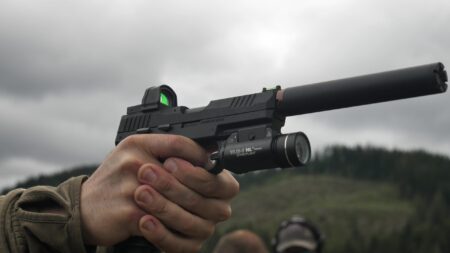
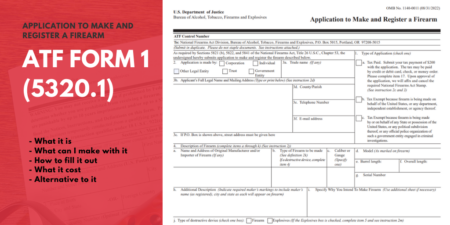
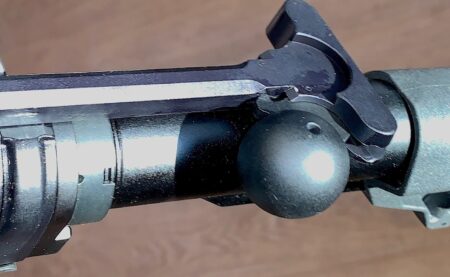
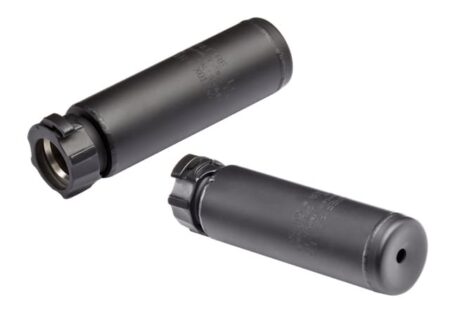
The attack referenced by GOA was a brief filed by the DOJ in the case Brown v. ATF, which challenges the NFA registration requirement for suppressors, short-barreled long guns, and NFA-defined “any other weapons.” The $200 tax was removed when President Donald Trump signed his One Big Beautiful Bill on July 4 and will take effect on January 1.
Concerning the Interstate Commerce clause, the DOJ wrote in its brief: “At any rate, Congress does, under existing precedent, have the power to regulate the intrastate manufacture, making, distribution, sale, transfer, and possession of NFA firearms. In addition to the ‘persons’ and ‘things’ in interstate commerce, the Commerce Clause authorizes Congress ‘to regulate activities that substantially affect interstate commerce.’ …courts have consistently upheld federal firearms laws against Commerce Clause challenges.”
The brief also addressed the Necessary and Proper clause, writing: “Although plaintiffs dispute whether short-barreled rifles and suppressors are uniquely dangerous, they cite no authority adopting their view, while on the other side of the ledger, Congress and the courts have overwhelmingly acknowledged that these weapons possess characteristics that make them uniquely susceptible to criminal misuse.”
The brief concluded with the government insisting that pro-gun groups involved in the litigation must identify their members.
“Limiting a remedy to the members the advocacy groups have identified for standing purposes appropriately leaves the breadth of the remedy the groups can receive in their own hands,” the DOJ concluded. “Nothing prevents them from naming as many of their members as they wish so that each member can benefit from any relief the Court orders. Likewise, nothing prevents the advocacy groups from seeking to litigate this case as a class action. But what the Court cannot do is enjoin the government from enforcing the NFA against members of the advocacy groups when the government does not know who those members are because the groups have not identified them. Therefore, should any injunction issue in this case, the Court should make clear that the injunction runs only to the members that the advocacy groups chose to identify to the government for purposes of standing.”
Ultimately, NRA’s Institute for Legislative Action (NRA-ILA) put it best when it called the DOJ’s defense of the NFA “perilous.”
“The DOJ’s sweeping defense of the NFA’s registration requirements is especially perilous because it could establish a precedent for the federal registration of all firearms,” NRA-ILA said in a news item on its website. “Yet the DOJ has advanced similar arguments in other cases, including in response to the cert petition in Rush v. United States, an NRA challenge to the NFA’s restrictions on short-barreled rifles at the U.S. Supreme Court.”
Read the full article here