





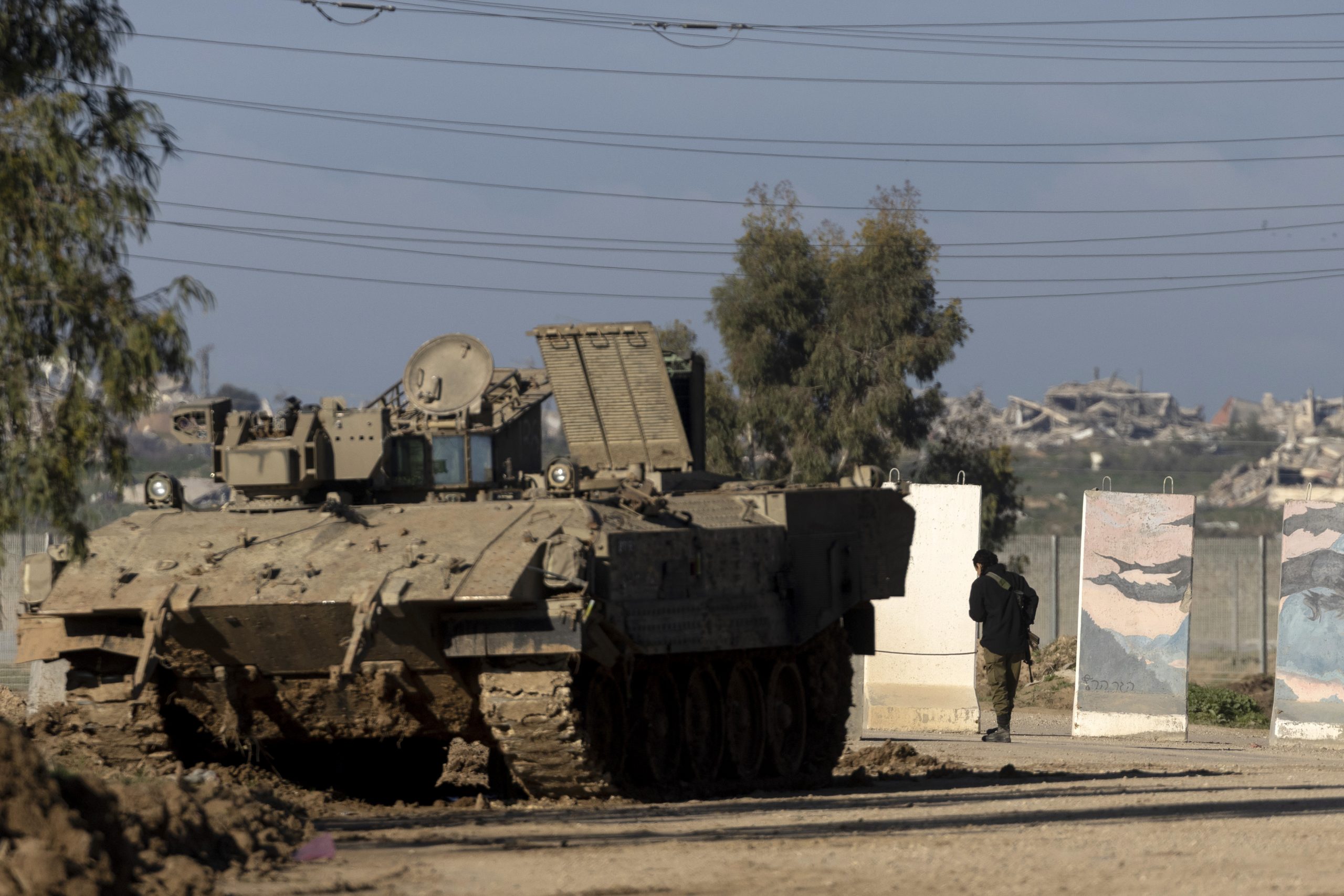
The Israel Defense Forces on Tuesday discovered a weapons cache in southern Gaza, suggesting Hamas is rearming even as the United States moves toward phase two of President Donald Trump’s peace plan—a plan that requires Hamas disarmament.
Israeli forces found “dozens of weapons” in an underground depot near the ceasefire line, “including AK-47s, RPGs, and magazines,” according to the IDF. The buildup indicates that Hamas may be gearing up for a renewed offensive, a possibility the Jewish state is preparing for with plans of a spring ground operation should Hamas launch widespread attacks. Eyal Zamir, chief of the general staff of the IDF, said Monday that the Israeli military is ready “for the possibility of a surprise war.”
Trump himself told reporters on Wednesday in Davos that Hamas must disarm or “be blown away very quickly.”
“They agreed to it, they’ve got to do it,” Trump said. “And we’re going to know over the next two or three days—certainly over the next three weeks—whether or not they’re going to do it. If they don’t do it, they’ll be blown away very quickly.”
A Trump administration official told the Washington Free Beacon that Trump is not bluffing, saying, “President Trump has been very clear on what happens if Hamas decides for some reason not to disarm.”
Israel, though, remains “skeptical that Hamas will disarm and that the Palestinian people want peace,” a U.S. official involved in the talks acknowledged in a small briefing with reporters late last week. The next step, the official said, “will be engaging in conversations with Hamas on the next phase, which is demilitarization,” and with Israel “on what amnesty program can be given to Hamas if they do this.”
The Israeli discovery comes just after Middle East peace envoy Steve Witkoff announced the beginning of phase two of Trump’s 20-point plan. With all 168 living Israeli hostages home and 27 of 28 bodies of the deceased returned to the Jewish state, the parties will now be “moving from ceasefire to demilitarization, technocratic governance, and reconstruction,” Witkoff said. The U.S. plan, as multiple officials told reporters, is unprecedented in scope and depends heavily on Hamas’s cooperation. More than 350 miles of underground tunnels in Gaza “will be destroyed,” the administration official said without providing a timeframe. Next, “the heavy weaponry like RPGs and rocket launchers and missiles, those need to be put into a place where they’re not being used to defend against Israel or for offensive raids or attacks on Israel.”
A separate official told the Free Beacon that several plans are “under discussion” and will take shape as phase two proceeds.
Peace-keeping forces have already begun a process to map Hamas’s intricate tunnel system, and “almost 50 kilometers have been destroyed at this point and ameliorated,” according to the U.S. official.
“Local Palestinian police forces” vetted by the United States and members of the newly established National Committee for the Administration of Gaza—which includes representatives from Turkey, Qatar, Egypt, and the United Arab Emirates—will handle security inside the territory.
Hamas leaders are “sending a lot of positive signals,” claiming their weapons supplies are “very depleted,” the U.S. official told reporters. But, in public, Hamas is delivering a vastly different message.
“There are those who want to impose their vision on us, contrary to the Palestinian, Arab, and Muslim position,” Hamas head Khaled Mashaal said in December. “The idea of total disarmament is unacceptable to the resistance. What is being proposed is a freeze, or storage … to provide guarantees against any military escalation from Gaza with the Israeli occupation.”
Amir Avivi, a former senior Israeli military officer who regularly advises the country’s government, said during a Monday briefing that the evidence inside Gaza demonstrates that “Hamas is getting stronger, more and more organized.” The situation, he said, is “not sustainable” for Israel, which views itself as the only party capable of eradicating the group.
“There is still thinking in the U.S. that they can dismantle Hamas,” Avivi said of the Trump peace plan. “I think there is no chance they can do it. I would be really surprised, and happy to be surprised, if there is a force that can go in and fight Hamas without Israeli soldiers needing to do it. But realistically speaking, I think the chances are really, really low.”
The terror group’s movements inside Gaza suggest disarmament is not on its menu. It continues to reconstitute tunnels that Israel destroyed during the war and is estimated to have at least 60,000 rifles in its possession. Israeli forces have also discovered ready-to-fire rocket launchers, and IDF troops have repeatedly come under Hamas and Palestinian Islamic Jihad attacks in the territory.
Israel has also discovered on-the-ground evidence indicating that Hamas has retained “strong financial standing,” holding as much as $300 million in cash inside the tunnels.
Hamas’s healthy financial status prompted the Trump administration on Wednesday to sanction several “covert funding networks” the group has been using to fortify its ranks. The six Gaza-based organizations, the Treasury Department said, “claim to provide medical care to Palestinian civilians but in fact, support the Izz al-Din al-Qassam Brigades, Hamas’s military wing.”
Joe Truzman, a research analyst with the Foundation for Defense of Democracies’ Long War Journal, told the Free Beacon that Hamas’s disarmament is “the most intractable obstacle to ending the war.”
He added that, though Hamas leaders have told the United States disarmament remains on the table, terrorism remains “a structural feature of the organization itself … Hamas’s open refusal to disarm is not a negotiating tactic to be overcome with incentives or guarantees.”
Read the full article here