



Crime, poverty, homelessness, high prices are denounced—by fellow Democrats
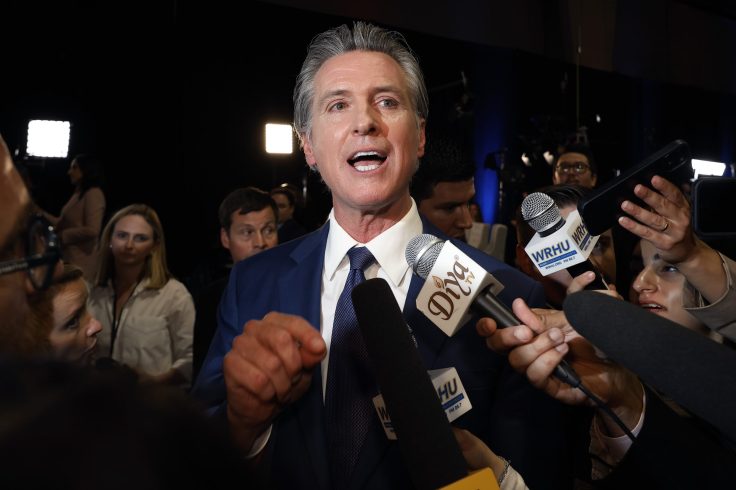
About an hour and 44 minutes into this week’s debate among seven candidates for governor of California, the moderator asked a question that he said had been sent in by “Henry in San Bernardino.” It said, “Governor Newsom made several high-profile commitments, such as addressing housing affordability, reducing homelessness, and improving public safety that some Californians feel remain unmet or insufficiently delivered. What concrete accountability mechanisms would you put in place to ensure that your own commitments are not just announced but measurably delivered within a defined timeline?”
The question underscored an awkward reality for the six Democrats on stage and for the party as a whole. The Golden State governor, Gavin Newsom, is near the top of polls for the 2028 presidential nomination. He has an autobiography, Young Man in a Hurry: a Memoir of Discovery, scheduled for publication in just a few weeks, on Feb. 24, that is already bringing a burst of press attention. Vogue is warning middle-aged women readers: “He is embarrassingly handsome.”
Yet after seven years with Newsom as governor, California is still suffering—not only from the problems Newsom got elected originally trying to fix, but from others that he has helped create along the way.
“We have the highest poverty rate in the United States of America,” said a former mayor of Los Angeles, Antonio Villaraigosa. “In our cities, we’ve had too much crime.” Villaraigosa said the state had spent $24 billion supposedly combating homelessness, “and homelessness went up.”
“Let’s face it, the cost of gas is high,” acknowledged the state’s superintendent of public instruction, Tony Thurmond, another Democrat running for governor.
If Newsom does end up as the Democratic presidential nominee in 2028, his opponents in the primary and general elections could make a pretty good attack ad just showing six other Democrats talking about what one of them, the mayor of San Jose, Matt Mahan, called “the brutally high cost of housing” and “the obvious failures of our policies to address homelessness.”
The former California state controller, Betty Yee, said politicians “should feel ashamed” of the impacts that “green energy” policies have had on low-income communities. She said the California government is “spending more than we are bringing in,” even though the state is not in a recession.
Yee said Californians “can’t afford a leader who thinks grandstanding is actually governing.” She left unclear who the comment was directed at, but California voters are surely picking up what she was putting down.
Another Democratic candidate, Xavier Becerra, a former California attorney general and former U.S. secretary of health and human services, said “the governor’s office is not a place for on-the-job training or inflated promises.” Like Yee, he didn’t name the target of that comment, but it also might have been interpreted as casting shade at Newsom, who was elected in 2018 and is term-limited.
The sole Republican candidate on the debate stage, Steve Hilton, said “the biggest driver of the high cost of living is Democrat policies.” He said the state had suffered from “16 years of Democrat one-party rule.” The most recent Republican governor of California was Arnold Schwarzenegger, who left office in January 2011. Presidents Nixon and Reagan were California Republicans, as was House Speaker Kevin McCarthy, but the party has struggled to compete in statewide elections in recent years.
As in other Democrat-dominated cities and states, the effect has been that the highest-stakes ideological battles are sometimes within the Democratic Party itself. Some of those rifts were on display in the debate, with Thurmond and billionaire environmentalist Tom Steyer anchoring the far left, and Villaraigosa and Mahan sounding more pragmatic, technocratic, and moderate by comparison. Steyer, Thurmond, and Yee backed a billionaire tax that, as Steyer put it, has rendered “the big tech CEOs … terrified.” Steyer and Thurmond also said they favored abolishing Immigration and Customs Enforcement. Thurmond said he backed “universal health care for all, including undocumented immigrants.” Steyer said he backs rent control.
A question about whether the candidates backed Newsom’s push to ban gas-powered vehicles in the state by 2035 also exposed differences among the candidates, with Thurmond and Yee favoring the policy and with Villaraigosa and Hilton opposing it. Mahan dodged: “only if the technology is there.”
Other sections of the debate dealt with California’s incomplete and over-budget high-speed rail project; its K-12 public education system that was compared unfavorably to that of Mississippi; homeowners insurers fleeing the state; and a lack of funding for drug treatment programs.
If the Democrats don’t nominate Newsom for president in 2028, there is always Kamala Harris, another California Democrat. The nonpartisan primary election in the governor’s race is June 2, 2026. Several candidates who did not participate in the televised debate are also running in the primary, including Rep. Eric Swalwell, who is a Democrat, and the sheriff of Riverside County, Calif., Chad Bianco, who is a Republican.
Read the full article here