




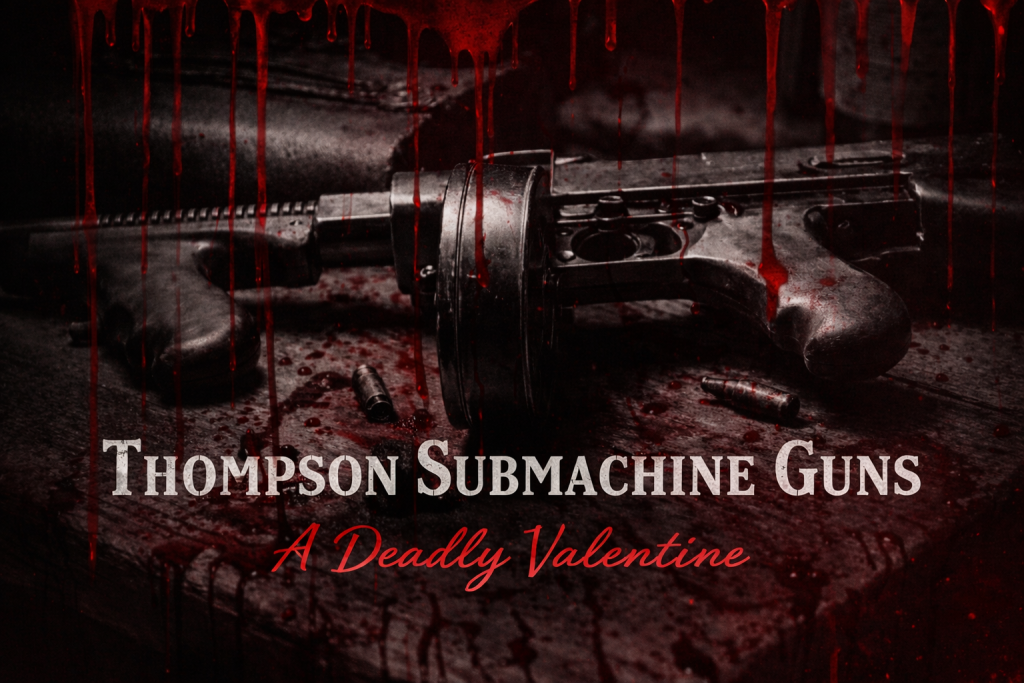
February 14, 1929, remains one of the bloodiest days in American crime history. Seven men lined up against a wall. Four men dressed as police officers.
Two Thompson submachine guns, unleashing hell in a North Clark Street garage in Chicago. The St. Valentine’s Day Massacre shocked the nation and came to symbolize the savage violence of Prohibition-era gang warfare.
What most people don’t know is that the guns used in America’s most notorious gangland slaying weren’t found in Chicago. They were discovered ten months later in a quiet Michigan town, following a traffic accident that would ultimately crack open the “Crime of the Century.”
The Massacre
Al Capone’s war with George “Bugs” Moran had been escalating for years. Moran’s North Side Gang and Capone’s South Side outfit had traded bullets and bombings throughout the roaring twenties. On one particularly brazen occasion, Moran’s crew had driven six cars past a Cicero hotel where Capone was dining and unleashed over 1,000 rounds at the building. Capone survived, but his patience didn’t.
When a $50,000 bounty landed on his head, Scarface decided it was time to end the rivalry permanently. The plan was simple and brutal: lure Moran’s top men to their headquarters with the promise of a bootleg whiskey delivery, then eliminate them all at once.
The hit went down on Valentine’s Day. Four men—two dressed as police officers, two in street clothes—entered the SMC Cartage Company garage at 2122 North Clark Street. Seven men from Moran’s crew were inside: Frank and Pete Gusenberg (Moran’s best killers), Adam Heyer, Albert Weinshank, James Clark, John May, and optometrist Reinhardt Schwimmer, who associated with the gang.
The fake cops ordered the men to line up facing the wall, as if conducting a routine police raid. Then the Thompson submachine guns opened up. When real police arrived, they found a charnel house. Incredibly, Frank Gusenberg was still breathing. Asked who shot him, the mortally wounded gangster kept to the code of silence: “No one, nobody shot me.”
Bugs Moran himself escaped death only because he was running late and, seeing what he thought were police officers entering his headquarters, decided to wait outside. The massacre destroyed his organization but failed to kill its leader.
The Getaway
Among those suspected of carrying out the hit was Fred Burke, a career criminal who had made his bones with the St. Louis gang Egan’s Rats before catching Al Capone’s attention in the 1920s. Burke was the kind of professional killer Capone preferred—ruthless, skilled, and mobile. After the massacre, Burke vanished into the Midwest.
He surfaced in St. Joseph, Michigan, living under the alias Fred Dane. Western Michigan had become known as “Capone’s Playground”—a place where Chicago gangsters came to relax, play golf, shop, and enjoy the beaches without the violence that defined their business back home. According to historian Chriss Lyons, the relationship between the mobsters and locals was surprisingly cordial.
“The gangsters weren’t there to start trouble,” Lyons explained. “The police didn’t bother them, and they didn’t bother the police. Capone was known as a very generous tipper.” During the Depression, when a 12-year-old caddy might receive a $100 tip from Capone—an astronomical sum for the era—locals saw him as a wealthy businessman rather than a killer. It was an unspoken arrangement: as long as the gangsters kept the violence in Chicago, they were welcome.
Burke enjoyed this refuge for nearly a year. Then, on the night of December 14, 1929, everything unraveled over a fender bender.
A Fatal Traffic Stop
St. Joseph Police Officer Charles Skelly witnessed a minor traffic accident and stopped the drunk driver who caused it. When Skelly ordered the man to the police station, the driver—Fred “Dane”—jumped into his car and sped away. Skelly gave chase, leaping onto the running board of another vehicle in pursuit.
When they caught up, Skelly jumped onto the running board of the fleeing car. The driver pulled a revolver and fired three rounds into Skelly’s torso, knocking him to the ground. The 25-year-old officer died hours later in the hospital. He remains the only St. Joseph police officer ever killed in the line of duty.
Burke fled the scene, but police found his abandoned vehicle with registration papers in the name of Fred Dane. A raid on Dane’s house produced a stunning discovery: two Thompson submachine guns with nine ammunition drums, two high-powered rifles, one sawed-off shotgun, approximately 5,000 rounds of ammunition, six tear gas bombs, and stolen bonds from a Jefferson, Wisconsin bank.
The Smoking Guns
Police sent the Thompson submachine guns for ballistic testing. The results were explosive. Not only were these the weapons used to kill mobster Frankie Yale in New York the previous year—they were the exact guns used in the St. Valentine’s Day Massacre.
Major Fred Silloway’s promise to “have the killers that night” had become a national embarrassment as the case went cold. Witnesses changed stories, disappeared, or turned up dead. Evidence vanished. But now, thanks to a drunk driving incident in Michigan, investigators finally had the murder weapons.
Fingerprint analysis revealed that Fred Dane was actually Fred Burke, a close Capone associate with a rap sheet spanning multiple states. Burke had already served time in Michigan’s Jackson Prison in 1919 for obtaining money under false pretenses. This time, he wouldn’t get off so lightly.
Police captured Burke nearly a year later at a Missouri farm, where he was living under yet another alias: Richard Franklin White. Multiple jurisdictions wanted him—Chicago for the massacre, Michigan for murdering Officer Skelly. Missouri’s governor ruled that Michigan had the stronger case.
Justice, Michigan-Style
On April 27, 1931, the Berrien County Circuit Court sentenced Burke to life in prison for second-degree murder in Officer Skelly’s death. He arrived at Marquette Prison the next day, registered under the name Fred Dane.
The Benton Harbor News-Palladium covered Burke’s case extensively, dubbing him “the most dangerous man in America.” The newspaper’s daily reports delighted in graphic depictions of Burke’s many crimes, and Berrien County took clear pride in harboring the famous fugitive.
Burke never stood trial for the St. Valentine’s Day Massacre. He never confessed to any involvement. On July 10, 1940, he died of a heart attack in Marquette Prison at age 47. The massacre officially remains unsolved to this day.
The Guns Live On
Today, those two Thompson submachine guns—the actual weapons that carried out the St. Valentine’s Day Massacre—are housed in the Berrien County Sheriff’s Department armory under lock and key. They’re taken out regularly and fired, and have won numerous awards in the historical gun category with the NRA.
Lieutenant Mike Kline tours with the weapons, and according to Chriss Lyons, people still struggle to believe they’re authentic. “When he went to NRA shows, people would be fascinated with the guns and they would say, ‘So these are kind of like the guns that were used in the Massacre?’” Lyons recounted. “Mike would say, ‘No, these ARE the guns that were used in the Massacre.’ People would persist, ‘No really, is that what the guns looked like?’”
It’s a testament to how legendary the massacre has become that the actual murder weapons seem too real to be real.
The Thompson’s Dark Legacy
The Thompson submachine gun, designed by John T. Thompson for military use in World War I, became synonymous with gangland violence in the 1920s. Capable of firing up to 600 rounds per minute, it was devastatingly effective in close quarters. The weapon’s association with organized crime eventually led to the National Firearms Act of 1934, which heavily regulated machine guns and remains a cornerstone of federal firearms law.
The St. Valentine’s Day Massacre proved to be the last major confrontation for both Capone and Moran. Capone was convicted of tax evasion in 1931 and spent the rest of his life in and out of prison and hospitals, dying from syphilis in 1947. Moran lost so many key men that he could no longer control his territory. He was relegated to small-time robberies until 1946, when he was sent to federal prison. He died in Leavenworth in 1957 of lung cancer.
On the seventh anniversary of the massacre, Jack McGurn—one of the Valentine’s Day hitmen—was killed in a crowded bowling alley with a burst of machine-gun fire. His killer was never identified, though Moran was suspected but never charged.
A Michigan Connection to Infamy
The St. Valentine’s Day Massacre remains America’s most spectacular unsolved gangland crime. But the case demonstrates how firearms evidence can crack even the coldest cases—and how a routine traffic stop in a quiet Michigan town can unravel the most carefully planned murders.
Officer Charles Skelly paid with his life, but his death brought the weapons used in the massacre to light. Those Thompson submachine guns, still in Michigan to this day, stand as silent witnesses to an era when American streets ran red with bootleggers’ blood and Valentine’s Day meant something far darker than chocolates and flowers.
Sources
- HISTORY.com Editors. “The St. Valentine’s Day Massacre.” HISTORY, A&E Television Networks, November 13, 2009, updated May 28, 2025. https://www.history.com/this-day-in-history/february-14/the-st-valentines-day-massacre
- Knight, Marcy Kennedy. “The Actual Tommy Guns Used in the St. Valentine’s Day Massacre.” The Mob Museum Blog, February 3, 2014. https://themobmuseum.org/blog/monday-feb-3-yesthese-are-the-actual-tommy-guns-used-in-the-st-valentines-day-massacre/
- Heldt, Frances. “Michigan and the St. Valentine’s Day Massacre.” Michiganology, Archives of Michigan. https://michiganology.org/stories/michigan-and-the-st-valentines-day-massacre/
- Lyons, Chriss. Capone’s Playground (referenced in Mob Museum article regarding western Michigan as gangster refuge during Prohibition era).
Read the full article here