





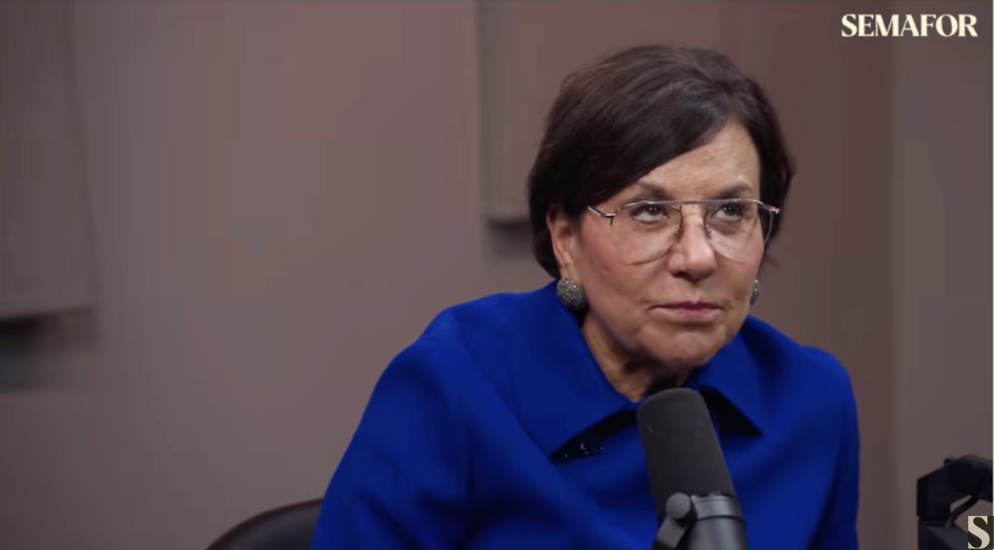
The senior fellow of the Harvard Corporation—essentially, its board chair—former Obama and Biden administration official Penny Pritzker, is, at age 66, launching a new career as a podcaster.
Pritzker, who was secretary of commerce in the Obama administration and a State Department special envoy for Ukraine reconstruction during the Biden administration, launched the show recently via Semafor, a newsletter and events company in which she reportedly invested earlier this year. Her status as an investor in Semafor is not disclosed in the program, which is available on Apple podcasts, Spotify, YouTube, and Amazon Music.
Semafor bills the program as “presented by PWC,” or PriceWaterhouseCoopers. PWC is Harvard’s audit and accounting firm. It’s an interesting time to be Harvard’s audit and accounting firm, as Harvard is touting what it says is a $56.9 billion (as of June 30, 2025) endowment that is 41 percent allocated to private equity, and, as the Wall Street Journal reported Tuesday, “Investors are increasingly worried that private-equity assets are overvalued, and are questioning whether regulators and auditors will hold firms accountable.”
Harvard used a PWC-certified financial statement earlier this month as part of offering documents to issue $696,175,000 in tax-exempt bonds via the Massachusetts Development Finance Agency, which is controlled by Massachusetts governor Maura Healey, a Democrat. That borrowing, according to the bond offering documents, is in part to fund a new 109,500 square foot, $175 million, Harvard economics building for which Pritzker gave $100 million.
An introductory promotion of the podcast features Pritzker describing the program as “conversations about leading complex organizations at a uniquely complex time.” The episodes so far have featured the CEOs of Starbucks and IBM making corporate-conference-circuit style observations about organizational change and managing through uncertainty. Pritzker has a co-host, Andrew Edgecliffe-Johnson, who adds a British accent. The show description identifies Pritzker as “investor, business builder, and former U.S. Secretary of Commerce,” but not anywhere specifically as an investor in Semafor or as senior fellow of Harvard’s Corporation.
Pritzker has been promoting the episodes from her LinkedIn account: “I sat down with my friend Arvind Krishna, Chairman and CEO of IBM … I was particularly struck by Arvind’s intentionality in nurturing authenticity and innovation across a global organization.”
Pritzker, a billionaire heiress to the Hyatt hotel fortune, shares some personal background as she banters with the guests. “My husband often says I’m a kind of person who runs towards a fire,” she said at one point. She also recalls, during high school, working at a hotel front desk. “You learned a lot about people and how to help people who are frustrated,” she said.
Pritzker’s involvement as an unpaid podcast host predates and is unrelated to her investment, said a Semafor spokeswoman, who said Pritzker had been asked “because her experience across government, business, and civic life gives her unique perspective and insights in conversations with business leaders on some of the top challenges of today.” She said PWC is a longstanding Semafor partner “across multiple products and platforms” and its sponsorship is an extension of the longstanding partnership and “is not directly linked to the show hosts.”
Pritzker and Harvard did not immediately respond to requests for comment.
Pritzker isn’t the only major research university board chair with a podcast. David Rubenstein, a former Carter administration official who is chairman of the board of the University of Chicago, a former Harvard Corporation member, launched an interview show in 2016 that has appeared on PBS and Bloomberg as well as on YouTube. Rubenstein is also an investor in Semafor.
Harvard, though, is in a situation that may require more urgent attention from Pritzker than UChicago demands from Rubenstein.
The Pritzker-picked Harvard president, Claudine Gay, resigned in January 2024 amid a plagiarism scandal, following a botched response to anti-Israel campus activism and disastrous testimony during what is being called “the most-watched congressional hearing in history.” Then, in 2025, Harvard sued the Trump administration rather than reach a negotiated settlement over research funding with the federal government the way other universities did. Pritzker herself was also hauled before a congressional committee for testimony, where, Rep. Elise Stefanik (R., N.Y.) reports in her bestselling new book Poisoned Ivies, Pritzker, “hired her own legal team separate from Harvard’s.” And, Stefanik’s book says, “at Pritzker’s deposition, there was a heated disagreement when her lawyers would not allow the Harvard lawyers into the room.”
Pritzker-led Harvard hired Clare Locke, a law firm that specializes in suing and threatening news organizations, to threaten the New York Post for defamation for reporting on Gay’s plagiarism. Now Pritzker is going to work as a “host” for Semafor, a news platform cofounded by my former New York Sun and Forward colleague Ben Smith, who, I should probably disclose, has been nothing but gracious to me in our occasional dealings in the years since.
Harvard, despite its claims and wishful thinking to the contrary, is not on the other side of its crisis. It still faces litigation and investigations from the Trump administration. Conservative faculty are leaving; Arthur Brooks is stepping down as a professor, as did James Hankins. There are new outbreaks of antisemitism each week. This past Friday evening, Israel was falsely accused of “genocide” from a speaker in the pulpit of Harvard’s Memorial Church. The accusation, which was met with applause, was made at a Harvard Arab Conference that the Harvard College official website touts (it “creates space for Arab excellence in all its forms.”) The Harvard Arab Conference app—download required for attendance—links to a blog demonizing Israel as “a brutal, monstrous, and racist entity that thrives on inhumanity.”
Other institutions are surpassing Harvard in attracting philanthropy from sophisticated donors. The University of Texas at Austin on April 21 announced a $750 million gift from Michael and Susan Dell to establish the UT Dell Campus for Advanced Research and the UT Dell Medical Center, announcing a “goal for the University to raise $10 billion in 10 years and rank in the top 10 for medical centers nationally within a decade.”
Forbes estimates Pritzker’s fortune at $4.3 billion; her family controls Hyatt hotels. Her brother, J.B. Pritzker, also a Democrat, is governor of Illinois; President Trump described him in June 2025 as “probably the worst in the country.”
Read the full article here