




Perhaps the greatest challenge every current affairs author faces is the inevitable decision of where to draw the line. As events continue to remain all-too-current, they must decide where to finally freeze time in place, put down the pen, and accept that no future “current” events will be included. Then, they must embrace the inescapable sense of anxiety over the universe of future events that, as a result, won’t make the cut.
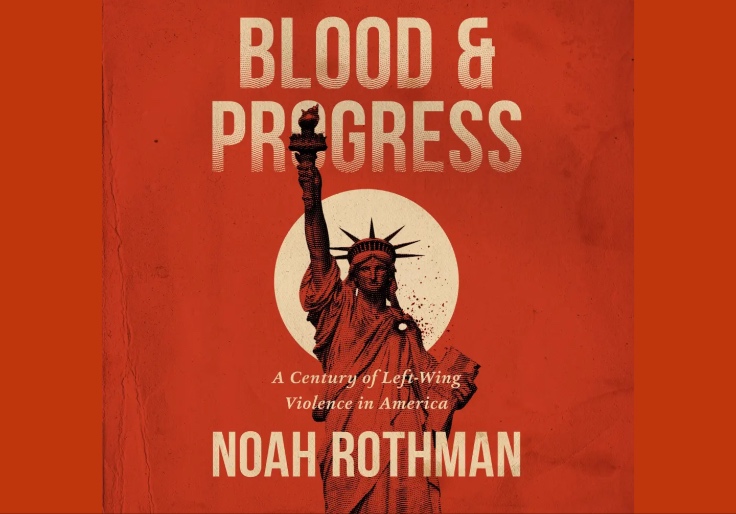
Given the state of our country, one can only imagine how National Review‘s Noah Rothman felt when writing his latest book, Blood & Progress: A Century of Left-Wing Violence in America. Even my own review of this excellent work was hampered by the sheer velocity of political violence in the United States, with news flooding in of the third assassination attempt targeting President Donald Trump—carried out, despite the unconvincing propagandizing of none other than the gaslighter-in-chief Barack Obama himself, by a leftist—just as I finished my first draft.
Blood & Progress opens with what was undeniably the most impactful, shocking, and brutal example of the left-wing violence that has become our daily reality in the United States: the assassination of Charlie Kirk in September 2025, with a husband, father, and patriot murdered for committing the unforgivable crime of engaging in polite and respectful right-wing dialogue on a college campus. In the context of Kirk’s murder—a murder that feels unprecedented and yet somehow normal—Rothman lays the groundwork for the thesis of Blood & Progress: Contrary to the notion that political violence is a problem limited solely to the American Right, there is a cyclic epidemic of left-wing political violence that is the result of what Rothman deems an “activist ecosystem” that remains instinctually hellbent on promoting its own myopic combination of denial, justification, and celebration of violence, all while reflexively blaming the Right for the crimes of the Left.
“This is a book about the assassins, the vandals, the small-cell terrorists, and the lizard-brained mobs that mete out destruction, violence, and death in the name of political causes and in the pursuit of political outcomes,” Rothman declares, before leading readers on a fascinating and yet phenomenally depressing tour of left-wing violence, reminding us of just how violent American life has become (again).
This journey includes the assassination of UnitedHealthcare CEO Brian Thompson in New York City and the unbelievable response to an act of cold-blooded murder (such as the use of pregnant “buts” by Democrats to condemn and then immediately justify violence, including Sen. Elizabeth Warren, Rep. Alexandria Ocasio-Cortez, and Sen. Bernie Sanders, who declared, “You don’t kill people. It’s abhorrent. I condemn it wholeheartedly. … but…”; the nationwide explosion of violence under the banner of Black Lives Matter following the death of George Floyd in Minneapolis; the establishment of an occupied autonomous zone in Seattle lauded by the New York Times as “a homeland for racial justice”; the attempt to assassinate Supreme Court justice Brett Kavanaugh; the explosion of antisemitism and antisemitic violence that followed the attacks of October 7, 2023, including the firebombing of Pennsylvania governor Josh Shapiro’s home and the murder of a young couple outside Washington, D.C.’s Jewish Museum by an assassin who screamed “Free, Free Palestine”; and, of course, the multiple attempts on the life of President Donald Trump.
One particularly jarring moment in the first chapter comes not when we find that left-wing violence has become hugely prevalent in modern American life, but that we have all become—to some degree—numb to this left-wing violence. Even the most avid political enthusiast will likely have forgotten—under the weight of sheer frequency—at least one example of violence that should be once-in-a-generation, but is now more once-in-an-afternoon. Even as a conservative reader whose career focuses on the battle against antisemitism in the West—making the notion of political violence far from imaginary—I was astonished by how normal this constant onslaught of violence has become, with the “fiery but mostly peaceful” riots of just a few years ago feeling more like a long-forgotten dream.
Beyond demonstrating the scale of such violence, and our arguably unintentional sense of apathy, Blood & Progress also thoroughly explains that we are actually living through another iteration of “mayhem and destruction” that have dogged previous generations, with the first such wave of “organized anarchistic and socialistic terror” occurring more than a hundred years ago. Leading readers through various states of such violence—including the “unlovely” decade of the 1910s, the notorious Weather Underground, and the idolization of militant black activists—Rothman frames the violence of today in the context of a century of left-wing political violence, supported by the bizarre adoration of violent people and violence itself (when politically convenient) among the American elite. Blood & Progress also proves that this problem is not one-directional but bi-directional, with this same infrastructure also promoting a system of propaganda that inverts reality, painting the innocent as guilty and the guilty as innocent, all along political lines.
Rothman’s mastery of language (seriously, you’ll expand your vocabulary if you have a thesaurus to hand), the formidable structure of his arguments, and his intellectual honesty regarding the moral weight of this subject ensure the notion of political violence is addressed with the seriousness it deserves, rather than being another example of partisan finger-pointing driven by whataboutism, cynicism, and opportunism. Far from mimicking the common partisan approach to left-wing violence, Rothman also provides a frank and necessary exploration of the mistakes of the American Right, including its wildly misguided response to the riots of January 6, 2021. This relentless honesty returns with a vengeance in the book’s final pages, in the form of Rothman’s answer to the question What do we do about all this? “I don’t know.”
But this book shows that we can only hope to answer this problem if we first collectively and consistently agree that the problem exists, an objective hampered by an American Left dedicated to a furious fight (at times literally) to gaslight the nation into absolute denial. This book stands as a powerful shield against this campaign, and thanks to Blood & Progress, the American people finally have something that could prevent them from being dragged into yet another cycle of left-wing political violence that will continue to be repeated, forgotten, and repeated again.
Blood & Progress: A Century of Left-Wing Violence in America
by Noah Rothman
Center Street, 368 pp., $30
Ian Haworth is a columnist, speaker, and podcast host. You can find him on Substack and follow him on X at @ighaworth.
Read the full article here