



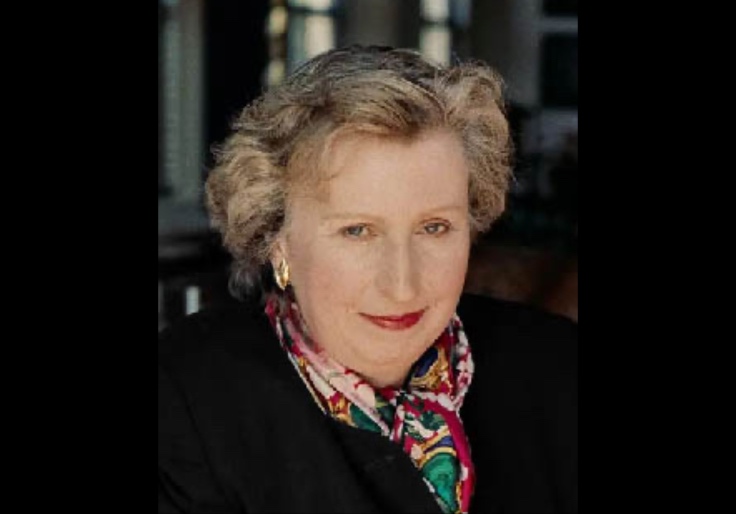
In the course of every hack writer’s life, with any luck, a great editor will appear. In my fortunate case that editor was Manuela Hoelterhoff, who died May 6 from cancer. She was 77.
We were entirely different people. She was born in Hamburg just after World War II (or 11, as our better public intellectuals might put it). Her father was one of 5,000 or so German survivors of the Battle of Stalingrad, where hundreds of thousands of fellow soldiers died. After the family came to America, her mother got a job at the Tolstoy Foundation, run by the great writer’s daughter. By contrast my dad served in the Pacific theater, then started out his career in a gas station. My mother was a public school teacher.
Manuela was bright and ambitious. She wrote a few articles for William F. Buckley’s National Review and then, in 1975, joined the Wall Street Journal, where she stayed for over 20 years in various capacities, including book editor. She won a Pulitzer in 1983 for criticism, in which she truly excelled, once writing of a Metropolitan Opera performance that “the place was so empty I thought I’d missed an air-raid drill.”
She also had a heart as warm as a Christmas fire.
By comparison I sounded frightfully like Gomer Pyle, was an academic slacker, and a journalistic nonentity. My biggest scoop had been an alleged Bigfoot sighting near the Dismal Swamp in Virginia. That résumé enhancer was followed by employment with an even more exotic being—the Rev. Sun Myung Moon, a.k.a. the Korean Lunar Deity, whose Washington Times had given me a job, unaware that when asked how many Supreme Court justices there were (just prior to ascending to Washington), I answered “a dozen.”
Nonetheless, she smiled upon me. An early assignment was to review Roseanne Barr’s My Life As a Woman. My analysis was somewhat mundane, reaching its high point when observing the author possessed a pair of “billowing glutes the size of sofa cushions.” This didn’t seem to offend Manuela, and indeed might have pleased her, as it did famed producer Ray Stark, who called (there was no email) to praise the piece and ask if I’d like to try my hand at Hollywood writing. Being an ignorant rube who didn’t, at the time, know Stark’s glorious reputation (West Side Story, Funny Girl, Steel Magnolias), I turned him down.
Manuela and I worked off and on for years. I had not heard from her for awhile when, in 2004, she called out of the blue. “Shiflett,” she said (she often started conversations by calling my name), “what are you doing these days?” Not much, I honestly replied. “Well, you are now the television critic for the Bloomberg Muse. Where are you living?”
“Richmond.”
“Where on earth is Richmond?”
The job was a breeze. I wrote one 600-word column a week and made a solid middle-class living. She let me review whatever I wanted, but there was one unspoken commandment: Do not bore me. She could be demanding but was also forgiving. One day I got another call:
“Shiflett, where did you learn to spell? It’s KAMA Sutra, not KARMA Sutra.” This inspired one of my better comebacks, which I attribute to her influence:
“Manuela, I am a writer, not a speller.”
While she often broadened my horizons, I sometimes broadened hers. One day Manuela came down to Washington to interview some art world deity. We had lunch, after which she asked for a lift to her appointment. It was a sweltering D.C. summer afternoon—hot, damp, the sort of weather only an anaconda could love. “I hope you’ve got a good air conditioner,” she said as we approached my car.
As it happened, my AC was taking the summer off, and I had gone old school. “It works like this,” I explained as we pulled out of the parking garage. “You put down your window and I’ll step on the gas.”
Manuela was not amused.
We shared a love of music, though her love was far more elevated than mine. She wrote the libretto for an opera (Modern Painters) while I created what one critic called “Gonzo folk” with titles like “Virgins in Heaven.” Yet she was entirely supportive. One evening, while still in the grips of youthful ambition, a colleague and I played a gig at a Columbia University venue. Just after taking the stage I noticed Manuela and then-partner Francesca Zambello in the audience. I gasped so profoundly my uvula could likely be heard slapping against the back of my throat.
This was hardly an overreaction. Manuela was a Pulitzer-winning opera critic and creator while Francesca was a world-renowned director who worked with the greats, including Placido Domingo. I sang like a drunk monkey and kept time like a sundial on a rainy day.
After the gig, I sheepishly approached their highnesses. Manuela could not have been nicer, with Francesca adding that “your voice fits the room.” It was only later that I remembered the venue, which was below a chapel, was popularly known as the Crypt.
I had just finished (I hope) rewriting a novel the day Manuela died. I hadn’t talked to her in a while. Her love life had gone bad, her beloved Beagles had died, she’d been battling cancer, and I wasn’t feeling that great myself. I might have dared to send her the title page (Three Clicks Past the Paraclete) to see what she thought.
I can imagine her response. “Shiflett—you’re groping for profundity. Try again. But don’t give up!”
She now belongs to the ages, and the ages had better watch their step.
Dave Shiflett is a contributor to the Wall Street Journal and posts his original music and writing at Daveshiflett.com.
Read the full article here