






Fifteen years ago, when my older children were in preschool at our synagogue, I participated in a focus group. The synagogue’s leadership wanted to understand why they were having trouble getting young families to attend services and become members—even if their kids were enrolled—and also why, once their kids finished preschool, the families didn’t come back. The mothers went around and discussed the attributes they liked about the institution—the rabbi was great; so were the teachers and the facilities—but some wished the services were shorter or had more English in them. Some wanted the playground opened for longer hours after preschool ended. And they didn’t like the schedule for Hebrew school classes. They were looking at other synagogues nearby and doing some comparison shopping.
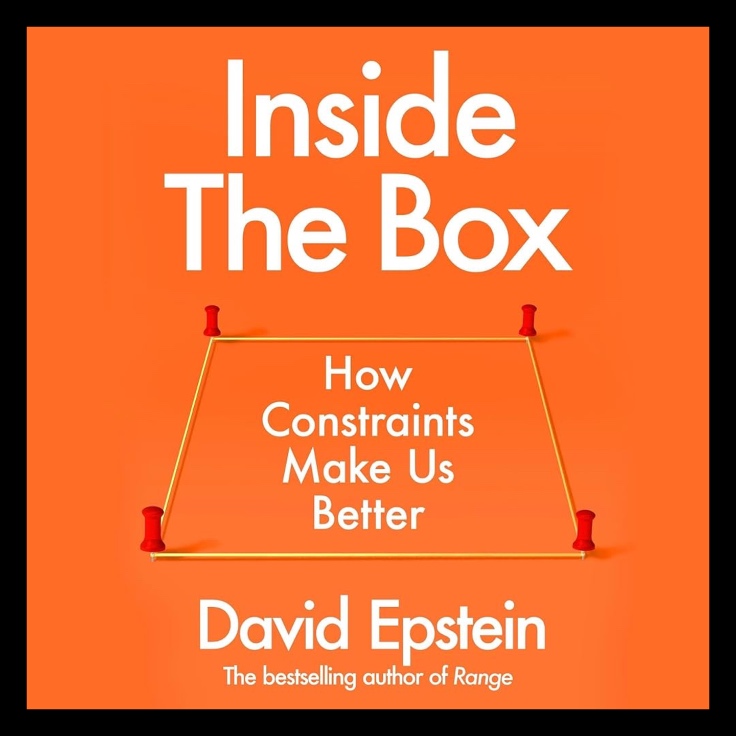
At some point, I began to feel a little queasy. It wasn’t just that these parents sounded awfully picky—to be fair, they were asked for their opinions. It was that I knew how hard it would be to sustain and build an institution when members were always wondering whether there was something better down the street. We live in a time and place where freedom can seem limitless and the endless options on offer are hurting our ability to lead happy, productive, and fulfilling lives. This idea, which until recently would have represented a conservative viewpoint—too much individual freedom and choice can undermine the goals we have for ourselves and our families—has become completely mainstream. The fact that it is now the theme of a popular business/self-help book (blurbed by the likes of Malcolm Gladwell and Angela Duckworth) is worth noting. David Epstein’s Inside the Box: How Constraints Make Us Better is, for all intents and purposes, a Burkean beach read.
Epstein, a former Sports Illustrated writer and author of other bestselling business books, begins his account by stating the obvious. “Grappling with an excess of choice and freedom would have been a laughable notion for most of history.” But in modern times, as other thinkers have noted, “the sheer weight of exploding choice—in matters of love, career, and faith—often led to dread and despair, as every decision carried the burden of infinite possibilities and the anxiety of taking the wrong path.”
How to get a younger generation to understand this problem? With B-school case studies, of course. Epstein tells the story of General Magic, a company formed by former Apple employees in 1990, with the financial support of Sony, Motorola, and AT&T, among others. The original idea was to create what we would now recognize as the iPhone. A phone and digital assistant called the “Pocket Crystal,” which would offer the “comfort of a touchstone, the tactile satisfaction of a seashell, and the enchantment of a crystal.” Despite having a ton of smart innovative people and more seed capital than they could dream of, General Magic was a flop. With no deadlines and no real budgetary limits, everything became possible. And then nothing was. One engineer showed his bosses how he could create a calendar for the device that would show about 200 years. They asked him if he could start at the beginning of the universe instead. “The magicians had so much, and could do so much, that they were rarely forced to set limits and choose what not to do, at least until it was too late.”
Epstein contrasts General Magic with Pixar, a company whose founders were focused on taking small steps to achieve their goals of digital animation. The team remained small and so did the budget. “Features that removed complexity were strongly preferred over features that added complexity,” they wrote of their experience later. And while they were surrounded by people who had ideas for “cool” new features, they did not succumb to the temptation to go off track.
It is not just entrepreneurs who need boundaries. Artists do too. Epstein writes about the rules created for music composition in the early 18th century. “One rule declared that each melody, or line of music, should have a single highest-pitch climax note that appears once and only once. Another rule forbade two overlapping melodies from ever jumping the same certain distance at the same time, lest distinct melodies blend and lose their independence.” As Epstein notes, “the full list is dizzying.” But it turns out these rules created some of the most original, complex, and beautiful music we have ever heard. Not only did Bach follow those rules, he created more of his own. Epstein quotes a prominent German composer who wrote that Bach was “perhaps the greatest example in any art form of a master’s ability to move with freedom and assurance, even in chains.” Epstein adds, this may in fact be “because of chains.”
Epstein is right to point out that this conception of artistic excellence as requiring rules and boundaries was accepted as obvious in a previous era. Today, though, creativity—whether artistic or scientific—is seen as requiring total freedom. Indeed, the very conception of genius as something that springs fully formed from the mind is everywhere. But for anyone who takes the time to study the great geniuses of history, this will seem plainly a myth.
The way we raise kids and teach them in schools is governed by the philosophy that more freedom will lead to more interesting ideas. Who needs a curriculum where you read the books of the past when you can just encourage students to think up their own ideas? Down with great literature, up with creative writing.
Even more mundane but still very helpful products, Epstein suggests, often result from constraints. He points to the many inventions that have been made originally for people with disabilities, but then actually turn into the best version of the product available. OXO kitchen utensils, so popular with home and professional chefs today, began when a man saw his arthritic wife struggling with a vegetable peeler and designed one that could be gripped no matter one’s hand strength. Given constraints, the human mind seems to come up with interesting new solutions.
Once you start to see the way we have pushed the elimination of constraints as the key to human fulfillment in every aspect of life, it’s impossible to unsee it. Epstein is hardly the first social science journalist to push back against this idea. Whether it’s Arthur Brooks or David Brooks, popular writers have noted the importance of boundaries and commitment to human thriving. The problem is that we cannot put this genie back in the bottle. And there are good reasons we should not even if we could.
Broadly speaking, there are three sets of constraints that we face. The first are legal. Though some might argue that our government is more intrusive than it should be, we certainly live in an age where adults are allowed to chart their own path. From our decisions about education and careers to our choice of sexual partners (and identity) to decisions about drug use, we live in an era of unprecedented political freedom. This is unlikely to change.
Then there are the constraints that others—our families, friends, and communities—impose on us. These too have been dwindling. People are cutting off family members, switching religions, or abandoning faith altogether, ghosting friends, skipping marriage, getting divorced, and not bothering to have children. There are simply fewer ties that bind and those that do seem much looser.
So what is a self-help/business book author to do? We can only resort to the third kind of constraints—those we impose on ourselves. We all try to do this in some spheres. We try to live within our budget. Indeed, money is probably the most significant constraint for most people. But how do we constrain ourselves in our relationships?
Epstein makes a passing reference to psychologist Scott Stanley’s “sliding versus deciding” model of romantic relationships. People feel like they are keeping their options open when they don’t decide to make a commitment to marry one person. But when they simply slide into long-term relationships, they tend to be less happy. Commitment makes us happier in the future but we have to be willing to close off other possibilities in the present. We have to artificially limit our choices somehow.
Epstein is a fan of the idea of “satisficing,” rather than maximizing, first articulated by the economist Herbert Simon, who argued that people are happier when they limit their choices and then pick the one that is good enough. In his own life, Simon just bought the same kind of socks and shoes and shirts for his whole life so he wouldn’t have to waste time thinking about whether there was another kind out there that might be better.
But how do we limit our choices? And how do we decide which choices to limit? With so many options for finding meaning and community, for instance, it is easy to shop around for different churches or synagogues. Unfortunately, the fulfillment comes not from finding the perfect person or the perfect community, but from putting down roots and accepting the imperfections as part of the deal. Good luck selling that in your focus group.
Inside the Box: How Constraints Make Us Better
by David Epstein
Riverhead Books, 278 pp., $32
Naomi Schaefer Riley, a senior fellow at the American Enterprise Institute and the Independent Women’s Forum, is the author of No Way to Treat a Child: How the Foster Care System, Family Courts, and Racial Activists Are Wrecking Young Lives.
Read the full article here