






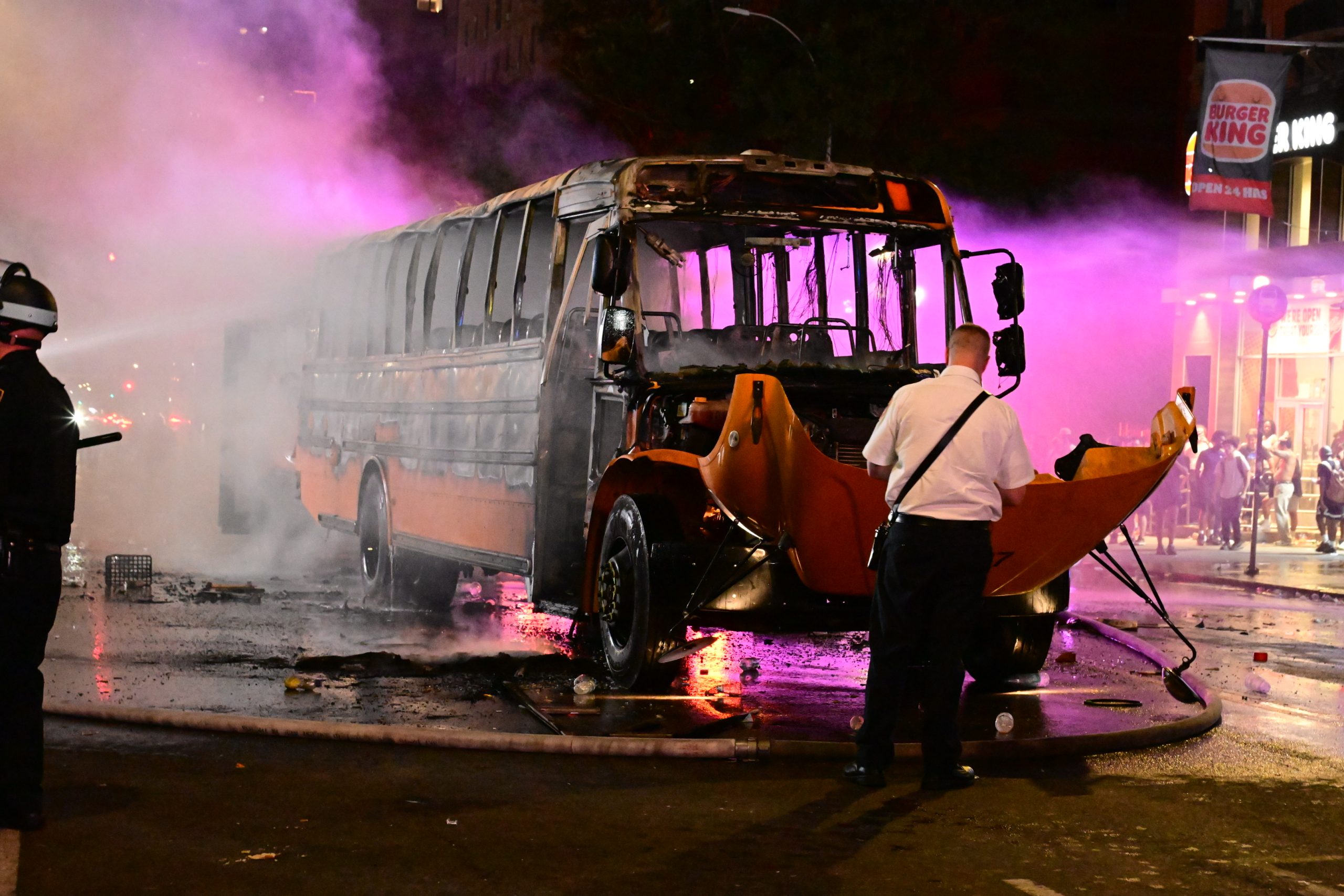
Who celebrates a basketball victory by torching a school bus?
New York City reacted to a championship victory by its Knicks basketball team with an orgy of violence and property damage, torching school buses, shattering a police-vehicle windshield, and attacking police officers.
The riot was downplayed by the city’s political class and press.
The city’s “there is only one solution, intifada revolution” mayor, socialist Zohran Mamdani, offered a generalized, “it is, frankly, unacceptable when we see violence, whether it’s directed at those around them or at police officers,” while insisting, “there were a select few who acted in a way that does not represent who we are as a city.”
“The vast, vast, vast majority of people who came out to celebrate did so peacefully,” New York’s governor, Kathy Hochul, a Democrat, insisted, which is technically true but also precisely the kind of spin we saw on display from so many in 2020 to deflect attention from the criminality they could see with their own eyes.
The New York Post, usually on high alert for signs of deterioration, kept what a headline called “anarchy in the big apple” off the tabloid front page. A Post editorial advised, “let’s all just bask in the euphoria,” claiming “the whole town erupted in joy.” Said the editorial, “Yes, some of it got out of hand, but the NYPD did an amazing job limiting the chaos and we expect New York’s finest will keep Thursday’s parade orderly and safe, too.”
The New York Times published an article reporting, “A teenager was shot, school buses were set on fire and four people were slashed or stabbed as tens of thousands of people swarmed the area around Madison Square Garden in a chaotic all-night celebration of the Knicks’ championship win late Saturday, according to the police and video footage. In all, 15 people were arrested, including a 28-year-old man from Texas who was charged with assault for punching a police officer, officials said. Another 48 people were taken into police custody and issued summonses. … In all, one school bus was engulfed in flames and four others were burned or broken, the police said.”
That Times article didn’t make the print newspaper, which instead relegated the violence to the sixth paragraph of a different article that emphasized “unity and warm feelings … the Knicks brought joy, unity and a sense of merry to New York like few things ever have.” Not so “merry” for the police officer who got punched or the bus company whose property was destroyed, though. It’s as if the Times can’t bear to admit that the chaos many feared would erupt under Mamdani is coming to pass.
CBS News did report, “Some crowds took over entire streets while fights broke out. One photo showed an NYPD vehicle with a cracked windshield.”
The reaction demonstrated what a former senator from New York, Daniel Patrick Moynihan, once described as “defining deviancy down.” It also illuminated the double standards. Had the perpetrators been disappointed 2020 Trump voters, or Israeli residents of Judea and Samaria, the denunciations of unprecedented and unconscionable political violence would have been torrential, and the effort to depict them as unrepresentative would have been mocked. Instead, the Knicks fans got the “mostly peaceful” treatment like Black Lives Matter protesters. It was reminiscent of the Times reporting taking care to mention Graham Platner’s ex-girlfriends who describe the Democratic Senate candidate from Maine “as a fun and caring partner … they felt safe with him.”
Whether to focus on a proverbial hotel that burned down or on the many hotels that didn’t burn down the night before is a classic journalistic choice. One can debate what offers the most accurate portrayal of reality or what best meets responsibility to readers and owners. One wise editor always advised me to write about the hotel that burned down, not to write about the ones that didn’t burn down. Frequently it seems that rather than applying a generally applicable rule, the press is checking on the political affiliation of the hotel owner, then only afterward deciding how to play it.
Schoolbuses don’t spontaneously ignite at random. It will bear watching to see here whether prosecutors in Manhattan follow all the investigative leads vigorously to their conclusion, or, instead, drop the charges or treat the matter as merely some innocent revelry that got out of hand.
Moynihan’s “defining deviancy down” essay, which appeared in the Winter 1993 issue of The American Scholar, includes a category called “normalizing.” Moynihan observes, “Here we are dealing with the popular psychological notion of ‘denial.’” Said Moynihan, “our response is curiously passive.” He quotes a New York judge, Edwin Torres: “A society that loses its sense of outrage is doomed to extinction.” Whether with respect to Hamas terrorism or marauders burning buses and assaulting cops, Mamdani’s approach aims at diminishing our sense of outrage at criminality, redirecting the anger instead against prosperity. Don’t fall for it, or your bus may be the next one to wind up in flames.
Read the full article here