






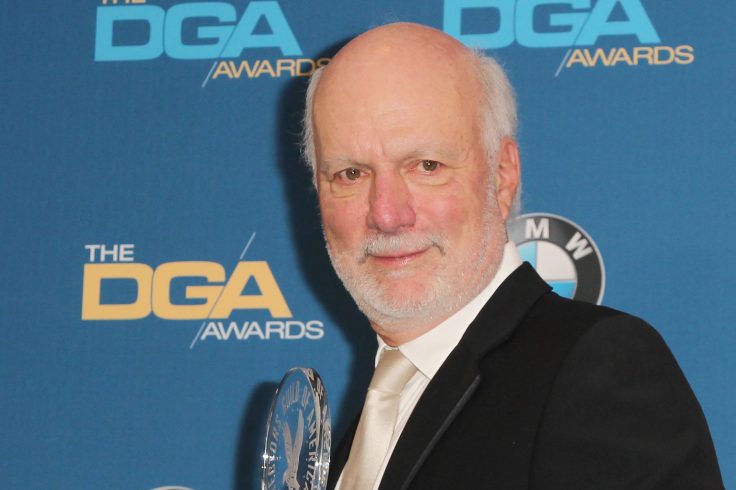
On my third day in show business, I went to Stage 25 on the Paramount Studios lot to get a cup of coffee and a doughnut. It was January 1990, and I had just been hired as a staff writer on the long-running hit comedy Cheers, and so far I had made two important career discoveries.
First: that every working soundstage has a table somewhere groaning with snacks and treats. It’s called the craft services table, even though it often sprawls across two or three tables, a deli-sized refrigerator, and a bank of toaster ovens. The entertainment industry is filled with nervous eaters—and no one is more nervous than a newly hired staff writer on a 10-week contract—so this area is replenished hourly with pastries and bagels and mini sandwiches, and it’s where everyone associated with the production self-medicates with sugary carbohydrates, high-fat dairy, and gossip.
The second thing I discovered was this: No one in show business will ever teach you anything, or explain what’s going on, or patiently show you the ropes. If you’re new and want to learn something, go get a cup of coffee and a doughnut at the craft services table and hide in a corner and watch. This is what I was doing on my third day in show business when I watched my boss, James Burrows, sitting at the piano on the set—You remember that, don’t you? Upstage left, in the alcove of the bar under the stairs?—and he was idly playing “I’ll Know” from Guys and Dolls. The rest of the cast and crew were on their mid-morning break, so it was just me and James Burrows—everyone called him Jimmy, but I didn’t feel like I could do that on my third day in show business—in the empty Cheers bar with a doughnut from craft services.
He was playing “I’ll Know,” I learned later, because his father was the legendary Broadway impresario Abe Burrows, who wrote Guys and Dolls and How to Succeed in Business Without Really Trying and Cactus Flower and had a hand in at least a dozen other Broadway hits. Jimmy was a child of show business (I was calling him Jimmy by this time) and had grown up in a house filled with stars and music and parties where famous grownups would smoke and drink and laugh and ask little Jimmy to play the piano. He grew up to have a string of hits of his own—Cheers, Frasier, Friends, Will & Grace, Big Bang Theory—but even when he was directing multi-camera comedies for a modern audience, he was never too far away from the Broadway stage.
Jimmy spoke in an old-timey show-biz argot. When we wrote something that was just a little too neatly plotted or overly choreographed, he would shake his head and say, Too center-door fancy. Meaning: It feels too airless, it’s not unexpected enough. Make it funnier and messier and real-er. When he sensed the audience was losing the thread of the story, he’d remind us to put some sunny Spain at the top. Meaning: We needed a little recap to keep the audience engaged, like in those moments in Shakespeare when two characters walk onstage and announce Here we are in sunny Spain so that everyone shivering in the London gloom at the Old Globe knew exactly where they were supposed to be.
That’s how he directed television: like it wasn’t television at all, but an off-Broadway comedy. He would rehearse for a few days, get the show up on its feet, guide the writers through revisions and adjustments, and only then would he think about cameras and shots and how he was going to film the episode. The result is that all of his shows have the same loose, spontaneous liveliness. Characters are always entering and exiting and sitting and crossing, with the cameras often barely keeping up. If you think about the Cheers bar, or the Big Bang Theory living room, or the coffee shop in Friends—you feel like you’e there too, just a little bit offscreen.
On most multi-camera comedy sets, each camera is hooked up to a bank of monitors which allows the director—and everyone else on the set, which includes the writers and producers and studio executives and network vice presidents—to watch each angle of every scene and make every frame perfect. It’s called the “quad split” and on my seventh (or maybe eighth) day in show business I learned that Jimmy Burrows did not use a quad split. The audience doesn’t watch the shots, he said to me when I asked why. They watch the show.
At its best—and, I’d argue, at its most profitable—comedy on television is really just the theater plus some cameras zooming around trying to catch the action. Jimmy knew that instinctively—it was in his show business DNA, straight from Abe and Broadway and playing the piano at parties—which is why he is responsible for so many endlessly re-run hit television comedies and also why television comedy is in such trouble today. Too many people watching the quad split. Not enough people watching the show. Too many people making little movies. Not enough people putting on plays.
Depending on how you do the math, I have now been in show business for 12,816 days, which probably explains why I’m sometimes cranky and dismissive about today’s entertainment industry. When I heard the news, on June 19, that Jimmy Burrows had died at the age of 85, I immediately remembered day three and the doughnut and “I’ll Know.” Of course, back then I really didn’t understand what I was watching. I didn’t know that my boss was playing a song from his father’s hit show on a piano on the set of his own hit show, and that the son had inherited from the father the gift of creating crowd-pleasing mega-hits and enveloping audiences in great bear hugs of laughter and surprise and unforgettable characters. I didn’t know any of that. I didn’t know anything, actually, except how to stand in the corner with a treat from craft services and watch Jimmy Burrows work and try to learn as much as I could in the days to come.
Rob Long is a writer and television producer, and currently a student at Princeton Theological Seminary.
Read the full article here