




America has always been a country of hustlers. In 2008 we elected Barack Obama, a serial memoirist with no functional experience who hustled his way to the White House after trouncing an establishment favorite. He shattered cherished norms, made promises he couldn’t keep, and started wars he didn’t want to finish but declared victory anyway. He revolutionized American politics, reshaped the presidency in his image by pushing the boundaries of executive power, and dramatically increased his net worth upon leaving office. Yes, he did.
Donald Trump is president now, having pulled off one of the greatest political comebacks of all time. The second term is different in some ways. Over the course of a decade, Trump has hired James Comey, fired James Comey (and his daughter), and is now trying to imprison James Comey, who has since retired to write third-rate crime fiction. In other ways, not much has changed. After a four-year hiatus, mainstream journalists have resumed publishing bestsellers about the president.
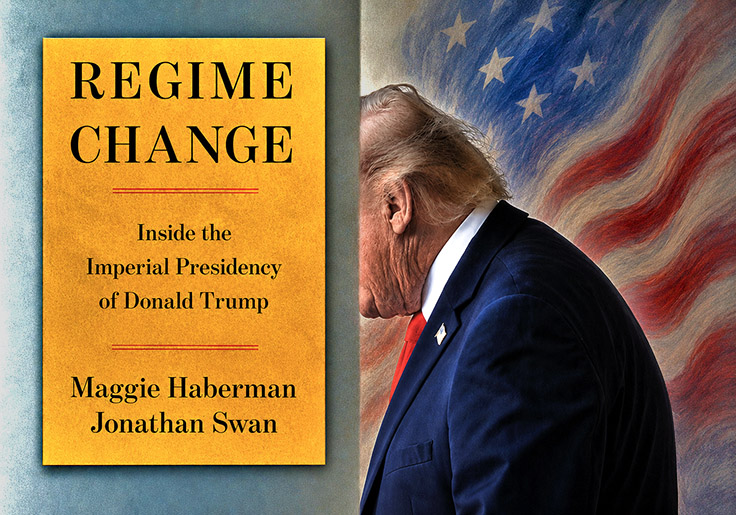
In Regime Change: Inside the Imperial Presidency of Donald Trump, veteran New York Times reporters Maggie Haberman and Jonathan Swan point out that Trump has always regarded “hustler” as a “term of admiration,” but considers “con man” to be one of the “worst insults.” The book’s target readers—other journalists—are encouraged to savor the irony and affirm their existing view of Trump as a world-historic strongman intent on subverting our cherished democracy.
Based on over a thousand (mostly anonymous) interviews with “people close to President Trump,” Regime Change purports to give the inside scoop on how Trump became “the most consequential and feared President of our lifetimes” while waging a “campaign of retribution unlike anything before.” Like the man himself, the book’s authors are fond of superlatives.
“No White House communications director had ever communicated like this,” the authors write of Steven Cheung’s use of the word “retards” to describe members of Congress. Trump’s decision to bomb Iran shattered what was “perhaps the most sacred covenant” he made with voters. They go on to explain why—based on journalistic insights beyond the reach of ordinary voters—it would be foolish to describe anything Trump says as a “sacred covenant.”
Ominous title sections—Whirlwind, Retribution, The Enemy Within, Plunder—convey a sense of imminent doom that rarely comports with the “inside” look at a White House operation that is (still) quite bumbling, haphazard, rarely coherent, often absurd, albeit unrelenting. Veep meets Uncut Gems.
Regime Change describes a free-wheeling Oval Office with a revolving door of “Republican lawmakers, titans of industry, former pro wrestlers, country musicians, Gulf royals, crypto bros, or friends of felons seeking pardons,” while the man who would go on to become the world’s first trillionaire plays video games in the dark upstairs. The Situation Room oscillates between high-stakes war planning and higher-stakes crisis PR meetings to address “nipple fetish” allegations in the files of a notorious pedophile.
What we’re seeing now is “pure Trump,” in the words of Steve Bannon, the president’s briefly imprisoned former adviser. Gone are the “well-credentialed strangers” Trump relied on in his first term, replaced by loyalists with varying appetites for self-abasement. The authors contend that second-term Trump is the Kool-Aid Man, smashing through institutional barriers that had previously frustrated his ambitions, thereby demonstrating “they had no mechanism to stop him.” The evidence is underwhelming.
Regime Change offers dramatic accounts of Trump aides discussing policies that would be genuinely draconian—suspending habeas corpus and invoking the Insurrection Act. The conversations go nowhere, in part, because of strong pushback from within the administration. The same is true of Trump’s repeated threats to fire former Federal Reserve chairman Jerome Powell. The word filibuster does not appear in the book, for obvious reasons. Notwithstanding his unchecked power, Trump still can’t get the GOP Senate to abolish it.
The book’s portentous framing is undermined as well by its very existence. Regime Change is merely the latest bestseller to offer a critical take on a man often denounced as an existential threat to the journalistic craft. This version of the Trump administration “rarely” leaks, they write. But Haberman and Swan got plenty of people to leak to them. They are mostly anonymous apart from Tucker Carlson, who makes several appearances—including as an emissary for the Maduro regime in Venezuela—and whose conversations with Trump unfold as if transcribed from an audio recording.
For all its apocalyptic melodrama, the book’s most enduring image of Trump is that of an elderly man “clutching a tube of superglue and attempting to affix gold decorations to the marble fireplace mantel.” There are few things he enjoys more than getting Vice President J.D. Vance in a room with Secretary of State Marco Rubio and asking people to assess their prospects in 2028. Trump takes great pleasure in trolling Democratic leaders by having the White House photographer snap their photos next to an array of “Trump 2028” hats. They were there to discuss the impending government shutdown, but Trump “knew that nothing would come of the meeting” and was “content to play games … it was good sport.”
But, oh, the precious norms.
In refusing to play by the rules and accept “because that’s the way it’s always been done” as an answer, Trump is a quintessentially American figure. He takes what he wants until somebody stops him. Jill Biden would be proud (and boiling with envy). Trump was counted out, shot at, and hauled before judges only to emerge victorious—just as he planned all along.
“I do understand that it’s all basically a game,” Trump said almost 50 years ago. “We’re all here to play the game, and we’re all hopefully going to play it well.” In a final interview with the Regime Change authors, Trump urged them to write the “one thing you can say about me that anybody believes. … Essentially I won every fucking time.”
Trump is (probably) done winning at the ballot box, but his legacy will endure. Just as he advanced his predecessor’s expansive view of executive power, future White House occupants will inherit Trump’s victories and learn from his defeats. In many ways, Regime Change is a primer on how to half-ass an imperial presidency.
Haberman and Swan recount a March 2025 meeting with oil executives at the White House where attendees marveled at Trump’s ability to make decisions the old-fashioned way without getting bogged down in expert analyses and environmental impact statements. They were thrilled, for the time being.
“He has a better sense of his executive authority than anybody else we’ve ever dealt with,” one executive said. “I would never want a Democrat to have that same sense of executive authority. But this guy fucking does.”
When Democrats do take power, we can take comfort in knowing our esteemed journalists—models of consistency in every respect—will be first to sound the alarm.
Regime Change: Inside the Imperial Presidency of Donald Trump
by Maggie Haberman and Jonathan Swan
Simon & Schuster, 496 pp., $34
Read the full article here