






John Roberts kicks ass. The chief justice’s supremely magisterial end-of-term majority opinion in Trump v. Barbara, the birthright citizenship case, powerfully vindicated the framers of the Fourteenth Amendment. Roberts’s impressive historical analysis left the lead dissenter, Justice Clarence Thomas, looking like the bloodied loser of a Trumpian UFC cage match.
What’s more, the chief’s majority opinion just a day earlier in Trump v. Slaughter, upholding the president’s power to remove a member of the Federal Trade Commission, finally overturned the long-weakened 1935 precedent called Humphrey’s Executor. Roberts rightly restored the primacy of an earlier executive power case, Myers v. United States (1928), while in a companion ruling, Trump v. Cook, Roberts protected the Federal Reserve from injurious presidential political meddling.
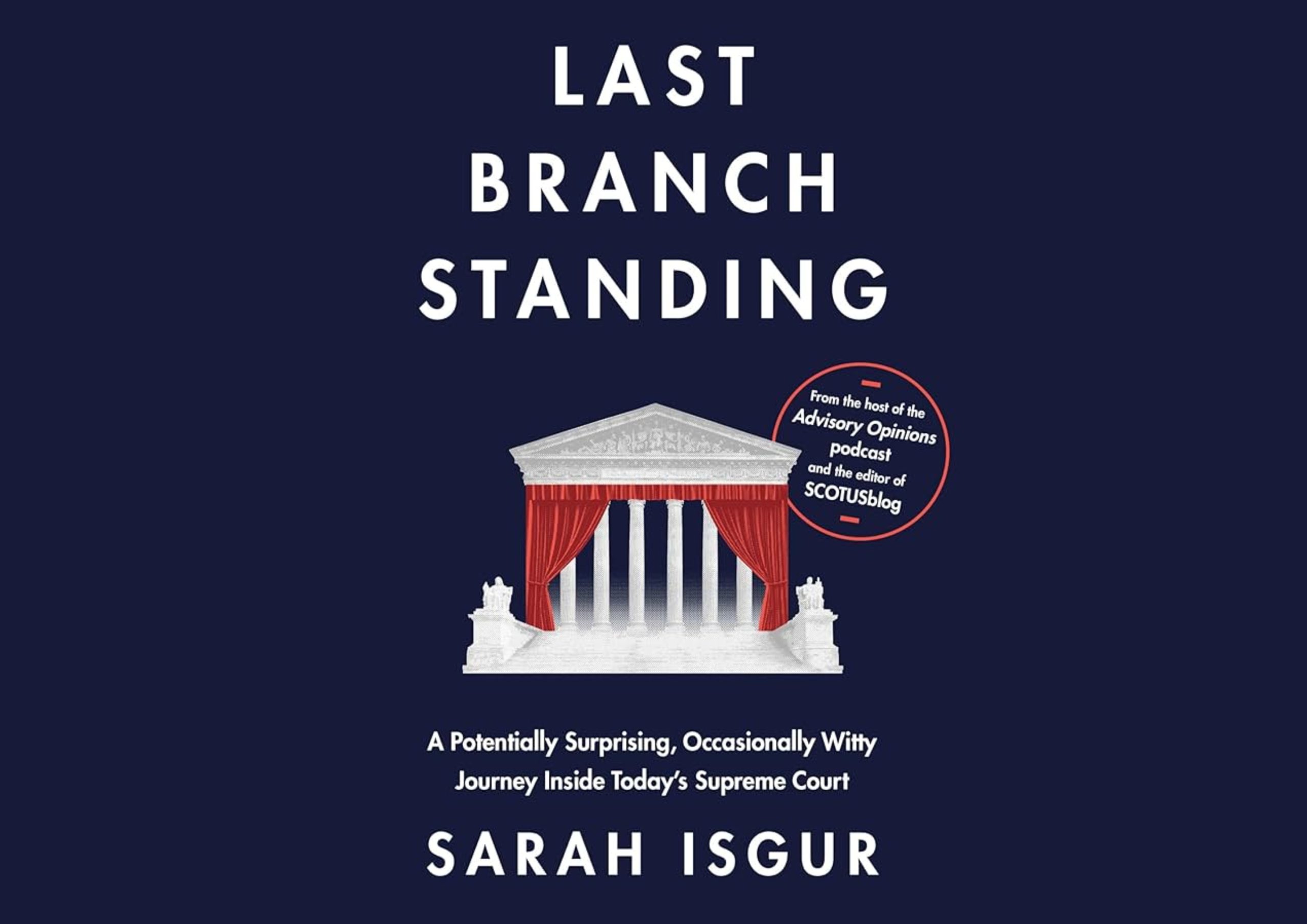
Yet a reader who had just finished Sarah Isgur’s spritely new Last Branch Standing would not have been at all surprised by the chief’s dominant trifecta. Isgur is a gifted writer and also exceptionally knowledgeable about the federal courts. A member of the Federalist Society since her years as a Harvard Law School student, Isgur’s thank-you acknowledgments in Last Branch include at least a dozen appellate jurists. At Harvard, her then-dean, now Justice Elena Kagan, fiercely defended Isgur when she was slimed by a wholly false blog post, and Isgur and her husband, former Texas solicitor general (and onetime Supreme Court clerk) Scott Keller were married in the chambers of Justice Brett Kavanaugh.
The first one-third of Last Branch is compelling reading and informatively sophisticated; the final two-thirds are a comparative letdown. Isgur’s brief portraits of each current justice are excellent and indeed often witty; the depth and breadth of her understanding of the Court’s current doctrinal proclivities and interpersonal dynamics are expert and astute. Isgur’s title derives from how today’s Court is coping “without a functioning Congress” that “isn’t doing its job,” thus resulting in “a too-powerful executive branch.” As Last Branch rightly puts it, “as Congress has left the field, the Court is left to grapple with an executive branch gone wild” during both the Biden and Trump presidencies.
Isgur powerfully highlights statistical facts the vast majority of partisan critics knowingly ignore. “The Court is taking fewer cases than ever and overturning fewer precedents than at any time in the last seventy years.” While “the vast majority of the work of the Court mostly gets ignored,” especially when decisions are unanimous or feature dissents that don’t cleave to simplistic ideological divides, “partisans can’t abide an institution that has its own legitimacy if that institution doesn’t bend to their partisan interests.”
Isgur deeply appreciates how law, including constitutional decision-making, is supposed to be different in kind from mere politics. That appreciation of law’s fundamentally professional nature is utterly rejected by an increasing number of present-day ideologues, including a depressing proportion of ostensible law professors, who suffer from the “postmodern” affliction that everything is nothing more than politics in one or another guise. Anyone who is unable, or unwilling, to acknowledge the professional excellence of an opinion whose outcome one finds personally distasteful—say in my case the 2022 majority holding in Dobbs v. Jackson Women’s Health Organization, which overturned Roe v. Wade—has no business holding themselves out as a worthwhile commentator on the justices’ work.
Isgur accurately asserts that “the opinions of the Court are certainly more sophisticated and better written than at any time in the past,” or at least since John Marshall and Joseph Story sat together in the early 19th century. By comparison, virtually everything the Warren and Burger courts produced between Justice Robert H. Jackson’s death in 1954 and Antonin Scalia’s arrival in 1986 deserves some degree of professional opprobrium, excepting only the usually dissenting opinions of John Marshall Harlan II.
Last Branch repeatedly emphasizes how “it’s too simplistic to think of the Court as a 6-3 conservative, single-dimension behemoth.” Instead, it must be understood as a group of three trios—liberals Kagan, Sonia Sotomayor, and Ketanji Brown Jackson—three institutionalists focused on the consequences of the Court’s rulings: Roberts, Kavanaugh, and Amy Coney Barrett—and the three conservative purists concerned only about getting the law “right” as they see it: Thomas, Samuel Alito, and Neil Gorsuch. As this end of term repeatedly featured, any two if not all three of the institutionalists usually control the outcomes of the Court’s divided cases.
Of John Roberts, Isgur writes that “no other chief has been in the majority as often for at least seventy-five years” per Roberts’s 90+ percent score since 2018. She also asserts that Roberts is “perhaps the most powerful chief justice since John Marshall” died in 1835. Two weeks ago that seemed an interesting contention, but now, after the close of this term, Roberts has confirmed Isgur’s prescience.
Last Branch is repeatedly charming. “A few years back, when the Chief walked in to find a clerk asleep at his desk, the Chief didn’t wake him. He took a selfie with him and then hung it like a trophy.” Of the other institutionalists, Isgur reports, “Kavanaugh has been in the majority at a higher rate than any justice since 1953.” Barrett is “the first mother of school-age children ever to sit on the Court,” and as the only justice with no Ivy League degrees, she’s taken 75 percent of her clerks from non-Ivy law schools. In stark contrast, only one of Kagan’s 60-plus clerks has come with public university bachelors and law degrees. And even before this recently concluded term, Barrett already was “the least likely to vote for Trump” of all six Republican-nominated justices.
Of the conservative purists, Clarence Thomas is “correctly viewed as the intellectual leader of the right” and may well “leave the most lasting legacy of any justice currently serving.” The highly introverted Alito works mainly from home, and, like Gorsuch, does not participate in the “cert pool” whereby the other seven justices’ clerks split up the onerous work of evaluating every one of the thousands of often meritless petitions submitted to the Court. Gorsuch, whom Isgur memorably tags “the Great Concurrer,” “writes separately more than any other justice,” as was certainly true this term too. Gorsuch’s chambers appropriately feature a portrait of 19th-century justice Benjamin Curtis, best known for dissenting in the infamous Dred Scott v. Sandford case upholding race slavery. While Isgur unsurprisingly declares that Thomas is the justice “you’d most like to have as a mentor,” her characterization of Gorsuch as the justice “you’d most like to have on your side in a bar fight” is certain to be without evidentiary support!
Among the three liberals, Elena Kagan, like Roberts, “views the job as an exercise in consensus building.” Isgur also asserts Kagan “is the best writer on the Court today. Maybe ever,” but Gorsuch is at least her equal and maybe that of Robert Jackson as well. Sonia Sotomayor is perhaps best known for her often lengthy dissenting statements delivered from the bench, but she nonetheless has volunteered that “Clarence Thomas and I can spend hours outside in the hallways either after lunch or leaving a conference just talking about life.”
Ketanji Jackson, the most junior justice, has been giving Gorsuch serious competition for separate writings; in the 2024-25 term she issued 10 dissents and 9 concurrences, while Kagan in stark contrast published just 4 and none. Across three terms, Jackson’s separate writings totaled nearly 60,000 words, with Gorsuch at 56,000, Barrett under 20,000, and Chief Justice Roberts at 168. ‘Nuf said.
Isgur rightly reminds us that the Supreme Court is “by design a counter-majoritarian institution,” such that it is “supposed to be unpopular.” Ideologically partisan critics who call for Court “reform” purposely ignore what a superb bench the current one is, and inaccurately attempt to paint even the institutionalist trio of justices as Trump lackies. In fact, as Last Branch documents, “Trump in his first term had the lowest success rate at the Supreme Court of any president in at least a century,” and the president’s recent losses in the birthright and Federal Reserve cases, among others, only further highlight this basic truth. As Isgur writes in appropriate exasperation, “if the Court were biased in favor of Trump, these numbers don’t make any sense.” In fact, of course, they aren’t biased, and unlike partisan hacks, the numbers don’t lie.
Last Branch Standing: A Potentially Surprising, Occasionally Witty Journey Inside Today’s Supreme Court
by Sarah Isgur
Crown, 389 pp., $32
David J. Garrow’s books include the Pulitzer Prize-winning Martin Luther King Jr. biography Bearing the Cross and Rising Star: The Making of Barack Obama.
Read the full article here