





Bugging out of the city and into the country during an SHTF scenario would be very stressful, to put it mildly. Hopefully, you and your family would be able to bug out quickly, but the trip to your bug out location would probably take a while. Once you finally got there, everyone would be eager to relax and get some rest. That would be a mistake.
I’m not saying no one can sleep at a bug out location, but I am saying that you’ll want to take turns standing guard. During certain scenarios, desperate people could pour out of the cities and into the country, looking for food and water. Even more likely, marauders could invade remote homes, knowing the police are too busy to respond and the neighbors are too far away to help.
This is why, if you do have a bug out location (or are searching for one), you need to make sure you can defend it. Here are the top factors you need to take into consideration when it comes to defending a bug out location.
1. Make Sure the BOL is Worth Defending
If your bug out location is not worth defending, then what’s the point of defending it? Your BOL will only be worth defending if it meets several of the qualities that any bug location needs to have, and that includes:
- Naturally defensible terrain (more on this later.)
- Natural source of water (lake, pond, river, stream, well, etc.)
- Adequate shelter for you and your family.
- Abundance of natural resources (timber, wildlife, wild edibles, fish).
- Suitable farming/agricultural land and good soil.
- Outside the area of immediate danger.
- Outside of any urbanized areas
If your bug out location does not meet these qualities, then it’s not going to be a suitable place to stay over the long term, and subsequently, it’s not going to be worth risking your life to defend.
2. Make Sure the BOL is Naturally Defensible
One of the key qualities to look for in a BOL in the first place is for it to be naturally defensible. If it’s not, then you’re going to have an extremely tough time defending it and you may actually be giving a major advantage to the enemy/attacking force.
Here are the qualities to look for to make sure your bug out location is naturally defensible:
- Away from major roads (so it can’t be easily discovered in the first place).
- On high ground (it doesn’t have to be on top of a mountain, but make sure it’s not deep in a valley or at the bottom of a hill).
- Natural elements that make an enemy attack more difficult (thorny brush, rough/rocky terrain, steep uphill slopes, etc.)
- Clear view of the land before you (so you can spot enemy movements).
- A natural choke point, a narrow path, bridge, or gap between two obstacles that forces anyone approaching to funnel through a single, predictable route.
There are additional modifications you can make to your bug out location to make it even easier to defend, which we will discuss later.
3. Remember There is Safety in Numbers
The old saying goes that there is safety in numbers, and this adage certainly holds true for this scenario. Defending your bug out location will always be easier the larger your group is.
This is why it’s smart to make your bug out location a rendezvous point for both your immediate family and your close (and trusted) friends and relatives who live in the area.
Yes, this means you’re going to need to stock up on more provisions, have a larger area, and have an even greater abundance of natural resources than you would need for a typical family of four or five. But the tradeoff is you will have more manpower, and thus safety in numbers.
4. Keep Your Bug Out Location a Secret
Your bug out location will always be easier to defend if you don’t have anyone attacking it in the first place, and this is why you must do everything in your power to make your bug out location a secret at all costs.
The only people who should know about your bug out location are the people rendezvousing there, and you must make absolutely clear to them that they are to tell no one else about the location, and to not invite anyone else to the location unless if you all unanimously agree.
5. Add Defenses To Your Bug Out Location
You’ll need to begin modifying your bug out location to make it more easily defensible. Yes, you should have pre-selected an area with naturally defensible terrain, but that doesn’t mean that you can’t make additional modifications as needed.
Defending your bug out location comes down to three primary principles:
- Maximizing places of cover and firing positions for the defenders.
- Minimizing places of cover and firing positions for the attackers.
- Inhibiting the enemy advance as much as possible.
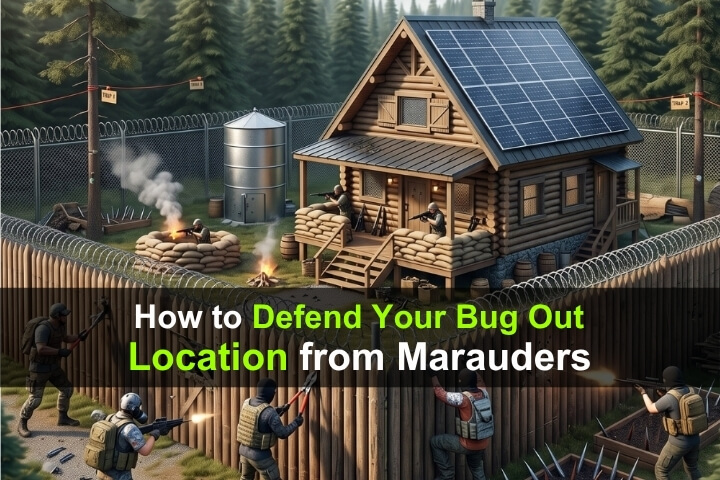
The best defensive structures/firing positions for you and the defenders will be to build bunkers and trenches into the ground, and to enhance these bunkers and trenches with the aid of sandbags. You should also dig tunnels or windy ditches leading between bunkers and firing positions so you can always stay on the move (movement will be key to your defense).
Meanwhile, you need to minimize places of cover for your attackers, and you need to inhibit their attack as much as possible.
Here are some defensive modifications you can use to make the enemy attack as difficult as possible:
- Install layers of barbed wire fences and nail boards in a perimeter around your bug out location.
- Grow thorny brushes around your bug out location.
- Create fake cover for the enemy that bullets can pass through but that they will move to instinctively (brush, logs, etc.)
- Make the attacking ground as rough and steep as possible with the aid of sharp rocks.
- Consider turning the attacking ground into mud to slow the enemy advance.
- Build traps for the enemy (i.e. pits with sharp spears pointed upwards and covered with foliage).
6. Set Up an Early Warning System
No matter how well-defended your BOL is, none of it matters if the enemy gets the drop on you. This is why an early warning system should be considered just as important as your physical defenses. Some simple, low-tech options include:
- Tripwires connected to tin cans filled with rocks (cheap, silent to set up, and loud enough to wake a sleeping guard).
- Motion-activated solar lights aimed outward at likely approach routes.
- A trained dog, which can pick up on a stranger’s scent or footsteps long before a human would notice.
- Fishing line strung ankle-height across trails, tied to a small bell or noisemaker.
The goal isn’t to stop the enemy with these devices, it’s to buy your group precious seconds (or minutes) to get to your firing positions before the attack actually reaches you.
7. Get Some Suitable Defensive Weapons
Mounting a defense is going to require suitable defensive weapons and a healthy supply of ammunition and magazines.
At a minimum, you will need the following firearms in your defensive arsenal:
- Sidearm (at least one per person).
- Pump or Semi-Auto Shotgun (for close quarters defense).
- Defensive Semi-Automatic Rifle (AR-15, AK-47, Ruger Mini-14, etc.)
- Long Range Rifle (in .308 or .30-06, for picking off enemy targets at longer distances).
You will need at least one thousand rounds of ammunition per weapon (not per caliber, but per weapon) and at least five magazines for every pistol and at least ten magazines for every semi-automatic rifle.
Every person in your group should ideally carry a sidearm with them at all times so they will always be armed in the event of an immediate and unexpected attack, and you should keep your shotguns and defensive rifles within easy reach.
Every person capable of holding a firearm should also be comfortable using it under stress, which means regular range time now, while ammo and practice are still easy to come by. It’s also worth designating roles ahead of time, such as who takes the long-range rifle if someone spots movement at a distance, and who holds the choke point with the shotgun. Deciding this in advance means there’s no confusion (or arguing) once the adrenaline kicks in.
Related: 9 Best Firearms to Have After SHTF
8. Have A Healthy Stockpile of Provisions
One strategy the enemy may use to take your bug out location is to starve you out, but you can mitigate this by:
- Having a healthy stockpile of provisions.
- Having a self-sustaining source of food.
- Choosing an area with an abundance of food/water sources.
The enemy probably won’t try to poison your water source (as that would mean they would poisoning their water source should they win), but nonetheless, you should still have a healthy stockpile of clean drinking water (one gallon of water per person per day is the rule).
You should also have more than one way to purify water on hand. A gravity-fed filter is great for daily use, but boiling and chemical treatment (like water purification tablets) should be your backups in case your primary filter breaks or wears out.
You will also need a healthy stockpile of long-lasting, non-perishable, and nutritious food. White rice, beans, canned meats and vegetables, flour, and potatoes work best.
Related: The Beginner’s Guide to Emergency Food Storage
You are also going to need plenty of medications and first aid equipment should anybody in your group be wounded or injured in the defense of your location.
9. Establish a Guard Rotation
Even the best defenses are useless if no one is watching them. This is why you need a guard rotation in place from the moment you arrive at your BOL, not after the first scare.
A few things to keep in mind when setting up your rotation:
- Shifts of 2-4 hours work best. Any longer and fatigue sets in, causing guards to lose focus.
- Always post at least two guards at once if you have the manpower, one to watch and one to run for help if something happens.
- Rotate guard positions, not just guard shifts, so no one becomes overly familiar (and complacent) with a single vantage point.
- Set up a simple challenge-and-password system so guards can identify friend from foe in the dark without hesitation.
A tired, distracted guard is almost as dangerous as having no guard at all, so treat your rotation schedule with the same seriousness as your physical defenses.
10. Have An Escape Route
Finally, you must have an emergency escape route should things become dire and defeat be imminent.
Your escape route can be a road that leads out of the bug out location that you can take via vehicle, it can be a tunnel that leads you out, or it can be both of those things.
What’s important is that you have a way out of your bug out location should you be forced to evacuate, because the last thing you want is to become trapped and have no way out.
Conclusion
Defending your bug out location, especially if manpower is limited to just you and your family, will be no easy feat.
Nonetheless, defending your bug out location from marauders can be done with knowledge and application of the principles in this article.
Have plenty of provisions to outlast a siege, make sure your bug out location is worth defending, and maximizing your defensive positions while hindering the enemy advance is what it all comes down to.
You May Also Like:

Read the full article here