




The celebrity Cambridge education professor Jason Arday—whose rags-to-riches memoir from Simon & Schuster lands August 11—has repeatedly lied about his charitable fundraising prowess, according to 16 years of records reviewed by the Washington Free Beacon.
The revelation comes as Arday’s scholarly work and inspiring life story are under heavy scrutiny in Britain from journalists and at least one other academic, who have presented evidence of sweeping plagiarism and rampant fabulism by the youngest black professor in Cambridge’s 800-year history. But Cambridge and Simon & Schuster are standing by Arday, with the university declining to investigate the plagiarism accusations. And the publisher, the Free Beacon has found, stealth-edited Arday’s online biography to remove false claims and reel in his embellishments and, most notably, toned down claims about his charitable fundraising in the final edits of his book.
The Free Beacon has also reviewed a key document detailing how a high-powered London law firm enlisted by Arday last year intimidated a small publication out of running an investigation into allegations of Arday’s plagiarism and dishonesty. But that would only hold back the burgeoning scandal for so long. The dam broke two weeks ago when academic Nathan Cofnas published a withering Substack laying out glaring similarities between Arday’s academic work and those of other academics. Major British publications, from the conservative Telegraph to the liberal Guardian, began weighing in with a steady drumbeat of revelations chipping away at Arday’s carefully curated public image and putting Cambridge under mounting pressure.
Dating back at least to his mid-20s, Arday, now 41, has repeatedly claimed to have set—and then shattered—wildly ambitious goals for charitable fundraising, often, in his telling, from receiving sponsorships for charity running events. His total haul reached £5.5 million, or $7.4 million, by his most recent accounts. These fundraising feats were a major reason he received at least one of his honorary doctorates and, by his account, became a torchbearer for the 2012 London Olympics. The fundraising was also central to much of the glowing press he has received, as well as to his paid speaking engagements.
Arday has made equally astonishing claims of athletic prowess. These include his claim to have completed 30 marathons in 35 days and run 600 miles in 6 days, the latter of which would place him among the most elite long-distance runners in the world.
These tales of beating expectations have served as a heartwarming companion to the fairy tale of Arday’s ascent, against all odds, to one of academia’s most prestigious jobs. In 2023, he famously became Cambridge’s youngest black professor—an enviable appointment in British academia that is equivalent to receiving an endowed chair in the United States and is typically granted only to elite academics after years of scholarly output—studying race in higher education. All this despite, according to his claims, having grown up in the British equivalent of a housing project and with autism so severe that he didn’t speak until age 11 or learn to read until he was 18.
But with his life story and scholarly work now called into question, Arday is suddenly pouring cold water on his own myth. In an interview with the Times of London published Friday, the paper wrote that he “conceded” the truth that “he did not raise all the money for charity but was part of a syndicate of about 100 people, but when he spoke at events or to the press the coverage focused on him.”
Asked why he didn’t correct the record, Arday said: “Could I have ever guessed that somebody would literally comb through every single word I’ve ever said on that? There’s no way because I never, ever guessed I’d ever be in this position.”
Arday said, “What I am not is a liar.”
This past weekend, a claim Arday made—that someone delivered a pig’s head to his parents’ address—has also been called into question after a reporter for the Guardian contacted London’s Metropolitan Police, which said no investigation had taken place. Nor did any area butchers recall police having inquired about a hog as Arday had claimed.
Of all the examples of his fabulism, Arday’s tall tales about fundraising stand out. The Free Beacon has scoured the detailed available record, dating back to 2010, of claims about Arday’s fundraising—either assertions he made directly, or glowing reports made by credulous journalists, companies, and universities that helped burnish the hagiography. What is abundantly clear is that Arday’s claims about his charitable prowess have routinely been false. And even after he became an increasingly public figure over the past five years, he continued to paint himself as a superlative fundraiser (and extraordinary athlete) and, per what he told the Times, did not object as numerous institutions built him up.
In 2010, when he was 24, Arday, according to a blog post, claimed to have previously established a goal when he was entering young adulthood of raising £100,000 for charity by age 25; the next goal was £250,000 by age 50. A decade later, he had inflated these goals to claim that he had sought to raise £1 million by age 40.
The claims of his actual fundraising tally escalated from “more than £100,000,” according to a 2010 article about his purported feats as a long-distance runner, to £4.5 million for 80-plus charities per his TEDx bio in April 2021, to just over £5 million according to a 2021 talk he gave, to £5.5 million according to a 2024 speech.
The available records provide few specifics about which charities Arday reportedly helped fund, save the homelessness nonprofit Shelter and Shooting Star Children’s Hospice. A representative for Shooting Star told the Free Beacon that Arday had raised just £10,800 over time. A representative for Shelter said it was barred by law from sharing such information.
About a year ago, the truth started to catch up with Arday. A British agency that regulates truth in advertising received formal complaints regarding the assertions made about him by Simon & Schuster and an agency that represented him for speaking engagements. And crucially, Jack Grove, a journalist at Times Higher Education—a stand-alone publication, formerly linked to the Times of London, that covers universities—launched an investigation and started asking tough questions about Arday, including of Cambridge.
Grove’s article was never published. The Free Beacon has reviewed a threatening letter Arday’s lawyers at the British law firm Carter-Ruck sent to Grove’s bosses, accusing the journalist of a “a targeted campaign against our client,” one that “may be, whether consciously or unconsciously, racially motivated.”
After the mid-2025 turning point, multiple institutions that maintained an affiliation with Arday started to quietly retract and hedge. Many made stealth edits to their online bios about him, toning down or eliminating claims of his fundraising achievements or the assertion that he had committed awesome athletic feats. This included changing assertions that Arday fundraised solo to indicate that he did so as part of broader teams or collectives. These edits, none of which were acknowledged on the web pages, were made as long as a year before Arday admitted to the Times that he hadn’t raised all that money on his own.
Crucially, among those making quiet edits is Simon & Schuster, the powerhouse publisher that is slated to release Arday’s memoir in the United States next week and in the United Kingdom later this month. In a statement to the Free Beacon, Julia Prosser, a spokeswoman for the publisher, said the book would be released as planned. Arday, Prosser said, “worked closely with his co-writer”—Eve Claxton, who is uncredited on the book’s Amazon page and the corresponding U.S. book cover—”as well as our editorial and legal teams, to carefully research, write and corroborate the narrative.”
But documents suggest Simon & Schuster realized Arday’s public image was under scrutiny, given the edits they made to claims about his fundraising during the 11th hour of the book’s production and the stealth changes they made to his Simon & Schuster speaker bio.
According to the available archived pages, Simon & Schuster quietly edited Arday’s bio at some point between May 19 and July 24, 2025. The initial version stated: “Arday has been a prolific fundraiser having raised over £5.5 million pounds for 80 national charities over an [sic] 20-year period. His fundraising achievements include running: 30 marathons in 35 days, 300 miles in 3 days and 600 miles in 6 days.”
The edited version, which stands today, much more narrowly states: “Arday is a prolific fundraiser; he has been part of several fundraising teams that have raised millions of pounds for charity, winning numerous prodigious fundraising awards.” Gone are the mentions of the running feats.
That malapropism “prodigious fundraising awards” has notably appeared in bios of Arday posted by multiple unrelated institutions, including the management company Amfo Talent, the National Autistic Society, and the 2026 Arizona Women’s Board Authors Luncheon. Arday is himself known for malapropisms, most famously by confusing “paltry” with “poultry” in a 2019 conference address keynote.
The Advertising Standards Authority, the British advertising industry’s self-regulator, received formal complaints on August 22 and 31 pertaining to various claims about Arday’s life that were published in bios about him by Amfo Talent and Simon & Schuster, respectively, according to internal documents obtained by the Free Beacon. The complainant, whose identity was known to the ASA, asked to remain anonymous.
The complaint questioned, among other things, Simon & Schuster’s claims about Arday’s charity work.
On Sept. 11, 2025, Ross Poulton, an ASA representative, told the complainant that the regulator had contacted Amfo, reminded the company of the policy about substantiating claims in advertising, “and recommended removing or amending” claims that lacked adequate substantiation where Arday was concerned. Izzy Dharmasiri, a spokeswoman for the ASA, confirmed these details to the Free Beacon and added that the organization decided the complaint about the Simon & Schuster bio was out of its remit because it was U.S.-centric and that the organization had closed the complaint with no further action.
Arday’s Amfo Talent bio received stealth edits sometime after June 18, 2025. Amfo stopped saying he’d raised £5 million and switched to saying he was a member of teams that had “raised millions.” Amfo later boiled the claims down to Arday having “contributed to a range of charitable initiatives and community projects.” Amfo also removed references to Arday having won “numerous prodigious fundraising awards” and cut boasts about how many miles he had run. The new bio simply stated: “In addition to his academic and public work, Jason has contributed to a range of charitable initiatives and community projects.”
Amfo did not return requests for comment.
These companies were not the only ones to backpedal where Arday was concerned. Numerous other companies and institutions would edit his bio over the ensuing months, including Cambridge itself. The university’s Jesus College changed his title from “Professorial Fellow of Education” to “Fellow of Education” and deleted an M.A. in education studies from Liverpool John Moores University from his roster of degrees. The reason for and significance of these edits are unclear.
The earliest available documentation of Arday’s fundraising goals and achievements is the 2010 JustGiving fundraising page tied to Arday’s assertion that he ran 30 marathons in 35 days. On the page, Arday’s pitch to raise funds for Shooting Star and Shelter included his claim that a visit to a homeless shelter when he was 17 inspired him to raise “£250,000 before the age of 50,” which he said he was “well on my way to achieving.”
But Arday’s actual marathon fundraising tally was considerably more modest: just £6,285, according to the record on JustGiving, an online fundraising platform. Arday also wrote on the fundraising page about previous, similarly modest efforts, stating: “In the last 3 years whilst at University we were able to put on several fundraisers which raised just under £4,000.”
An Aug. 25, 2010, local news article about Arday’s assertion that he had completed the marathon challenge cited the £6,000 figure yet reported as fact that he had “raised more than £100,000 for charity” since age 17.
In another JustGiving fundraising page dated the following year, Arday professed to raise money for Shelter by pledging to run 300 miles in three days. Arday wrote that during his 2010 marathon challenge, “we were able to raise just over £8,000” for Shelter and Shooting Star. Arday further said on the fundraising page: “This summer, I am very sad to say that this will be my last ever running challenge of any kind, which I will be doing for charity.” The news outlet Your Local Guardian relayed these same details on July 26, 2011, plus the claim about raising £100,000 since age 17.
Arday continued on the fundraising page: “I feel the time has come to focus on raising money for charity through other innovative means, which do not involve me killing myself!!” The local news outlet reported he hoped to raise £2,000 through the 300-mile challenge. The fundraising page indicates he raised just £380 from 21 people.
In a 2012 appearance on the British TV show Surprise Surprise, Arday’s then-partner and now-wife, Debbie McKenzie, said he had learned to read at age 16; sitting next to her, he did not correct her and say he had been 18. She added that he had “raised almost £250,000 for charity.” To honor this feat, the program pledged to send him to New York to watch the city’s marathon (which was canceled due to Hurricane Sandy) and to meet tennis star Andy Murray and see him play. The Guardian reported Murray was inspired by Arday’s claims of awesome athletic feats, including suffering a seizure during his 20th marathon, falling and suffering a hairline fracture in his leg, and yet completing all 30 runs.
Arday in the mid-2010s submitted for a university job application a CV that the Free Beacon obtained in which he claimed to have raised just over £1.5 million for charity, including by cycling from London to Paris in 2009, completing the 2010 marathon challenge, running 300 miles in three days in 2011, and running from Edinburgh to London in six days in 2013.
In a 2023 podcast, Arday, who writes about the “decolonization” of academia, claimed that in 2017 he was “awarded” a Member of the Order of the British Empire for his charity work, which he said he turned down due to his critiques of empire. The 2017 London Gazette honours lists make no mention of an award to Arday, and there are no public reports that he was ever offered an MBE.
A TEDx bio page on Arday, first archived in April 2021, said he had raised “over £4.5 million pounds for 80+ national charities.” In a 10-minute video address he gave for TEDx at Durham University that was uploaded the following September, he said, “My lifelong ambition was to raise £1 million for charity before I turned 40. And at 36, I’ve raised just over £5 million.” In this version of his origin story, he was 18 rather than 17 when he visited the homeless shelter. His memoir also says he was 18.
Arday’s March 2023 appointment at Cambridge, as a professor of educational sociology, generated considerable glowing publicity, with multiple outlets noting his impressive fundraising. On July 11 of that year, the Guardian ran a profile that said he’d raised more than £5 million.
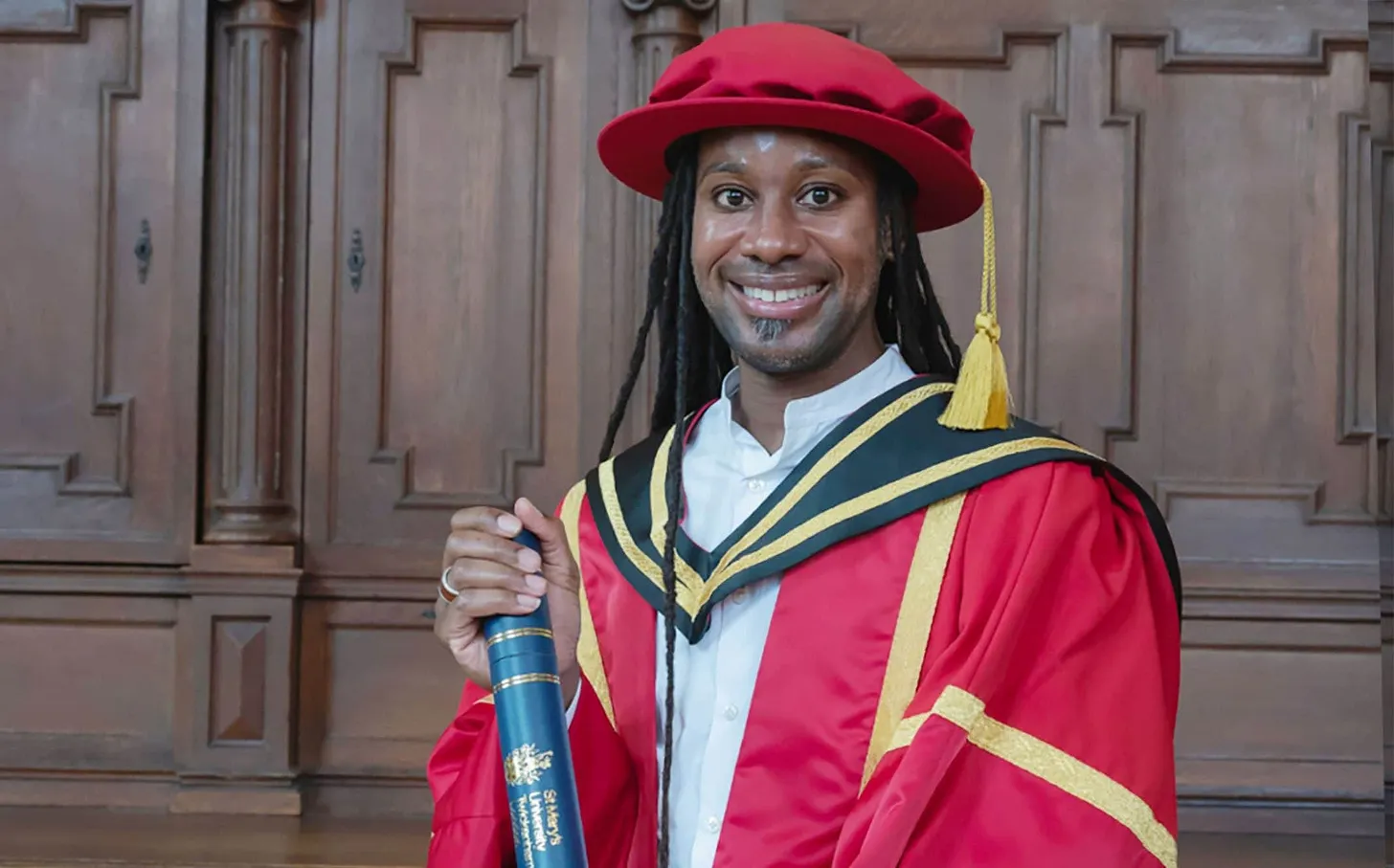
At this point, despite what multiple British academics told the Free Beacon was a remarkably unimpressive publication record on his part, Arday’s renown hit such a fever pitch that he started receiving multiple honorary doctorates, including from Southampton Solent University in 2023. The following year, St Mary’s University bestowed one upon him in Westminster Cathedral. The honor was in part to recognize charity work; the university asserted he’d raised £5.5 million.
Arday directly recited these monetary figures himself, repeatedly claiming full credit. On a November 2023 appearance in a “Black Men on the Couch” event at Cambridge, he said that “by the grace of God,” he’d raised “millions for charity.”
According to the Telegraph, Arday gave an address to the National Funeral Directors Association convention in New Orleans in October 2024 in which he said, “I had an opportunity to do a series of ultramarathons over a five-year period, which earned just over £5m for charity. So my target was to raise £1m for charity before I turned 40, but by the time I’d got to 30 I’d raised over £3m and at the moment it’s £5.5m and counting.” Funeral Industry News reported that Arday’s “inspiring” remarks “resonated deeply with attendees, fostering both personal and professional growth.”
The Daily Mail reported Friday that in 2024 Arday also gave a speech at the Greenbelt Festival in which he said he’d had a target of raising £1 million by age 40, which he met by age 30 thanks to running 600 miles in six days. The news outlet noted there is no evidence that he accomplished this athletic feat.
These recitations of wildly inflated monetary figures would ultimately come to a halt after the Times Higher Education’s Jack Grove began investigating Arday for the article that never ran.
In October 2023, Cambridge announced Arday would donate the £20,000 advance he received for his joint authorship of a book on neurodiversity, race, and class. The pledge, which was covered by the BBC, said Arday would donate the sum to “charities committed to supporting neuro-divergent working-class families.”
Two months after the Arday neurodiversity book’s September 2025 publication, Grove contacted the publisher, Princeton University Press, and inquired about which charities had received the advance. According to emails obtained by the Free Beacon, a spokesperson for the publisher declined to provide Grove specifics, even after Grove asserted that the publishing group needed to have done “some due diligence” regarding the donation. Grove called it “rather strange” that the donation had gone unmentioned since the initial announcement.
Sonita Alleyne, the master of Jesus College, Cambridge, last week signed a letter of protest over the plagiarism allegations that Arday has faced. Begun by the British left-wing legal advocacy nonprofit the Good Law Project, the letter denounced the “entirely false allegations” as part of a racist smear campaign. Dame Ijeoma Uchegbu, president of Wolfson College, Cambridge, removed her name over the weekend, however.
On July 11, 2025, Grove emailed a public information officer at Cambridge with a host of questions regarding claims Arday had made about his life and work. Grove’s email, which the Free Beacon obtained, asked for evidence backing the claim that the professor had raised £5.5 million for 80 national charities and his claim to have run 600 miles in six days.
As Grove got deeper into his investigation last year, Arday secured the services of Carter-Ruck, a law firm specializing in defamation which has a reputation for sending legal threats to journalists and publications working on negative stories about their clients. An unnamed person reported Grove to the police, alleging he was harassing Arday. The authorities ultimately closed the case following a four-month investigation, according to the Telegraph.
The Free Beacon obtained the “Not for Publication” letter Carter-Ruck sent Times Higher Education on Sept. 24, 2025, making accusations of racism.
Journalists have fewer protections in Britain than in the United States thanks to daunting libel laws, and Carter-Ruck succeeded in getting Times Higher Education to spike Grove’s article. This kept the bad press about Arday at bay, but only temporarily. On July 21, Cofnas, an American academic living in Belgium, broke the story in his Substack about the plagiarism accusations. Cofnas, who has courted controversy by endorsing the taboo science of intelligence’s ties to race, told the Free Beacon he first heard from a Cambridge whistleblower on June 13. In his eventual article, he published lengthy swaths of text from Arday’s academic papers and Ph.D. thesis alongside earlier work by other scholars, demonstrating the text was either identical or only worded somewhat differently.
“Jason Arday should NOT be fired. He was hired to represent DEI, and he’s doing a great job,” Cofnas wrote with apparent irony last Thursday on X.
Contacted by the Free Beacon for comment, a Cambridge representative said, “We take allegations of academic misconduct incredibly seriously.” But because the plagiarism accusations concerned scholarship Arday had conducted before his time at the university, “it is standard practice,” the spokesperson said, for those institutions, and not Cambridge, to investigate. “Allegations of plagiarism regarding Professor Arday’s thesis and some of his journal publications have been investigated by Liverpool John Moores University and the journals in question,” the representative added.
A Liverpool John Moores representative on Tuesday provided a statement: “In September 2025, the university received allegations of academic misconduct against its former PhD student, Professor Jason Arday. A confidential procedure was conducted in response to those allegations and Professor Arday’s PhD,” which he received from the university, “still stands.” The statement did not indicate what the procedure had concluded about whether Arday had plagiarized.
Then, on July 27, Retraction Watch, the influential academic watchdog, published its own exposé, which included the news that Times Higher Education killed Grove’s investigation due to Carter-Ruck’s intervention.
Other organizations that have edited bios of Arday as the scandal has engulfed him include Anglia Ruskin University, which changed the text of a speech read about him at the 2024 ceremony where he received an honorary doctorate. As multiple news outlets have reported, between February 28 and July 21—the day Cofnas’s article dropped—the university altered the claim that he had run “600 miles in six days for charity” to say he had run that far in 12 days. The new edit also included the hedge about his raising money through collectives. Southampton Solent made similar edits by last Friday. St Mary’s added the hedge about collectives at some point after December 6.
Asked by the Guardian for an August 1 article to name members of the fundraising collectives, Arday said NDAs he had signed prevented him from doing so.
Arday is facing these challenges just as his memoir is slated to drop next week.
The Free Beacon obtained the U.S. proof of the book, typeset on January 6, and the U.K. final edition, typeset June 18 (the PDFs’ respective metadata confirm these dates). Comparing the two reveals that Simon & Schuster and Arday watered down his fundraising claims for the final edition.
“Galleys or ARCs (advanced reader copies) are uncorrected manuscripts that contain the following disclaimer: Do not quote for publication until verified with the finished book at the publication date,” Prosser, the Simon & Schuster spokeswoman, told the Free Beacon.
In the U.S. proof, Arday recalls saying to his mother after the seminal visit to the homeless shelter when he was 18 (not 17), “I’m going to raise a lot of money, and I’m going to give it away to people who don’t have a home.” In the later U.K. edition, this quote was altered to have him say, “I’m going to work with a lot of people to raise money” for the homeless—an apparent nod to his purportedly having fundraised as a part of teams, not solo.
In the U.S. proof, Arday writes that for the 2010 marathon challenge, he hoped to raise £5,000. “After about three months, we’d raised less than £200,” he acknowledged.
But in the U.K. final edition, there is no mention of any specific fundraising tally or modest goal, nor is there any mention of the specific six- or seven-figure fundraising targets he has repeatedly recited for at least 16 years. Instead, he recounts his struggles to raise money for his reported 2010 feat of running 30 marathons in 35 days. “After about three months, we’d hardly raised anything,” he writes of the lead-up, noting that friends, “all recent graduates,” often donated just £5 to £10.
In both editions of the book, he writes that in the end, “I had far exceeded our original fundraising goal.”
Considering his goal was to raise £5,000 and he raised £6,285—a figure neither edition of the book actually specified—this claim is truthful.
Read the full article here