



Much as Helen’s face is said to have launched a thousand ships, Christopher Nolan’s new movie depicting Odysseus’ return from the Trojan War has launched a thousand takes. Keyboard warriors have raged about everything from the director’s choice of translation to his alleged transgressions against historical accuracy. This is in a movie that depicts a witch turning people into pigs, of which the archaeological record provides scant evidence.
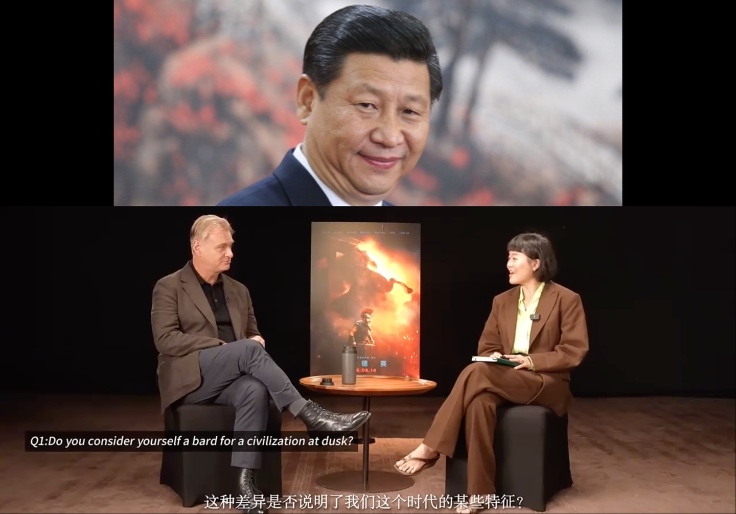
The newest cause of internet angst is the interview of Nolan by Chinese podcaster and Ph.D. candidate Yiyang Zhuge. Many fear that the interview highlights the diminution of the American intellect and heralds the coming collapse of Western civilization. What the interview actually reveals is less fanciful and more insidious—the Chinese Communist Party’s drive to control art and literature.
In some corners, the interview was cause for despair or alarm. Many lamented that China can produce people who can thoughtfully discuss great works of the Western tradition and imagined that the United States cannot do the same. It is true that American entertainment journalists rarely ask questions nearly as interesting as the ones Zhuge posed to Nolan.
But in many respects, she is a product of the United States as much as she is of her home country. She attended Groton, the elite boarding school that educated Franklin D. Roosevelt and Walter Russell Mead. Her undergraduate and doctoral studies have also been in the United States. Her pedigree shows in most of the conversation, which is largely the sort of thing to be expected from two brilliant people discussing the task of adapting an ancient Greek classic to film.
The most interesting figure affecting the interview, though, does not show up on the screen and may not be aware that the conversation even occurred. That is Xi Jinping.
The interview opens strangely: Zhuge’s first question is to ask Nolan if he’s “a bard for a civilization at dusk.” After Nolan points out that in Homer’s time, Greece was on the ascent but had not yet regained the glories of an earlier age, Zhuge interjects that Athens lost the Peloponnesian War because of the democracy’s hubris.
This may seem like an odd way to begin the conversation that focuses on other topics, but Zhuge had little choice but to start along those lines. She is parroting two of Xi’s favorite arguments. The first is that “the East is rising and the West is declining.” The other is that the United States is on the verge of falling into the “Thucydides trap” of provoking a war with Xi rather than making way for China’s inexorable rise. Xi brought up the Thucydides trap in his most recent meeting with Donald Trump.
A Chinese lover of the Western classics, as Zhuge clearly is, has to frame her thoughts around Xi’s ideas because the CCP abhors the discussion of interesting ideas or works of art on their own merits. Xi, parroting Mao and Stalin, says that “art and literary workers are the engineers of the human soul.” Much as another engineer might use a backhoe to reshape a pile of dirt, so an artist or writer will use their paintings and prose to reshape souls. For now, Zhuge can still openly admire these parts of the Western tradition that she finds so beautiful, but first she must dance to the party’s tune.
Nolan, who sat for the interview during the publicity campaign for his movie in China, may have had no idea that this was occurring. He may be uninterested in ideological struggle. His responses nonetheless showed why Western ideas fill the CCP with fear.
He describes xenia, the law of Zeus, and argues that this obligation to hospitality is a foundational tenet of the moral universe, today just as much as in the Odyssey. As he sees it, xenia is similar to the Golden Rule, that people ought to treat others as they want to be treated. The ancient Greeks were motivated by the fear of inadvertently snubbing Zeus in disguise rather than the belief that humans have transcendent moral worth, but the end result appears to him to be the same.
This idea of transcendent moral law, that there are some lines no person ought to cross, is a direct threat to the Leninist idea that people exist to serve the party’s interests. Xi’s Document 9, a directive to the party, describes people who “believe Western freedom, democracy, and human rights are universal and eternal”—as a severe threat to China.
Nolan can still make his movies, and Zhuge can still enjoy the Western tradition. But those freedoms depend on American power countering the party’s schemes. If Americans lose their hold on global affairs, our souls will be engineered.
The post 'The Odyssey' and the Clash of Civilizations appeared first on .
Read the full article here