




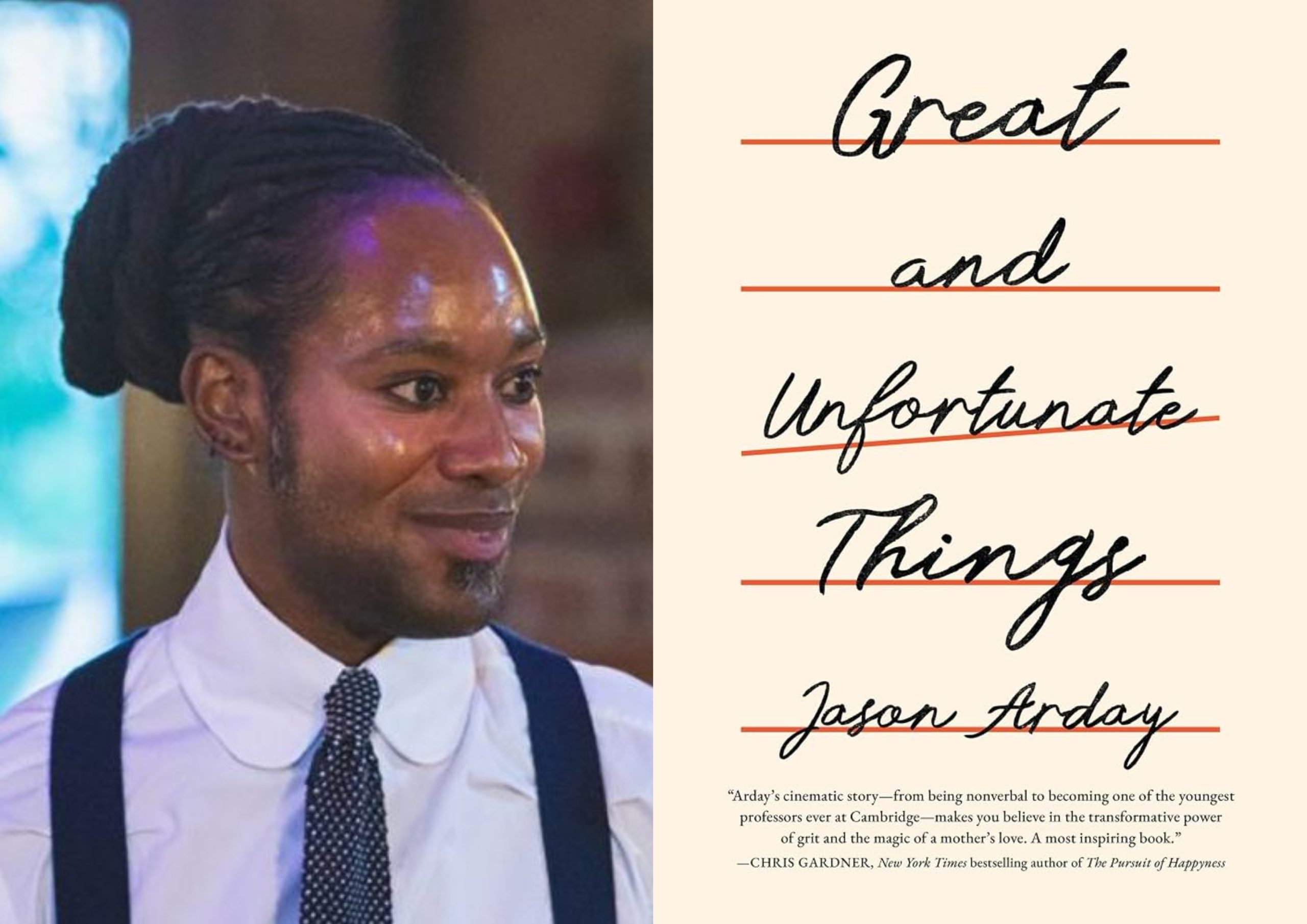
Jason Arday, who resigned from Cambridge last week amid accusations of academic plagiarism and serial fabulism, still became a published Simon & Schuster author this week after the publishing giant released his memoir. The book was meant to inspire readers—and stir profit—through Arday’s remarkable life story. But despite targeted 11th-hour editing, the memoir is rife with melodramatic biographical claims that bear remarkable similarity to storylines from Arday’s favorite low-brow soap operas, other TV dramas, the Rocky movie franchise, and movies such as Forrest Gump.
A Washington Free Beacon review of the memoir, Great and Unfortunate Things, published Tuesday in the United States with a British edition coming later this month, as well as of further claims Arday made in his book proposal, found extensive evidence that suggests Arday, 41, plucked plot lines from films and TV shows and wove them into what he presented as the true events of his life. This includes assertions that he survived cancer, spent weeks in a coma, had brain surgery that led to memory loss, and developed epilepsy thanks to head trauma from a gang attack—as well as his foundational claims of having been mute as a child and illiterate until young adulthood. Many of these claims are now in doubt.
The Free Beacon‘s findings include the fact that pivotal dialogue in the memoir’s prologue is similar to lines spoken by a Thracian prophetess in the pulpy Starz series Spartacus: Blood and Sand, which was known for sex, violence, and bad writing. Just the News first reported last week that the seventh episode of the show, which aired in 2010, shared its title, “Great and Unfortunate Things,” with Arday’s book.
In the show’s pilot, Spartacus’s wife utters a prophecy to him: “That you are destined for great and unfortunate things, if you go to war.” Similarly, per Arday’s telling in the uncannily cinematic prologue to his memoir, the midwife at his birth insists to his mother, “This boy is destined for great things.” Later in the memoir, Arday claims that in 2006 he traveled to Brazil with a nonprofit to deliver water pumps to poor communities. There, a woman tells him, “I can tell you’re destined to do great things. But I also believe you’re destined for very sad and difficult things.”
Journalist Daniel Engber last week wrote in the Atlantic about the original 2024 book proposal for Arday’s memoir, which Engber obtained. Arday, Engber reported, made an explicit connection in his proposal between the Brazilian woman he claimed to have met and the real-life Spartacus, a Thracian gladiator and slave who led a major revolt in 73 B.C. and is believed to have died in battle. In Arday’s book proposal, the Brazilian woman prophesies that he will suffer a fate similar to the doomed gladiator.
The published version of Arday’s memoir makes no mention of the Spartacus connection.
There is evidence suggesting the conversation with the Brazilian oracle is fiction. Arday, who did not return a request for comment for this article, claimed in the proposal that the Brazil trip took place in 2005, not 2006 as he says in the book. And according to the Telegraph, the charity that Arday said sent him to Brazil, WaterAid, doesn’t send volunteers abroad.
What’s more, in a recording the Free Beacon obtained of a lecture Arday gave last year, he told a similar yet conflicting tale about his connection to the real-life Spartacus, who he appeared to believe was a mythic character. He said it was his mother, who was “obsessed with Greek and Roman mythology,” who told him of the inspirational man when he was 19. “Spartacus was a rebel. He was a rebel leader,” he said of how he related to the character, before also comparing himself to Nelson Mandela.
Arday says in his memoir that he was inspired by—and repeatedly watched—the Rocky franchise, which served as an avatar for his own hard-scrabble struggle. He also religiously viewed two hugely popular Australian soap operas, Neighbours and Home and Away, and writes that from doing so, “my understanding of the human experience expanded.”
In its review, the Free Beacon found multiple instances of Arday, as he leveraged his astonishing life story as an accelerant to his swift ascendance up the academic ladder, never having made certain claims about his life until after particular storylines in these shows and films first hit the screen.
Among the other dramatic details from the book proposal that were absent from the published work was the claim that Arday survived testicular cancer. This rare malignancy afflicted the character Kyle Canning on Neighbours in 2021, a plot line that immediately followed another character on the soap suffering a testicular cancer scare.
There are longstanding records of Arday claiming to have epilepsy. In November 2012, the Guardian reported that tennis legend Andy Murray, having just met Arday, was wowed by his claims of athletic perseverance. Arday had told Murray that in 2010, he suffered a seizure in the middle of running 30 marathons in 35 days for charity, fell and suffered a hairline fracture in his leg, and yet completed his final 10 marathons (the memoir asserts there were 9 marathons to go). But in his memoir, he provides his epilepsy with its own origin story, a tale there is no apparent record of him having told until this year. He claims he was cursed with lifelong seizures thanks to the severe beating by a gang of thugs he suffered at age 18 (despite a clean CT scan after the attack; this contradiction is never explained).
In 2020, Neighbours featured a plotline in which the character Levi Canning is severely beaten by an intruder, which leads to lifelong seizures.
Arday claims in his book that, in a providential fluke, his attackers later wound up taking a class he taught at an unnamed London university, and in a miraculous act of so-called restorative justice, they all resolved their differences. Similarly, on Neighbors, one of Canning’s assailants eventually apologizes, and the two reconcile.
The month before the 2012 Guardian article was published, the New Zealand All Blacks rugby player Richie McCaw came out with his own memoir. In it, McCaw revealed he secretly played the 2011 World Cup on a broken metatarsal. Arday is a professed mega-fan of the team and has adopted their mantra, that a player should “leave the jersey in a better place” than when he received it, as one of his own and sought to apply it to his tenure in academia.
Any Given Sunday, an Oliver Stone football film released in the United Kingdom in 2000, is one of Arday’s documented favorites. In recordings of two interviews Arday gave that the Free Beacon obtained, he cites an inspirational speech by Al Pacino’s character in the film as another personal philosophy. In the movie, the team’s star player (played by real-life NFL star Lawrence Taylor) hides a severe neck injury and is admonished by a doctor not to play football, just as Arday says he was warned by a physician about his leg fracture and the marathon challenge. Despite warnings that include potential seizures, the player persists and triumphs, just like Arday says he doggedly did in his long-distance running.
The book proposal claimed that a car accident sent Arday into a monthslong coma as a teen. His parents, he asserted, were told it would be merciful to turn off life support. The coma storylines—sometimes including a terrified family being advised to pull the plug—are plentiful in Arday’s favorite TV shows: the TV show Oz, most notably in 1999; on Home and Away, including in 1999, and again in 2016; and Neighbours in 1999 and 2008 (including multiple characters needing, like Arday claimed of his post-coma plight, to relearn to walk).
In his memoir, Arday claims he had a brain tumor removed and then suffered a mini-stroke that wiped out his short-term memory shortly before his 2015 Ph.D. thesis defense. On Neighbours, in 2007, a character has a brain tumor removed and suffers partial amnesia.
Perhaps the most obvious comparison between Arday’s story and a fictional tale concerns Forrest Gump. The classic 1994 film features a boy compromised by both mental and physical handicaps, who, thanks to the enduring love of an unflappable, aphorism-spouting mother who dismisses the doctors who write him off, breaks free of his shackles, becomes a long-distance runner, and goes on to secure his triumphant place in history. In his memoir, Arday directly compares his inspiring life story to the “fantastical” film. He cites his unflappable mother, who is herself a font of the sort of self-help sayings women embroider on pillows, pointing out the “similarities there.
Prone to fixations, autistic people often become superfans of narrow slivers of pop culture and other arcana. Research shows they also have a tendency to engage in “scripting”—memorizing and rehearsing, for example, lines from films or TV and weaving them into their everyday lives—and can form strong parasocial bonds with fictional characters. This can help them mirror and better comprehend real-life emotions.
Referring in particular to the penchant among people on the spectrum for role-playing games, Liam Cross, an autism researcher at the University of Plymouth’s school of psychology, told the Free Beacon: “Not only can this act as a way to scaffold social learning, but we see what’s called ‘bleed,’ where parts of the character one is playing and the self start to merge together and overlap.”
Gray Atherton, who is Cross’s Plymouth colleague, said: “One possibility of an individual ‘confusing’ fantasy with reality could be that if an individual spends an inordinate amount of time engaging with a fictional world or characters, they may begin to relate to those characters or story in a way that can feel ‘real.'” But Atherton cautioned: “It would be a stretch to characterize autism as a condition that would mean an individual genuinely confuses their own lived experience with those in a TV show, movie or book.”
In Arday’s memoir, the morning of his fateful 2022 Cambridge interview, he listens, for one, to the song “Pinball Wizard.” This comes from The Who’s 1969 rock opera, Tommy, later a Broadway musical, which concerns a British boy who’s rendered deaf (like Arday was in one ear), “dumb” (like Arday says he was until age 11) and blind after witnessing a murder, is abused by his uncle (like the abuse Arday says he suffered at the hands of a speech therapist), becomes a master pinball player (like Arday’s professed mastery at the British cue sport “snooker”), and finally, as an adult, literally finds his voice and becomes a messianic rock star (like Arday’s messiah-like academic fame, now interrupted).
There’s no available evidence that Arday was a fan of It’s a Wonderful Life. But it’s worth noting that, like Arday, George Bailey is deaf in one ear and, after falling into despair, goes to a bridge to commit suicide, only to be rescued from the brink—in Bailey’s case, by an angel, in Arday’s, by an unnamed family member.
Arday claims in his book that he was rescued thanks to the fact that he wears a medical bracelet for his epilepsy that includes a tracking device. And yet a Free Beacon review of photographs including clear views of his wrists demonstrates no clear evidence that he wears such a bracelet.
The bedrock of the Arday mythology is his claim of childhood illiteracy: He claims he could not read until he was 18. However, his ex-wife, Debbie McKenzie, said in an appearance with him on a British TV show in 2012 that he learned to read at 16.
In his memoir, Arday claims McKenzie first started teaching him to read shortly after they met when he was 18. That would have been between 2003 and 2004, roughly the same period when Neighbours ran a plotline about the character Connor O’Neill’s secret illiteracy and his girlfriend’s effort to arrange tutoring for him.
Additionally, Rocky II (which he became a fan of long before meeting McKenzie) reveals Rocky’s illiteracy. Who practices reading with him? His girlfriend, Adrian. And who later falls into a coma? Adrian.
Like Arday’s devoted parents in his book proposal’s telling, Rocky remains faithful to Adrian throughout her plight in the hospital, even as the restless boxer prepares for the big fight. And when she finally wakes, Rocky is there standing vigil by her side.
Adrian says there’s one thing Rocky can do for her.
“Win,” she says. “Win.”
Representatives for Simon & Schuster did not return a request for comment for this article. However, Julia Prosser, a spokeswoman for the publishing giant, last week told the Free Beacon that Arday “worked closely with his co-writer, as well as our editorial and legal teams, to carefully research, write and corroborate the narrative.”
Arday has canceled promotional events for the book. Earlier this week, his name was removed from the board listings of the British Sociological Association and the Autism Centre of Excellence. Cambridge’s vice-chancellor, Deborah Prentice—the chief executive of the university—on Wednesday said in a “dear colleagues” letter that the investigation into Arday’s appointment would include outside academics. She noted that Durham and Glasgow Universities were also investigating his previous tenures there. She said she “shared” concerns about Arday, but called his case an “aberration.”
Despite profound doubts about the value of Arday’s word about his own life, his memoir remains an editor’s pick on Amazon. Although the site this week snipped out a paragraph from the description of the book that had touted that “he finds his voice, literally and figuratively” and “becomes one of the youngest professors in the University of Cambridge’s history.” A bookstore in Chicago’s O’Hare airport is similarly offering Arday’s memoir as a “Read of the Month,” hailing the memoir as a “story of almost inconceivable perseverance and achievement.”
Read the full article here