





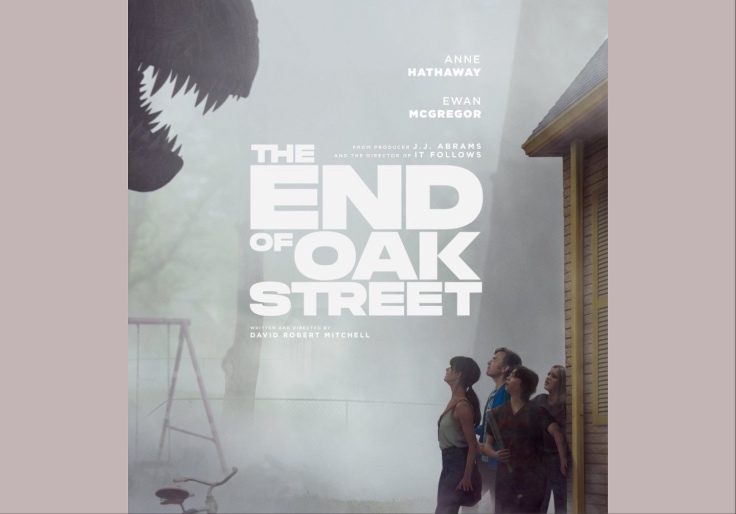
The new Anne Hathaway movie, The End of Oak Street, is an exercise in Larry Tate-ism. To explain to those who aren’t 147 years old like me, Larry Tate was the advertising executive on the sitcom Bewitched whose opinions would shift drastically depending on what his client would say. When his underling Darrin came up with a slogan, Larry Tate would say, “That’s ridiculous.” Then the client would say, “I find it intriguing.” At which point Larry Tate would respond, “Exactly! A ridiculously intriguing slogan!”
And so it is with The End of Oak Street, only we the audience are both Larry Tate and the client. The movie is ridiculous and deserves to be called out for its silliness. At times you can barely believe what you’re watching, and you can’t tell whether you’re supposed to be scared when what you really want to do is laugh. At the same time, The End of Oak Street is really entertaining. It’s the most sheerly fun movie of the year so far. So, Larry Tate-style, it’s ridiculously entertaining! It’s terribly fun! It’s dreadfully alluring!
What we have here is the throwback to end all throwbacks. The End of Oak Street is not just an homage to Steven Spielberg; it’s writer-director David Robert Mitchell’s homage to one specific year in Spielberg’s career. That year was 1982, when Spielberg scored an unheard-of one-two punch at the box office. He wrote and directed the heartwarming E.T., which became the highest-grossing movie of all time. That came out on June 11, 1982. Only seven days earlier, he released Poltergeist, another huge hit, which credits him as producer but which he also shadow-directed.
Everything here—everything—is Spielberg 1982. The cinematography by Michael Gioulakis is a near-exact match of Allen Daviau’s for E.T. Michael Giacchino, the best composer writing for the movies today, has written an entire score directly evoking the musical themes struck by John Williams in E.T. and Jerry Goldsmith in Poltergeist.
The End of Oak Street is not merely an evocation of these two pictures; it is those two pictures. Mitchell put them in a blender, liquefied them, and poured them into a mold borrowed from The Twilight Zone—the TV series Spielberg turned into an anthology movie in 1983.
Then he journeyed forward another decade in Spielberg’s career to integrate the dinosaurs from Jurassic Park into the mix. Finally, and I think most cleverly, Mitchell pulls off a final moment that serves as a truly unsettling homage to the greatest twist ending in movie history, the one from the Spielberg-produced Back to the Future (1985).
The dinosaurs here take the place of the ghosts who bedevil the family in Poltergeist, who are living unknowingly on top of a desecrated graveyard. They begin romping around set in the same sort of suburban neighborhood where both Poltergeist and E.T. take place. The family here mixes the two—it’s troubled, like the divorced mom in E.T., but is anchored by a Poltergeist-like materfamilias who proves unexpectedly tough and resourceful.
I don’t want to say much more about this movie. In fact, there really isn’t that much more to say. It’s Anne Hathaway, her husband Ewan McGregor (who is actually bad, which is something I thought I would never say of him), and their two kids trying to survive the dinosaur invasion. Why it is that dinosaurs begin to roam around Oak Street is given a blessedly cursory explanation. That’s the element Mitchell cleverly borrowed from The Twilight Zone, which specialized in episodes about how families or neighbors find themselves forced to cope with an uncanny and unsettling event.
What Mitchell understands is if you’re going to attempt an exercise in nostalgia, you might as well go all the way. Movie directors often say they’re making films to honor their forebears, the way Brian De Palma spent 10 years redoing Hitchcock, but Mitchell is onto something new here. Don’t make something that evokes Tarantino; just take the cast from Pulp Fiction and the crooks from Reservoir Dogs and have them kill Hitler. Don’t pay tribute to Scorsese; have Travis Bickle from Taxi Driver plot the assassination of Henry Hill from Goodfellas. As Tom Lehrer sang, “Plagiarize! Let no one else’s work evade your eyes! Remember why the good Lord made your eyes. So don’t shade your eyes. Just plagiarize, plagiarize, plagiarize.”
Only be sure to call it homage.
The post REVIEW: 'The End of Oak Street' appeared first on .
Read the full article here