





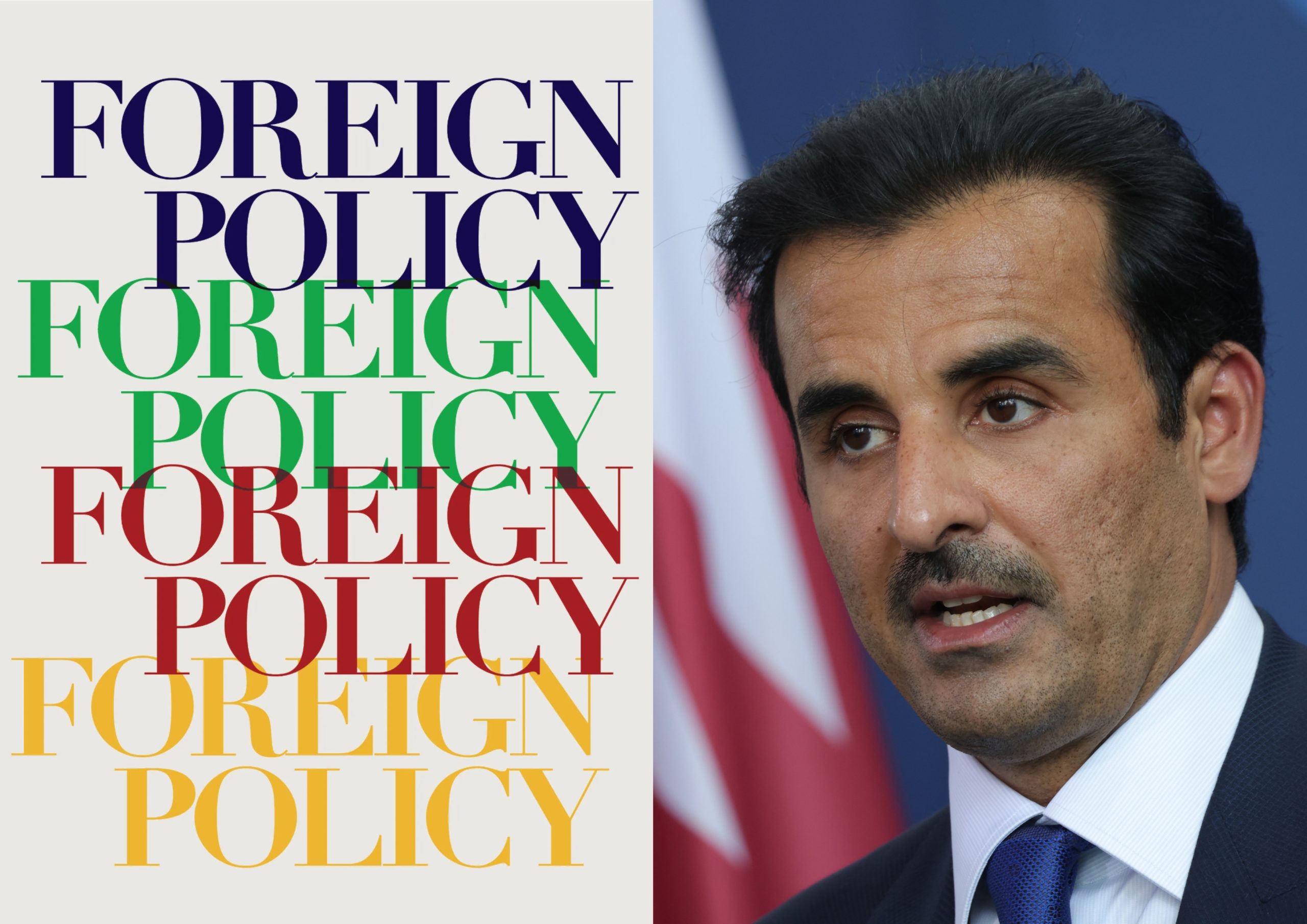
Foreign Policy, the influential Washington-based publication, has financial ties to the State of Qatar, according to a Washington Free Beacon review. Doha’s patronage raises red flags about the magazine’s coverage of issues like the Iran war, Israel’s operations in Gaza, and other areas where Qatar is using its vast wealth to influence American foreign policy.
Foreign Policy, which calls itself “the global magazine of news and ideas,” touts itself as an official partner of the Doha Forum—an annual conference founded by the State of Qatar—for which Foreign Policy produces podcasts and events. The Doha Forum is organized each year by Qatar’s Ministry of Foreign Affairs “under the patronage” of its emir, Sheikh Tamim bin Hamad Al Thani. Under that umbrella, Foreign Policy partners with it on two “Doha Debates” podcasts—Global Reboot and Counterpoint—and helped organize a January 2026 “high-level panel discussion” held on the sidelines of the World Economic Forum in Davos. The event, Qatar’s state news agency said, was held as “a preparatory step toward the Doha Forum 2026, scheduled to be held in December in Qatar.”
Amid this partnership, Foreign Policy magazine has published a noticeable number of breathless pieces that adopt Qatar’s virulently anti-Israel views and also its objection to the U.S. war with Iran. Foreign Policy pieces have accused Israel of “genocide” and criticized President Donald Trump’s “reckless war” against Iran. In other cases, the publication has lambasted Trump for triggering “a Middle East nuclear arms race” by inking a technology pact with Saudi Arabia—with which Qatar’s relations are strained—and argued that Trump’s Gaza peace plan is being stymied by Israel, rather than Hamas, whose leaders live openly in Qatar.
Foreign Policy has also paid Twitter to promote some of these articles, including a July piece that fawned over the foreign policy prowess of Democratic New York Rep. Alexandria Ocasio-Cortez, the founder of the far-left “squad” and fierce opponent of Israel and the American military campaign against Iran.
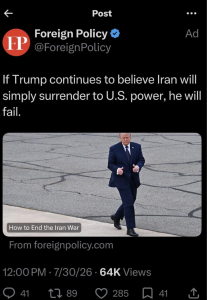
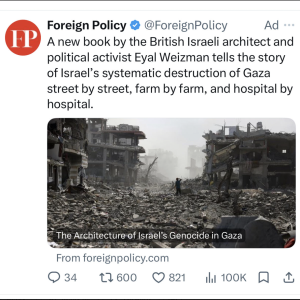
“FP spoke with 25 current and former advisors, progressive activists, and think tank experts in Ocasio-Cortez’s orbit to map out her views on the Middle East, Latin America, and the world after Trump,” the publication wrote in a July 17 X post that FP paid to “boost,” or push into users’ feeds (the post was marked as a paid advertisement). A July 30th post also marked as a paid advertisement declared, “If Trump continues to believe Iran will simply surrender to U.S. power, he will fail.” Yet another from this month promoted a book purporting, as Foreign Policy put it, to detail “the architecture of Israel’s genocide in Gaza” and its “systematic destruction” of it “street by street, farm by farm, and hospital by hospital.”
 Foreign Policy‘s paid social media promotion of its Qatar-friendly articles, combined with its financial ties to Qatar’s lavishly funded influence operation, raises questions of how deeply the Qataris have penetrated the venerable magazine, or the type of influence Qatar may be peddling inside the publication, which was founded in 1970 and now owned by the Graham family, who famously used to own the Washington Post before selling it to Jeff Bezos. Foreign Policy is one of two publications controlled by Graham Holdings (the other is the liberal blog Slate) in a holding company made up of an eclectic list of companies ranging from the Kaplan education company to local TV stations, treated lumber, and car dealerships.
Doha has a documented history of using its state-funded initiatives, including the Qatar Foundation, to shape discourse in the American media and other cultural institutions, like universities and public schools.
The “Doha Debates” series that partners with Foreign Policy receives funding from the Qatar Foundation—controlled by the powerful mother of Qatar’s emir—which is known to police how some grantees discuss sensitive foreign policy matters, like Hamas’s Oct. 7 terror attacks.
Since Foreign Policy held its January event in Davos with the Doha Forum—a panel that was moderated by the publication’s editor in chief, Ravi Agrawal—it has published numerous articles that appear to hew closely to Qatar’s own view of the Middle East and beyond.
An Aug. 6 “analysis,” for instance, declared that “Hamas Agreed to Disarm. Why Did Israel Reject the Deal?” The article went on to cite “experts” who said, “that Israel’s position on the [Hamas] disarmament plan is extremely unlikely to change until at least after the country’s highly anticipated elections in October, which could see [Prime Minister Benjamin] Netanyahu—Israel’s longest-serving prime minister—lose power.”
A July 28 essay, meanwhile, purported to expose “Netanyahu’s Palestine philosophy,” describing it as “consistently disastrous.” The article featured a photo of the Israeli leader extending his arm into the air, reminiscent of a Nazi salute.
The magazine’s Aug. 4 book review on “Israel’s genocide in Gaza” opens with a lament about how pro-Hamas demonstrations on college campuses “in the spring of 2024 were violently repressed and have largely gone away.” The piece was authored by George Washington University professor Marc Lynch.
“While many Americans believe that Israel has committed a genocide against Palestinians in Gaza over the past three years, attempts to understand what really happened there and hold Israel accountable have fallen short so far. The legal case at the International Court of Justice has been stalled by American and European opposition,” Lynch wrote. “The ferocious debate over the term itself has degenerated into partisan flamethrowing and definitional nitpicking. The campus protests that erupted in the spring of 2024 were violently repressed and have largely gone away.”
Pages of ink have also been dedicated to the U.S. war against Iran, which is often portrayed by the magazine as a quagmire that has only strengthened Tehran’s hand. A July 23 piece explained “how Iran gained the upper hand,” while another from that same day argued that the “only one way out of Trump’s reckless war” is to “pay off Iran to open” the Strait of Hormuz.
Others have described Trump’s nuclear deal with Saudi Arabia—a country often at odds with Qatar over its support for Iran—as “diplomatic malpractice” and declared Riyadh’s crown leaders “the architects of their own misfortune.”
Qatar’s relationship with Foreign Policy has not gone unnoticed by congressional staffers involved in Middle East issues.
“Everyone knows that Qatar has bought its way into every part of Washington DC. When you get to the Hill, the first thing that happens is you get a call offering you a business class flight to watch Formula 1 in Doha,” said one senior Republican congressional staffer. “When you become a journalist, the first thing that happens is you get a call offering you a file on someone Qatar doesn’t like.”
Qatar’s interest in American schools and cultural outposts was first documented in a 2010 diplomatic cable from the State Department published by WikiLeaks. In it, Qatari officials privately explained “that their drive for international conferences, their hosting of U.S. military bases, and their relentless engagement with others were all part of a strategy to protect Qatar.”
“We have no military,” one Qatari is quoted as saying. “So think of the conferences as our aircraft carriers, and the military bases as our nuclear weapons.”
The Free Beacon has further reported on how Qatari cash has influenced high-profile universities, such as Georgetown University, which maintains a Doha campus and helps train future American diplomats.
“Georgetown’s key centers function as platforms promoting political Islam, minimizing the threat of Islamist extremism, and advancing anti-Israel narratives,” a June 25, 2025, probe by the Institute for the Study of Global Antisemitism and Policy concluded. “Affiliations include extensive networks linked to Islamist movements and entities associated with the Muslim Brotherhood.”
Foreign Policy did not respond to a request for comment.
Read the full article here