



The Ortega regime has been cracking down on dissent and going after an American faith-based relief group
The Senate is taking up new legislation to reauthorize and expand sanctions on Nicaragua, citing mass “widespread human rights abuses” and “systematic corruption” under longtime dictator Daniel Ortega, according to a copy of the bipartisan measure obtained by the Washington Free Beacon.
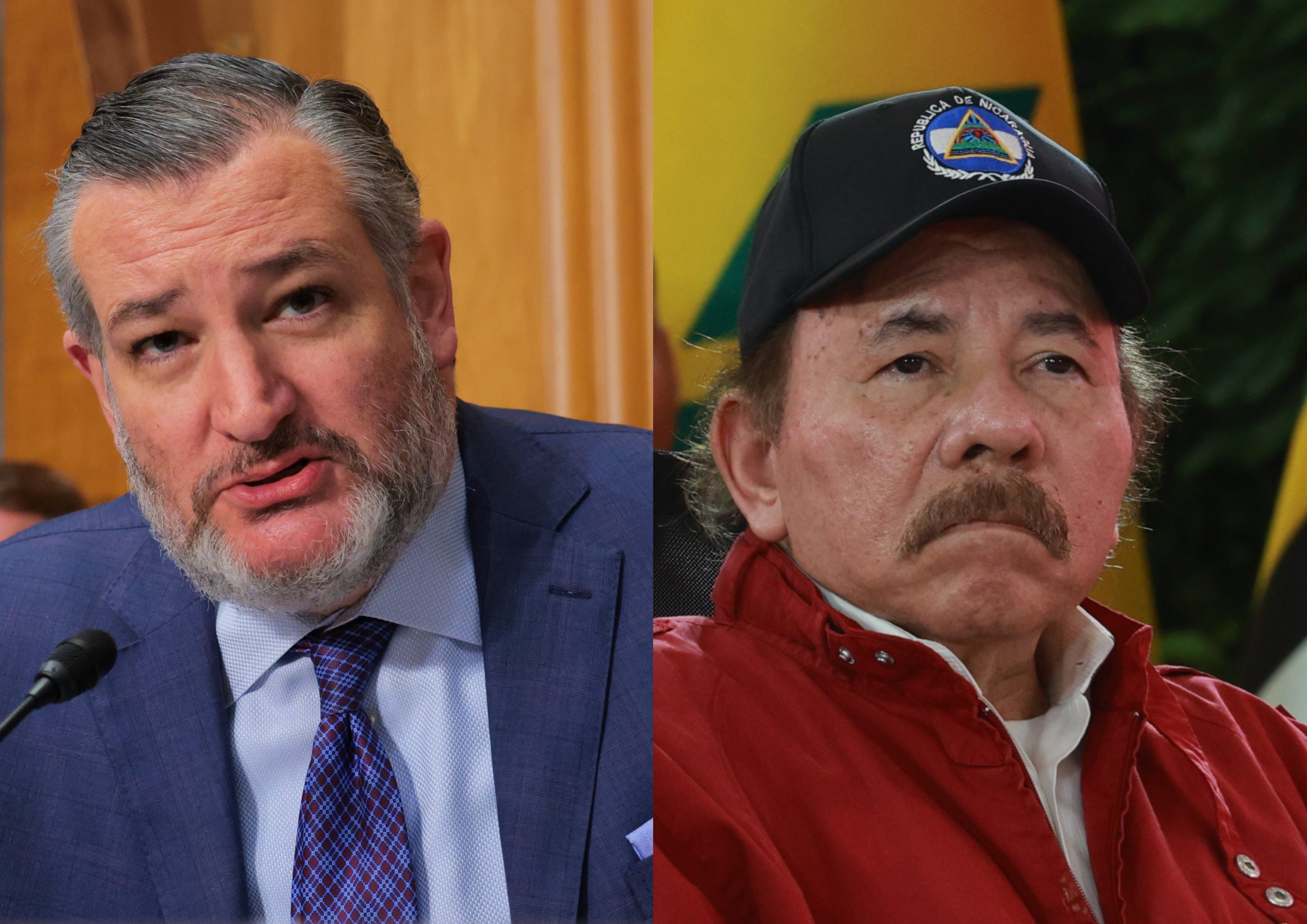
The legislation, backed by Sens. Ted Cruz (R., Texas) and Tim Kaine (D., Va.), will vastly expand economic sanctions on Ortega’s regime until the anti-American dictator commits to holding free elections and stops violently repressing Nicaraguan opposition forces. Ortega, 80, along with his wife and co-president Rosario Murillo, announced in late July that he will abolish elections in the Latin American country to ensure his 20-year tenure extends into perpetuity. To accomplish this goal, Ortega has systematically arrested his political opponents and cracked down on faith-based organizations, including a Texas-based Christian ministry that was operating inside the country.
Ortega’s regime, the bill states, “has engaged in systematic corruption, undermined democratic institutions, eroded the rule of law, and committed widespread human rights abuses, including state-sponsored violence against Nicaraguan citizens, contributing to regional instability, forced migration, transnational repression, and national security concerns.”
The legislation directly builds on Cruz’s 2018 Nicaragua Investment Conditionality Act (NICA), which restricted the country’s access to international financial loans and most American funding due to Ortega’s human rights abuses. The new measure will expand these sanctions to include Nicaragua’s lucrative gold sector and will penalize the regime for its persecution of Christian groups inside the nation. The early bipartisan backing for the bill signals that it is likely to draw widespread support as lawmakers seek to hold Ortega responsible for the deteriorating political situation in his country. The bill is also certain to draw favor in the Trump White House, which has made security in the Western Hemisphere a top foreign policy priority.
“The Ortega regime in Nicaragua is engaging in human rights abuses, religious persecution, and political repression by means of corruption and election manipulation,” Cruz told the Free Beacon. “Since the beginning of my career in the Senate, I have sought to counter these abuses and tactics. This bipartisan legislation builds on the NICA framework I authored and built, which passed through Congress and was signed into law. I intend to advance it.”
Ortega and his wife have been consolidating power through violence for the better part of a decade. Since 2018, Cruz’s bill notes, “the Murillo-Ortega regime has revoked the legal registration of hundreds of non-profit and faith-based organizations as part of its broader campaign to suppress civil society and religious institutions.”
In 2023, for instance, Ortega’s regime arrested 11 Nicaraguan pastors and ministry workers affiliated with the Mountain Gateway, a Christian missionary group headquartered in Texas, which Cruz represents in the Senate. Ortega also issued arrest warrants for three U.S. citizens affiliated with the organization, confirming what the United Nations recently described as “a complex transnational surveillance and intelligence network involving the army, the police, the diplomatic service, other State institutions and non-State actors.” The pastors and around 100 other political prisoners were ultimately released in September 2024 after the State Department intervened, though Ortega’s regime continues to target faith-based organizations in the country.
The United Nations said it compiled evidence that Ortega’s regime enforced the “disappearance of 75 persons (60 men and 15 women) for periods ranging from several weeks to over two years.” From April 2025 to mid-January 2026 alone, “at least 199 persons (174 men and 25 women) were arrested for political reasons, including active and retired military and State officials, former Sandinista and relatives and associates of exiles,” according to the United Nations.
After Ortega’s July announcement that “there won’t be any more elections” in the country, his parliament quickly moved to enact the plan. Cruz’s bill ensures that sanctions on Nicaragua will not be lifted until Ortega commits to holding “competitive, free, and fair elections that meet democratic standards and permit credible international observation of elections.”
Read the full article here