





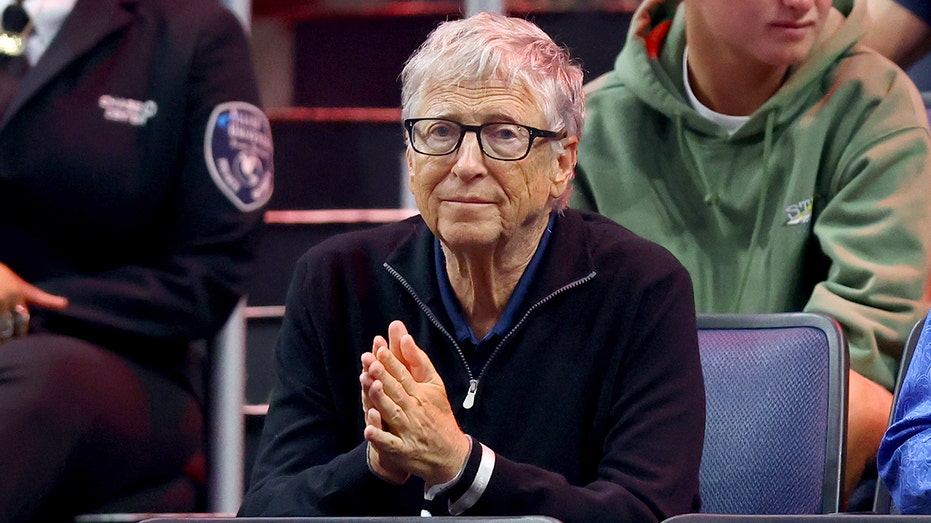
Microsoft co-founder Bill Gates warned that the emergence of artificial intelligence (AI) will present major challenges as it reshapes industries and work, suggesting that it could be helpful to explore ways to reserve work in certain areas for humans to ease the transition.
Gates on Tuesday published an essay on his GatesNotes website that calls for public debate and a plan to manage the technological evolution of AI and its impact on the workforce and society at large, which he said should be a priority given that the
“In terms of equity, AI will either be the greatest equalizer ever invented, or the worst source of injustice. The challenge is monumental. Even under the best circumstances, the transition to this new AI era will be one of the most turbulent times in human history,” he wrote.
Gates said that there are significant questions about how AI can be deployed in a way that doesn’t widen the divide between the rich and poor, as well as how to best protect those vulnerable to losing their jobs due to AI.
CHINA NARROWS AMERICA’S AI LEAD AS HUAWEI EXPANDS ITS GLOBAL TECH FOOTPRINT, FORMER US OFFICIAL WARNS
“I believe that answering these questions and acting on the answers should be the world’s top priority. If the world takes the right steps AI will be a force for good and leave everyone better off,” Gates wrote.
“Unfortunately, right now we are not preparing for it. I don’t see evidence that leaders, experts, and communities are confronting the challenges adequately,” he said. “There is no plan to ease the entry into the AI era.”
Gates said that he thinks many commentators are underestimating the scope of the impact AI will have, in part because of current reliability issues, as well as misleading analogies to the impact of past technological innovations because of how much more transformative AI can be.
The billionaire co-founder of Microsoft acknowledged his potential bias toward tech in general and AI given how he made his fortune, along with his ongoing work as chairman of the Gates Foundation that involves AI deployment.
WARREN BUFFETT EXCLUDES GATES FOUNDATION FROM HIS ANNUAL DONATIONS OF BERKSHIRE STOCK
However, he added that his “views on AI are not motivated by the potential to make more money for myself,” adding that profits generated from his investments will go to the Gates Foundation to tackle inequity.
“For as long as I can remember, I’ve wished innovation could happen faster. With AI, my feelings are more complicated. I wish the world could get the benefits rapidly and delay the problems it will cause as long as possible, but the benefits and problems are arriving at the same time,” Gates wrote.
“I believe we need time to prepare for the period of social, political, and economic upheaval we are about to enter,” he added. “The people who need the most time are the ones who have the least – the accounting worker who’s replaced by a bot or the $20-an-hour worker who loses their job to a $10-an-hour robot.”

Gates said that AI is likely to impact workers in industries such as law, customer service, medicine, software and manufacturing over the course of a decade, adding that, “There will be some new jobs, but without the right policies there will be far fewer than exist today.”
“If someone had a credible plan for slowing down AI advances globally, I would likely support it. However, I don’t think that’s going to happen. The geopolitical and economic incentives are pushing too hard to go full speed ahead,” he wrote.
BILL GATES APOLOGIZES TO FOUNDATION STAFF OVER EPSTEIN TIES
Gates said that he believes that as AI and robotics improve, “we’ll set aside certain things for only people to do,” with some roles classified as “Human Reserved” for varying reasons.
“We might set something aside as Human Reserved for economic reasons. For example, we may do it because allowing machines to take over a certain role will displace a large number of people who can’t easily change jobs,” he said.
“Sometimes the decision to make something Human Reserved will be driven by other factors. In health, for example, imagine a robot giving you the awful news that you have an incurable disease. There’s no technical reason why it couldn’t. Yet it shouldn’t,” Gates said.
He added that he believes the Human Reserved domain “will evolve over time,” as AI could be phased-in over years or decades in certain fields, or a persistent mixture of humans and AI in areas like education and healthcare.
“The lines will vary from place to place. Some countries might insist on having humans take care of the elderly. But a country like Japan, which has a shrinking workforce and not enough young people to care for the old, may welcome a caregiving robot,” Gates wrote.
He added that he doesn’t have answers to a host of questions over matters like who would determine what roles could be reserved for humans, the criteria used to make those decisions, preventing companies from skirting those rules, or how those dynamics would affect international trade.
Gates said those questions “will need to be worked out in public as part of the transition plan.”
Read the full article here