





Anyone who has spent years working in boots knows that a long day often announces itself first through the feet. Ten hours on concrete, miles of fence line, repeated trips up ladders, or a full shift pushing carts across a warehouse floor can leave the ankles, arches, and heels aching long after the work is finished.
Long before gel insoles and specialized foot creams became common, working people relied on simpler routines. Warm water, salt, basic powders, grease or salve, dry socks, and careful attention to small problems helped keep them moving through jobs where taking several days off because of sore feet was rarely an option.

Much of that older advice centered on problems that have not changed. Skin still dries and cracks, sweat still collects inside closed boots, and muscles still become stiff after supporting the body for an entire day. The useful part of old time foot care was less about any single remedy and more about maintaining a routine before minor irritation became a serious problem.
Why hard working feet wear down
Each foot contains twenty-six bones, more than thirty joints, and a network of muscles and tendons designed to move over varied terrain. Hard, flat surfaces such as concrete do not provide that variety, and the repeated impact of walking or standing on them can be felt through the heel, legs, knees, and lower back.
Outdoor work creates a different set of problems. Dirt and pasture may be easier on the feet than concrete, but field work means moisture, long distances, plant debris inside footwear, and boots that may remain laced from early morning until evening.
Standing still for long periods adds another difficulty because fluid can collect in the lower legs and ankles. That is one reason boots that fit comfortably in the morning may feel noticeably tighter late in the day.
Sweat makes the situation worse. A foot sealed inside leather and a heavy sock for hours stays warm and damp, creating the conditions behind odor, softened skin, blisters, and fungal problems. Earlier generations may not have described the mechanics in modern terms, but their evening routines were largely aimed at managing those same problems.
The evening soak as the backbone of the routine
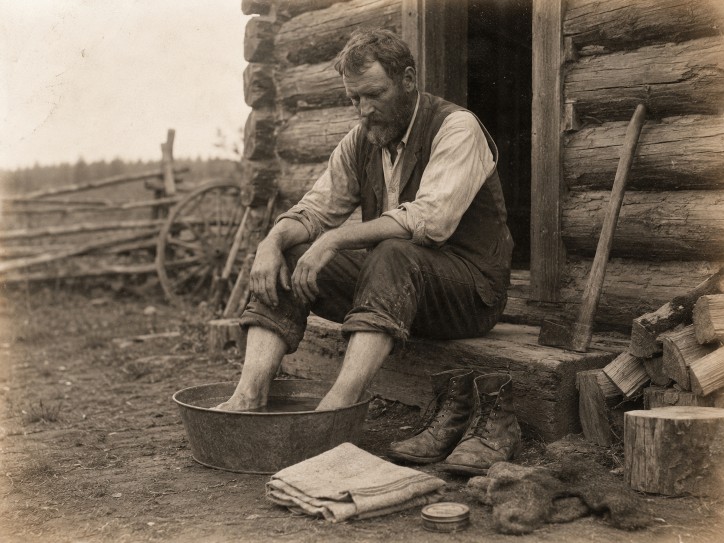
Warm foot soaks became a standard part of traditional foot care because they combined several useful steps in one simple routine. Warm water relaxed tired feet, softened thick skin before filing, and gave a worker fifteen or twenty minutes with the boots finally removed.
The water should be comfortably warm rather than hot enough to risk burning the skin. Fifteen to twenty minutes was generally considered sufficient, since soaking for too long leaves the skin overly soft and more easily damaged.
Drying afterward matters just as much as soaking. Moisture left between the toes can create another problem after the soak was supposed to solve the first one, so the feet should be dried thoroughly, especially in the spaces between the toes.
That simple habit was treated seriously by people who spent most of their lives in work boots because keeping the skin clean and dry was one of the easiest ways to prevent small problems from building.
Epsom salt, vinegar, tea, and baking soda
Epsom salt was one of the traditional additions to a warm foot bath. The source routine uses about half a cup per gallon of water, particularly on days when the feet and ankles feel tired after heavy work.
Apple cider vinegar was another common option, using roughly one part vinegar to four parts warm water. It was traditionally used when odor or athlete’s foot was the main concern, and some people alternated between Epsom salt soaks for aching feet and vinegar soaks when moisture and odor were the bigger problem.
Black tea also appeared in older foot care routines. Four or five tea bags could be brewed in a quart of hot water, allowed to cool, and then added to the basin. Tea soaks were commonly associated with feet that remained damp throughout the day.
Baking soda offered another inexpensive cabinet remedy. About a quarter cup added to the water was used to soften rough skin and help with odor.
The attraction of all these methods was their simplicity. Families did not need specialized products because most of what they used was already kept in the kitchen or pantry for other purposes.
Salves, greases, and cracked heels
After soaking and drying, traditional care often turned from water to fat.
Rendered tallow, lard, lanolin, petroleum jelly, castor oil, warmed olive oil, and mixtures of beeswax and oil were all used to slow moisture loss from dry skin. Cracked heels were a particular concern because once a fissure became deep enough to reach tender tissue, every step could become painful.
The usual routine was straightforward. After soaking, the thickened skin around the heel could be smoothed gently with a pumice stone. The heel was then coated with the chosen grease or salve before a clean cotton sock was pulled on for the night.
Repeated over several evenings, the goal was to keep the skin softer and prevent small cracks from becoming deeper ones.
The larger lesson was preventive rather than cosmetic. People who depended on their feet for a living had good reason to deal with dry heels early instead of waiting until a split became painful enough to interfere with work.
Socks, boots, and the rotation rule
Traditional foot care also depended heavily on what happened to the boots after they came off.
Leather needs time to dry. During a working day, sweat is absorbed into the lining and insole, and a pair of boots put back on after only a short overnight break may still contain substantial moisture.
Alternating between two pairs gives each pair more time to dry completely. At night, insoles can be removed, laces loosened, and the boots placed somewhere with good air movement.
Putting wet leather close to a stove may dry it faster, but excessive heat can also make leather stiff and encourage cracking. Air drying was therefore the better routine.
Socks deserve the same attention. Wool remained popular for demanding outdoor work because it continues to insulate when damp and helps move moisture away from the skin. Cotton tends to absorb moisture and hold it against the foot, which can soften the skin and increase the likelihood of blisters.
For someone working a long shift, simply carrying a clean spare pair of socks and changing halfway through the day can make a noticeable difference.
Keeping feet dry
Powder was another old solution to moisture inside boots.
Cornstarch and baking soda were commonly used either by themselves or mixed together. Rather than packing powder directly between the toes, the source recommends dusting it into the sock so it spreads more evenly.
For people dealing with persistently damp feet, a small container could be kept in a vehicle or lunch box for use during the day.
The same emphasis on dryness carried into traditional approaches to athlete’s foot. Vinegar soaks were used regularly, while socks were washed thoroughly and the inside of boots was treated with baking soda overnight.
Whatever method was chosen, the larger goal remained consistent: reduce the damp environment that allowed irritation, odor, and fungal problems to continue.
Callus care without doing damage
Calluses form because the skin is protecting itself against repeated pressure and friction, so the traditional approach was not to remove them completely.
Instead, thick areas were kept smooth enough that they would not develop ridges or split. After soaking, a pumice stone or foot file could be used gently, with the goal of reducing excessive buildup rather than taking the skin down until it became tender.
Sharp blades were avoided because cutting into a callus too deeply could create exactly the kind of wound a worker was trying to prevent.
A small amount of filing once or twice a week, followed by salve or another moisturizer, was considered a better approach than trying to remove months of thickened skin in a single session.
Blisters and hot spots
One of the most practical habits in traditional foot care was learning to respond to irritation early.
A warm, stinging, or rubbing spot inside the boot is a warning that friction has already started damaging the skin. If the problem is handled immediately, it may never progress beyond a minor hot spot. If ignored for the rest of the shift, it can become a blister that makes walking painful for several days.
Moleskin, cloth tape, or petroleum jelly were used to reduce friction as soon as trouble appeared.
The source also describes the older practice of draining a painful blister from the edge with a sterilized and cooled needle while leaving the overlying skin intact as protection for the raw tissue beneath. The area was then kept clean and dry.
Spreading redness or red streaking was treated as a reason to stop relying on home care and seek medical attention.
Ending the shift the right way
After a long day, simply getting weight off the feet was part of the routine.
Elevating the feet for about twenty minutes could help with end-of-day swelling. The heels could be rested on a chair while lying down, or pillows could be placed beneath the ankles in bed.
Rolling the arch over a bottle, rolling pin, or frozen water bottle was another method used to loosen the underside of the foot and reduce discomfort around the heel.
Calf stretching also belonged in the same routine because tight calves can increase tension around the heel and foot. One simple stretch involves stepping one foot backward while keeping the heel flat, then leaning toward a wall until the back of the lower leg stretches.
For people accustomed to spending the entire day inside rigid footwear, a short period of walking barefoot on grass or a cool floor also gave the smaller muscles of the feet a chance to move more freely.
When home remedies are not enough
Traditional remedies were intended for ordinary soreness, dry skin, minor blisters, and the everyday wear associated with long hours on the feet. They were never meant to replace professional medical care when something more serious was happening.
People with diabetes, poor circulation, or nerve damage need particular caution because reduced sensation can make hot water and foot injuries more dangerous.
Numbness, persistent tingling, a wound that refuses to heal, a toenail becoming dark, or swelling affecting only one foot are all signs that deserve professional evaluation rather than repeated home treatment.
Knowing when to stop experimenting with home remedies is as important as knowing how to use them.

Conclusion
Old time foot care survived because it was developed by people whose livelihood often depended on being able to stand, walk, climb, and work again the next morning. Their routines were inexpensive and repetitive rather than complicated, combining warm soaks, careful drying, salve for cracked skin, dry socks, powder when needed, and enough time for boots to air out properly.
The real strength of the system was consistency. Fifteen minutes of basic attention at the end of a working day can be far more useful than waiting until pain becomes severe enough to interfere with walking.
For generations of farmers, laborers, soldiers, tradesmen, and others who spent most of their lives on their feet, that steady maintenance was what kept small discomforts from turning into problems that could stop the work altogether.






Read the full article here