




There was a stretch of the year our grandmothers understood far better than most of us do now. The main harvest was coming in, but winter had not arrived yet. The days were getting shorter, the mornings were colder, the garden was slowing down, and frost could show up any night.
And inside the house, the women worked.
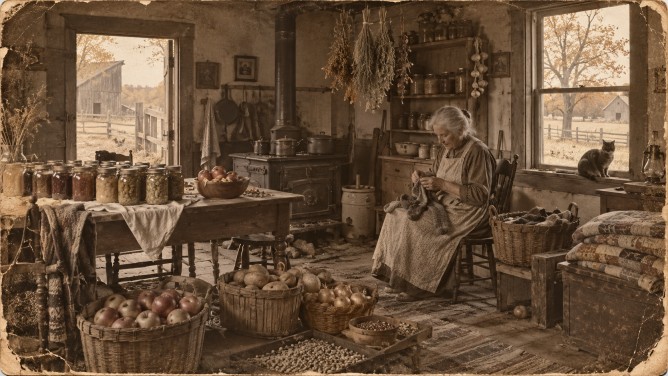
They canned and dried herbs. They sorted potatoes, patched shirts and coats, checked blankets, and saved seed. They rendered fat, made soap, dried beans, stored apples, mended socks, cleaned jars, and made sure that anything capable of being saved got saved.
Nobody called it preparedness. It was simply what September required.

The Work Started When The Harvest Came In
A good harvest created its own problem, because food does not preserve itself. Tomatoes softened. Beans dried on the vine. Apples bruised, corn molded if it was stored badly, meat spoiled, and herbs lost their strength when they sat out too long.
The women of the household had a short window to move all of that out of the field and into forms that might last until spring. It meant long days around a hot kitchen. Jars had to be washed. Vegetables were peeled and cut, fruit was cooked down, beans were shelled, and herbs were tied and hung. Cucumbers became pickles, cabbage became kraut, and apples became sauce, butter, vinegar, or dried slices on a string.
Nothing about that work was glamorous. It was repetitive, hot, and exhausting. But every jar cooling on the table was one more meal nobody would have to go find in January.
They Sorted Everything
One thing I admire about old household management is how little of it went into a single giant pile. Food was sorted, and the sorting carried real consequences.
The best potatoes were set aside for storage, damaged ones were used first, and seed potatoes were protected for next year. Good apples went into the cellar while bruised apples went into sauce, cider, or that evening’s supper. Beans were checked, onions were cured, and squash was inspected for soft spots before anything went into storage alongside it.
The same thinking applied to nearly everything else in the house. Use this now, store that, repair this one, save those for seed, feed the rest to the animals, and throw out anything that will spoil the crate around it.
That kind of judgment saved resources. We have refrigerators, freezers, supermarkets, and overnight delivery now, but the principle has not changed at all. A pantry lasts longer when somebody is paying attention to what needs to be used first.
The Sewing Basket Was Part Of Winter Preparation
Food was only half the work. Cold weather meant clothing had to be ready too, and a torn work shirt did not automatically become trash. Neither did a pair of socks with a hole worn through the heel.
Clothes were patched and buttons replaced. Socks were darned, coats inspected, and blankets repaired. Children’s clothing was handed down, altered, or let out wherever there was fabric to work with. A household could not casually replace everything that wore out, so somebody had to keep useful things useful.
That was often women’s work, and because it happened quietly at night beside a lamp or at the kitchen table, it was easy to underestimate. A patched coat still kept a child warm. A repaired blanket still covered a bed. That was preparedness too.
Herbs Had To Be Brought In Before Frost
Many households depended on herbs for cooking, teas, salves, and simple home remedies, and September was the time to bring in whatever was left. Mint, thyme, sage, yarrow, chamomile, and whatever else the family grew and knew how to use. The plants had to be cut, cleaned where necessary, bundled, dried properly, and kept away from moisture.
There was a great deal of practical knowledge hidden inside that simple work. Which plant was ready. Which part of it to harvest. Where it would dry without molding. How to store it so it lasted through winter.
A woman who had done this for forty years did not need an app to tell her any of it. She knew because somebody had taught her, and because she had repeated the work often enough that it lived in her hands. That kind of knowledge can disappear in a single generation.
They Looked For What The House Would Need Later
September was also a month for looking ahead. Was there enough soap, enough lamp oil, enough flour? Were the blankets clean and the stove ready for its first real fire? Did the children still have winter clothes that fit them? Was there enough feed for the animals, and were the jars, crocks, sacks, and bins still in good condition? Could the household sit through a three-day storm without needing to go anywhere?
Nobody had to call that an inventory. An experienced homemaker simply knew when the flour barrel felt too light. She knew how many jars were on the shelf without counting them, and she knew which child’s shoes would not survive another season. That awareness came from living close to everything the family used.
Waste Was A Failure They Could Not Afford
This may be the biggest lesson I take from those women. They respected resources in a way that is hard to find now.
A chicken carcass became broth. Old bread became another meal. Fabric became patches, fat became cooking grease or soap, and garden scraps fed the animals or went back into the soil. Jars were washed and used again. String was saved. Buttons were cut off clothing too far gone to repair.
They understood something our disposable economy has made easy to forget. Replacing something costs labor, and throwing food away means throwing away all the work that grew it. Preparedness starts to look different once you think that way. You buy more carefully, you maintain what you own, you rotate your food, you learn a few repairs, and you hesitate before deciding that something is useless.
Much Of Their Work Was Invisible
The strange thing is how rarely any of this made it into the family stories. Grandfather may be remembered for clearing the land, building the barn, hunting, or bringing in the harvest. Grandmother’s contribution usually sat quietly in the background of the same story.
The shirts were simply clean. The jars were simply full. The blankets were simply there, and the children somehow always had warm clothes. Meals kept appearing on the table. When somebody got sick, there was broth, clean bedding, tea, and a person who knew what to do next.
All of it looked ordinary because one woman had spent thousands of hours making sure it stayed ordinary. That kind of work is easy to overlook precisely because, when it is done well, nobody ever experiences a crisis.

We Can Still Learn From September
Most of us will never live the way our great-grandparents did, and I am not romanticizing it. I am thankful for refrigerators. I like washing machines. I appreciate grocery stores and modern medicine.
But I think we lost something real when we stopped treating the weeks between harvest and frost as a season of preparation. September is still a good month to walk through the house and take stock. Preserve what the garden gave you and rotate the pantry behind it. Dry your herbs. Check the winter clothes, repair what is torn, and inspect the blankets. Clean the equipment, put food away, and replace what is worn out before the cold arrives. Save something that would otherwise be thrown out, and teach a child one of those skills while your hands are already busy.
None of that will look impressive in a photograph. That may be exactly the point. The old women understood that a strong household gets built through hundreds of quiet jobs finished long before anybody desperately needs them. Winter arrived every single year, and their families were ready because somebody had been working on winter since September.






Read the full article here