




President Donald Trump’s Board of Peace is planning to spend just under $1 billion in funding for “peace and security” related projects inside the Gaza Strip, though it has yet to disarm Hamas, according to international officials and a funding proposal reviewed by the Washington Free Beacon.
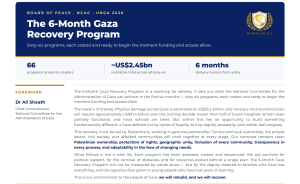
The board, along with members of the National Committee for the Administration of Gaza (NCAG)—the temporary body that is supposed to replace Hamas as Gaza’s ruler—pitched their reconstruction effort Wednesday morning to a room packed with diplomats and foreign leaders during the United Nations General Assembly meeting in New York City. Officials said they plan to spend approximately $2.45 billion in total over a six-month period on 66 separate projects that primarily encompass security and infrastructure, but also include line items like “human development” and “economic acceleration.”
The board currently has around $18 billion in commitments that are largely unspent, and is seeking more international partners who will front additional cash for a massive reconstruction effort that is ultimately estimated to cost $71 billion and is largely stalled. Hamas remains the dominant force in Gaza, has not made good on repeated promises to disarm, and Israel continues to carry out limited military operations in response to Hamas threats.
“The scope of the problem is immense,” said Major General Jasper Jeffers, who was appointed by the White House to serve as commander of the International Stabilization Force (ISF), the peacekeeping entity created under Trump’s 20-point Gaza peace plan. There remain “hundreds of miles of tunnels, numerous underground facilities, [and] tens of thousands of weapons,” he said, referring to the underground network of military bunkers and arms depots Hamas built throughout Gaza to fuel its war on Israel.
The ISF has yet to set foot in Gaza. Jeffers said his force of 50 international military leaders and an initial force of some 500 troops are “ready to deploy” in Gaza once on-the-ground access is permissible. The ISF is expected to grow exponentially in the coming months, encompassing thousands of soldiers from a host of nations. The future Gazan police force, meanwhile, has had over 250,000 applicants, some 19,000 of whom have been vetted and put through “initial training.” That force is meant to be comprised primarily of Palestinians who are not aligned with Hamas.
Jeffers expressed optimism that Gaza—a vast network of tunnels and bunkers full of weapons and militants—could be demilitarized. “For demilitarization, we’re working hard on a military technical plan that can be executed sector by sector” in Gaza, Jeffers said. Once forces enter a part of Gaza, “the weapons, the tunnels, all of the military infrastructure will be decommissioned or neutralized.”
Jeffers acknowledged that in certain cases “there will be weapons that won’t be able to be moved” and military leaders are currently crafting plans that will allow the new security force to “decommission” those types of arms.
“The intent,” he said, “is to neutralize and decommission.”
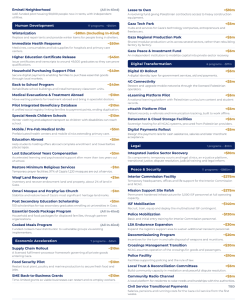
The six-month, $885 million peace and security funding proposal distributed to meeting participants requests $20 million for a “decommissioning program” that will provide “incentives for the turn-in and safe disposal of weapons and munitions.”
Another $10 million is slated for a “police facility” that will support “policing and the rule of law,” according to the proposal.
Another $275 million is proposed for an “interior commission facility” that will serve as a “temporary headquarters, office, and life support” for NCAG and other organizations. Another $275 million will be spent on a “mission support site” in Rafah that will become “permanent hardened infrastructure for 5,000 ISF personnel.” The ISF itself is slated to receive an initial $140 million to “recruit, train, equip and deploy the multinational ISF contingent.”
Hamas, however, has repeatedly signaled that disarmament is not on the table. The terror group emphasized at several junctures that it will not do so until a Palestinian state is formed, and its leader, Khaled Mashaal, said in February that armed resistance remains the priority.
“Criminalizing the resistance, its weapons, and those who carried it out is something we should not accept,” he said in Doha. “As long as there is occupation, there is resistance. Resistance is a right of peoples under occupation … something nations take pride in.”
Michael Rubin, director of policy analysis at the Middle East Forum think tank, said much of the discussion about Hamas disarming is “deja vu.”
“Sequencing matters. Hamas figures they can outlast Trump, and the Board of Peace is proving Hamas right,” Rubin said. “Every single time diplomats rationalize or excuse a failure of terrorist groups to disarm, the diplomatic initiative fails. If Trump doesn’t demand full Hamas disarmament, start the countdown to the next war.”
In a series of presentations during the event, board members talked up Hamas’s commitment “to fully disarm and relinquish governance.” The ultimate goal, officials said, is a “Gaza rebuilt by Gazans under one long-term plan.”
The board estimates around $35.2 billion in damage across Gaza and says the full “recovery and reconstruction will require approximately $71.4 billion over the coming decade.”
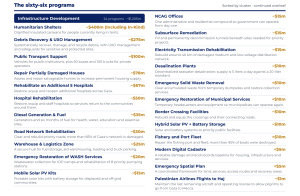
The six-month funding proposal also outlines 36 infrastructure projects that include around $400 million for “humanitarian shelters” and $78 million to “repair partially damaged houses.” Around $50 million is slated for “hospital rehabilitation” and another $67 million for rehabilitation of five hospitals, many of which were used by Hamas during the war to plan military operations, launch terrorist attacks, and torture Palestinian civilians. Much of Gaza, once tightly packed with apartment buildings, has been reduced to a wasteland of rubble that will likely cost tens of billions of dollars to clear and rebuild.
Other programs include “human development,” “economic acceleration,” and “digital transformation.”
Jared Kushner, the president’s son-in-law who helps manage the board, said that unlike past Gaza reconstruction projects, this one aims to be transparent and secure a generational shift in the way Gaza is run.
“The purpose of today was to be transparent to show everyone the work that’s been done over the last year,” he said. “A year ago none of this existed.”
“What you’ve seen is almost like the building of a really, really big startup,” Kushner explained. “I think we’re building something way more important than a company; we’re building something that is really a platform to enable the Palestinian people in Gaza to finally focus on improving their livelihoods and improving their lives, and for those who want to live in peace, to give them a chance to do so.”
Read the full article here