




I have heard it said that there is no way you are going to be able to survive a future catastrophe unless you own a home on a large lot in the suburbs, with a safe room, at a bare minimum. This was said on a radio show, by another preparedness expert, and the two other experts on the show agreed with him, and all three of them are all guys I respect. Although I respect them, I disagree with them. If this future catastrophe they were referring to is anything like past catastrophes, actual accounts given by survivors do not support their conclusion. In past catastrophes, many have survived even though they lived in urban areas, apartments, and all manner of living arrangements.
Assuming that the next catastrophe is of the sort that can be survived in place, rather than by bugging out, what you can do is be ready for it, and although most folks can’t afford a professionally installed bunker, you can gain many of the benefits for a modest investment and some elbow grease. I found myself in this situation when I bought my first home and I will share what I did to fortify two closets in my home to improve my chances against home intrusion.
What Kind of “Safe Room” Are We Building?
The term “safe room” gets used to describe rooms built to prepare for different threats: from tornado shelters to fallout shelters to shelters against home invasion. For our purposes, it’s a hardened area of the home that presents an obstacle to home invaders that provides hard cover for the occupants and buys them precious time to summon help, arm and armor themselves so they can have the best possible chance of either escaping, hiding, or fighting and surviving.
Most folks imagine the “safe room” as a bunker, a secret hidey hole in case they need to hide from a government run amok, a home invasion, severe weather event, earthquake, nuclear fallout, nuclear blast, or conventional bombs or mortars. In truth, most of these events require purpose-built shelters and specific placement within the home. This is not to say that a safe room cannot be a multipurpose shelter, to some extent, but some of these threats require that the room be located in different parts of the home. To survive nuclear fallout, the room should be as far away from the roof and exterior walls as possible and should have thick shielding, but in a home invasion, you want to be able to make a quick escape if the home invaders are persistent. If you are worried about storm surge, you want your shelter on an upper floor as opposed to the basement.
Harden the Exterior Doors and Windows of Your Home
The point of the safe room is to slow home invaders down and force them to make a huge racket getting into your home. That way, you become aware of them before they get in. This gives you time get into your safe room. Once you are there, they have to locate you and get in. That’s time you can use to wake up, call for help and arm and armor yourself.
Occasionally, someone does grab a pistol form the nightstand and shoot a home invader, but more often, they don’t have time, or the fine motor coordination to locate their handgun and put it to use. The adrenaline dump that occurs in a life-or-death situation robs them of their fine motor skills.
This is where the safe room comes in. In doesn’t take much fine motor coordination to jump out of bed and run for it. It also doesn’t take much fine motor coordination to jump out of bed, run into the closet, and shut the door … and that act buys you time and puts hard cover between you and the home invader.
To slow intruders down, I reinforced my doors and door frames. I installed plates around deadbolt locks, replaced the wood screws with longer ones, and installed hinge pins … all the standard stuff you do to make it take longer for someone to break in.
The next thing I did cost me several hundred dollars, but you can build it yourself if you have a welder and enough scrap metal. I installed security grates over the windows that released from the inside in case of fire, and security doors over the doors.
You can skip this step if you you lack the resources to do it, but I did it because intruders would probably resort to hooking heavy chains to the grates and ripping them off your house with a heavy truck. Doing that takes time and will make enough noise to raise the dead. You might even hear or see them hooking up the chains and get the party started before they’re ready.
Harden the Safe Room
What I had to work with was a closet under a stairway downstairs and walk-in closet upstairs. On the closet under the stairs, I cut a hatch to access the dead space and installed a shelf and a piece of trim to hide it. I installed magnets on the piece of drywall I cut out and metal plates on the wall to hold it in place. It was pretty primitive, but if you pushed on hard enough, it opened inward.
To create hard cover, I measured the spaces between the studs and poured concrete slabs which I reinforced with rebar. Hardware cloth would have been better, but you can use any scrap metal you have laying around in a pinch. The idea is that you want the concrete to hold together for as long as possible if someone starts shooting at it.
I stacked the blocks waist high in spaces between the studs, covered them with ballistic nylon, and held the slabs in place with steel stakes and metal strapping screwed to the studs. That way if a bullet made it through a stud between the slabs, hopefully the ¼” mild steel stake would stop it. If it didn’t stop it, it would at least slow it down and absorb a lot of energy. The nylon was there to help hold any pieces of concrete in place that got broken or turned to gravel by gunfire.
I also strapped slabs on the stairs and the closet sides, so once I was inside, I had a block wall to my back and was surrounded on three sides by steel reinforced concrete almost waist high. That is high enough if you crouch down.
If you can’t install hard cover in the walls, you can build it into furniture or doors. More about this later.
See Without Being Seen
To see out, I put a one-way mirror in a frame and hung that over a hole I cut in the wall. This enabled me to see out into the room. All a home invader would see is a mirror hanging on a wall
On the side of the stairs, I installed a slot in one of the stairs. They were carpeted, so I removed enough fiber so I could see out, but others couldn’t see in. Anybody heading up the stairs was in for a nasty surprise … or I could wait until they came back down and hit them from behind.
Today you could use cameras, but don’t overlook low-tech solutions as they tend to be more reliable.
Harden the Door and Door Frame
Replace the interior doors on the safe room with solid wood or steel exterior doors and give the hinges and hardware the same treatment and extra long screws that you installed on your exterior doors. In a wood-framed doorway, the screws need to go through the trim and deep into the wall studs.
If you can afford it, buy a bull-resistant door and install that, it’s way cheaper than a whole safe room. If you don’t have the money, you can use a trick I used in an apartment.
I hung a set of hooks over with tabs that hook over the top of the door. I countersunk two screws into the top of the door to hold it in place and installed it so the hooks were on the inside of the door. Then I hung two of the big old oversized surplus USMC Level IV plates, one above the other, from the hooks and strapped them down with nylon webbing and more countersunk screws so they wouldn’t swing or get moved my gunfire … not that a bullet would move them as they were pretty heavy.
When the door was closed it looked like any other closet door. All I had to do was roll out of bed, get behind that door and grab my shotgun. A home invader would think they’re shooting through a closet door, but in a crouch, two of those plates, one above the other, is enough to cover your vitals from head to groin. So, I made a door that would stop armor piercing rounds from a .30-06 for a little over $100.
Nowadays you could buy an exterior door you can disassemble and sandwich a few coated AR500 plates in it. Just be sure you know where they are, so you know where to stand.
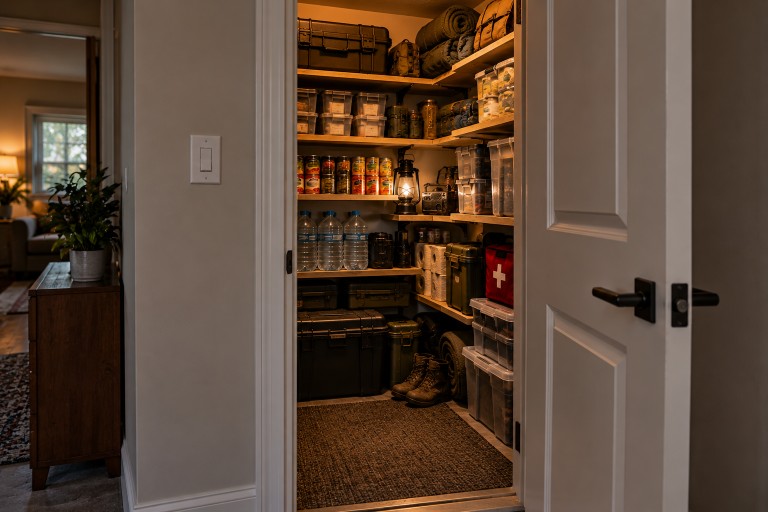
What to Stock It With
Since we’re talking safe room, I’ll list supplies for that, but you can easily modify the contents to meet your needs.
- Home Defense Pouch – A home defense pouch is essentially a battle belt in a waist pack. You can read more about them in this article. At a minimum, it should contain:
- Defensive Handgun
- Spare Magazines
- Tactical Flashlight
- Compact Combat Trauma Kit
- Knife
- Cellphone
- Less-lethal Option – ASP baton, pepper spray or Taser. Lethal force is not always the answer.
- Plate Carrier/Body Armor/Load Bearing Equipment – If you own body armor, you are going to want to be wearing it if you get in a gunfight.
- Shotgun – At ranges inside most homes and apartments, shotgun patterns with 00 or 000 buckshot are not very big, they have less risk of overpenetration than handguns and rifles and at close range, they are good at ending fights.
- Resupply Satchel – It always sucks to run out of ammunition, but it really sucks when someone’s shooting at you.
- Trauma Kit – You will have a small trauma kit in your home defense pouch or on your load bearing equipment, but who knows how many injuries will need to be treated, so it’s good to have a larger trauma kit nearby with several smaller “throw kits” that can be distributed as needed.
- Water and Food – Who knows how long you are going to be in your hidey hole? If they don’t find it, it could be a while so stock some drinking water and food that’s ready to eat.
- Light – Assume the power will be out. In addition to your tactical light, you’ll want a light with variable settings, a shroud, and red and white light. A low intensity red light isn’t as hard on your night vision and is harder to spot than white light.
- Phone – If it’s working, dial 9-1-1. They probably won’t get there in time for the fight, but they might be able to get you to a hospital before you bleed out.
- Radio – If your safe room is in a reinforced spot, it might also serve for other emergencies. If so, you may want a battery powered radio, so you’ll know when it’s safe to come out.
Summary
Choose the best interior space, harden it with simple reinforcements or furniture and stock it with water, food, light, first aid and other gear and supplies you probably already own.





Read the full article here