



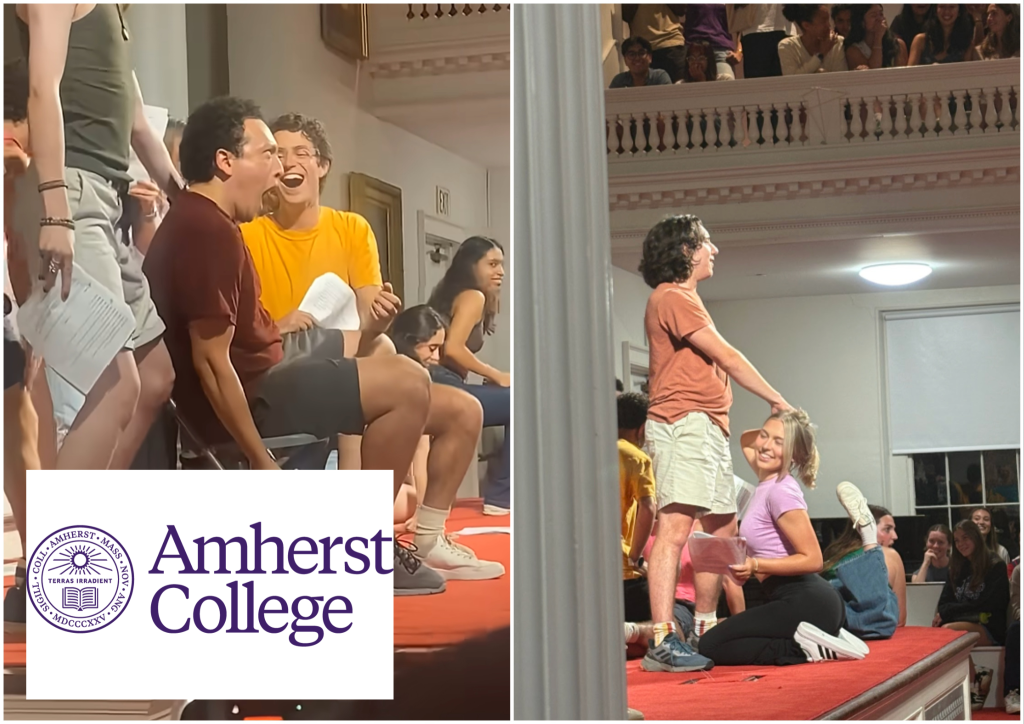
Amherst College is pressing the Washington Free Beacon to blur out the faces of students who performed mock sex acts in the college’s main chapel during an official orientation event. The $93,000-a-year college claims that the Free Beacon’s publication of videos of the performance led to “serious doxxing” and harassment. Amherst, which funds the event, has declined to say whether it will revise the program going forward.
Several days after the Free Beacon published a report on the performance in mid-December—and well after the racy photographs and videos had rocketed across in internet, including a New York Post article that described the sexual ceremony as “disgusting”—Amherst asked the Free Beacon to blur the faces of the students involved.
“I am writing to respectfully request that you consider blurring the faces of the participants in the videos and photos in the story about Amherst College that you ran last week,” Amherst’s director of communications, Caroline Hanna, wrote in an email to Washington Free Beacon editor in chief Eliana Johnson. “[B]lurring the faces will, we hope, make it a little harder for trolls and others to identify and harass the people in the videos.”
The Free Beacon will not modify the photographs or videos in question.
The request from Hanna, “she/her/hers,” came four days after Amherst’s dean of students, Angie Tissi-Galloway, told the student body in a Dec. 13 email that the school was “seeking the removal of the photos, videos, and alarming posts where possible” and “requesting corrections from media outlets that misreported the events in question.”
Asked about the time that lapsed between Tissi-Galloway’s email and Amherst’s outreach to the Free Beacon, Hanna said that the school had reached out to other media outlets that had reposted the Free Beacon’s videos before contacting the Free Beacon itself, though she did not explain why.
She also conceded that there were no errors in the Free Beacon report, authored by Amherst junior Jeb Allen, but said the school had requested corrections “from other outlets that subsequently misreported the Free Beacon story.” Hanna declined to say what corrections she had requested or from whom.
Amherst said it was making the request of the Free Beacon to protect students from unspecified “threats.” But when Allen—the president of Amherst’s only conservative student group—received a death threat last February from a fellow student, the college appears to have been less proactive about his safety.
The threat was posted on Fizz, a social media app for college students that allows them to post messages anonymously, in response to a different article Allen wrote for the college newspaper criticizing diversity programs. “[D]ragging jeb allen on fizz isn’t enough I need a— [gunshot],” the post read.
Allen alerted Amherst administrators to the threat and the college identified the student who made it. But instead of removing the student from campus, the school assured Allen that he was at no physical risk—a conclusion that appears to have been based on a single conversation in which the student apologized for wishing death on a classmate.
“I just met with that student and they were very apologetic and understood the harm behind their words,” a detective with the Amherst College Police Department, Cara Sullivan, emailed Allen on Feb. 20. “They have no intent of physically harming you and regret posting that about you.”
Allen forwarded the email to Amherst’s dean of students, Tissi-Galloway, and said that he was “not reassured” by the secondhand apology, adding that he wanted “there to be much further action.”
“I feel unsafe having the same student on campus that incited violence and posted that I should be killed yesterday,” he wrote. “I don’t care if they are deeply apologetic … and am concerned that this is being treated as nothing.”
His pleas fell on deaf ears. Amherst told Allen on Feb. 24 that the college’s “Threat Assessment Team” had not recommended “any interim measures or removal from campus,” citing a lack of “data to suggest an immediate threat.”
The student, who was not identified by name in the emails, was required to “[w]rite a response to a publicly available conservative viewpoint related to DEI policy,” according to an email Amherst officials sent to Allen in April. She also had to “[c]omplete a research project that aims to identify meaningful ways of engaging community and talking across differences.”
As part of that project, the student was encouraged to consult with staff at the school’s “Center for Restorative Practices.”
Hanna, the school’s director of communications, declined to say whether the school had imposed any other sanctions. She referred the Free Beacon to a series of articles in which Allen claims to have asked Amherst to go easy on the student, stating that “the accountability preferences of any aggrieved individuals are taken into account.”
Hanna declined to elaborate on the role student opinion plays in the disciplinary process, particularly when it involves security threats.
The episode highlights how Amherst—one of the most expensive and selective liberal arts colleges in the country—has held a conservative gadfly to wildly different standards than it applied to his progressive peers.
The student who threatened Allen was not barred from contacting him. But Allen, a member of Amherst’s football team, was slapped with a no-communication order after a separate student—with whom he had never spoken—accused the team of “white fragility” and said they had harassed her by viewing her public Instagram story, according to an essay Allen published last year.
The school told Allen in an email that the order did not constitute a formal sanction and that “there is no active College complaint against you.”
Amherst is now refusing to comment on whether it will sanction Allen for his Free Beacon report. A student government petition signed by more than 750 students—including at least one member of the student government, who was caught on video performing a mock sex act—has called on the college to discipline him for “intentionally spreading misinformation” and casting “our traditions in a false light.”
Amherst said it offered all students, including Allen, “support” in the wake of the brouhaha in December. Thus far Allen has received one message from the administration regarding his report: an email from his class dean—former Faculty Equity and Inclusion officer Ivan Contreras—offering to meet if fallout from the article “affects your academics.”
“We are aware of this morning’s reporting in the Washington Free Beacon and the New York Post about orientation programming that you wrote,” Contreras said. “We are aware that this will likely generate discourse from the student community.”
Read the full article here