





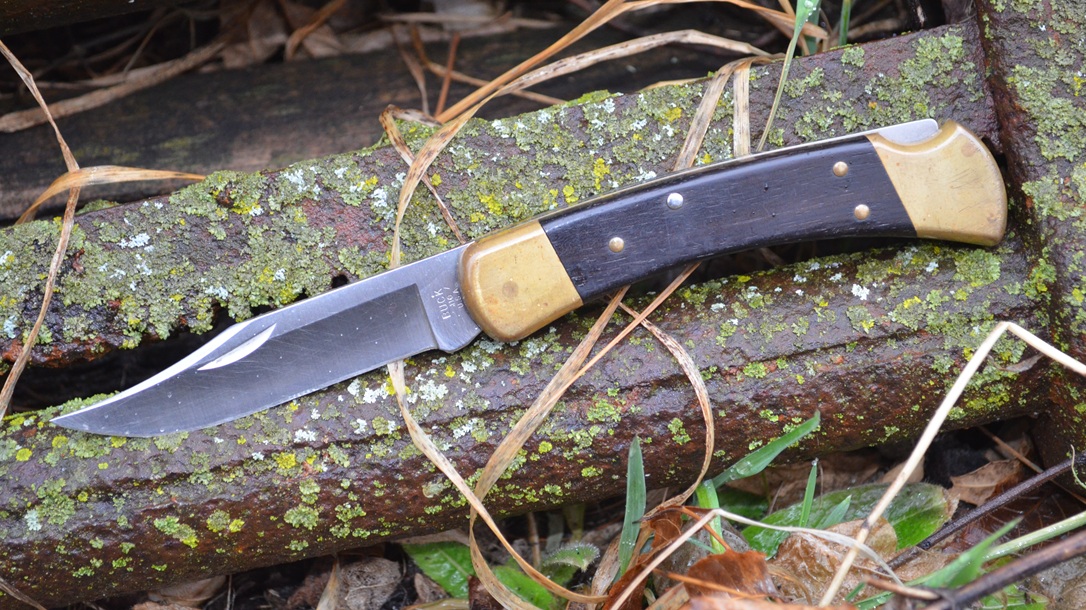
When I was growing up back in the 70s and 80s, everyone knew what you meant when you talked about a Buck knife. Whether it bore the Buck logo or not, if it was a lockback folding knife with a dark wood handle and brass (or brass-like) bolsters, that’s what it was called. Of course, there’s only one actual Buck 110 Folding Hunter, along with a bazillion imitations, counterfeits, and clones.
The Original Buck 110 Folder
Back in the day, you could find any number of those fakes at flea markets, most of ‘em stamped Pakistan on the blade. Comparing one of them to a bona fide 110, you knew right away which one was real.
But it’s telling about the quality and craftsmanship when a single knife becomes synonymous with an entire niche.
Advertisement — Continue Reading Below
Buck 110 Specs
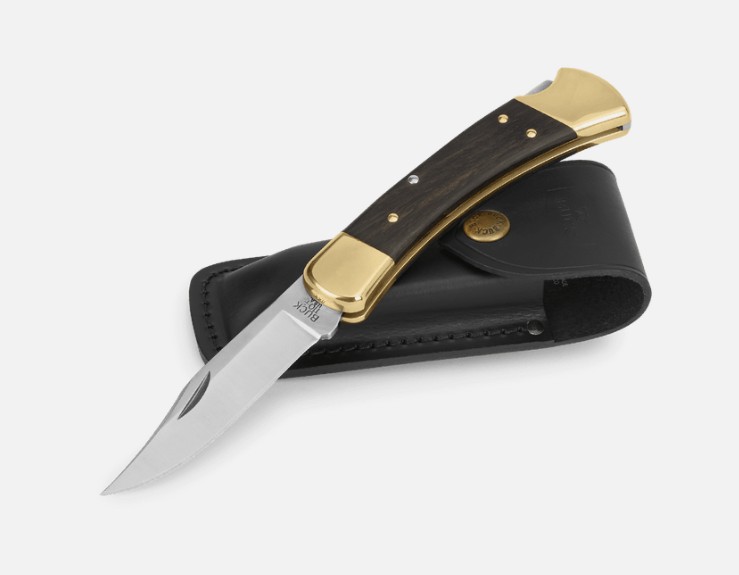
The Buck 110 isn’t a small knife. Open, it has an overall length of about 8.6 inches. The blade is 3.75 inches long. Closed, it’s 4.875 inches. It’s on the heavy side, around 7.2 ounces. To be honest, if you’re more accustomed to carrying a Swiss Army Knife, the Buck might seem like overkill.
This is a lockback knife. When the blade is fully deployed, it locks in place. The release is found on the back of the handle, near the butt end.
Advertisement — Continue Reading Below
The standard Buck 110 comes with a leather belt pouch. When I was in high school, I usually carried my knife in the right side back pocket of my jeans. By the time this carry method wore holes in the pocket, it was time to get a new pair of jeans.
I went to a fairly small, somewhat rural high school in the 1980s, and many of us carried pocket knives, with the Buck 110 being one of the most common. I can recall several occasions where a teacher would ask to borrow my knife to cut open a box or something.
Advertisement — Continue Reading Below
It’s big, and it’s heavy as far as folding knives go. The thing is, the knife has a solidity that many folders lack. It has substance, and the weight isn’t just ounces but reputation. This knife has been used by generations of hard-working folks, and it hasn’t changed a whole lot since it debuted in 1964. The steel has changed, but the iconic design is fairly close to the same.
Buck 110 Variants
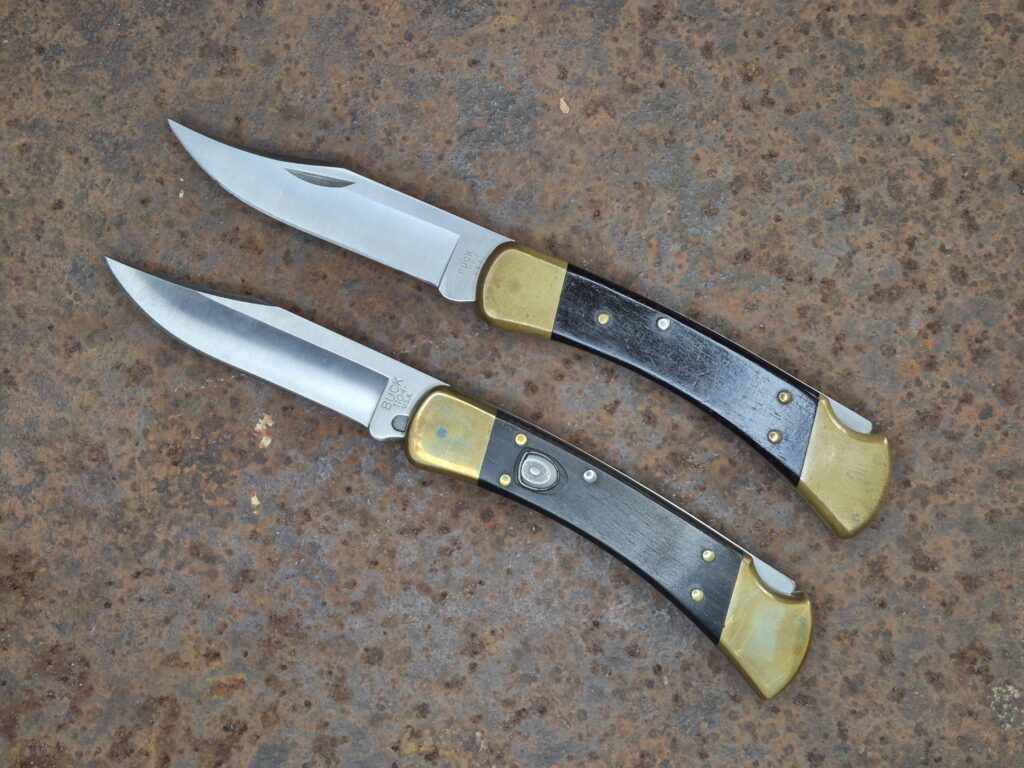
Over the years, Buck has come out with several variations on the 110 theme. The Slim and LT models use nylon handle construction to cut some of the weight. While the classic 110 has a clip point blade profile, there is also a drop point blade model that debuted a while back.
Advertisement — Continue Reading Below
The Buck 110 Auto is virtually identical to the classic 110 in terms of size.
Growing up, we’d hear stories about how some older cousin of a friend of a friend had converted their Buck 110 into a switchblade. Of course, few of these were ever actually seen, so they were just legends that got passed around. Until 2017, when Buck Knives unveiled the Buck 110 Auto at SHOT Show. This fully automatic version of the classic folding knife proved to be quite popular. A year later, they added the Buck 110 Auto Elite to the mix, upgrading the materials all around.
Buck 110 and EDC
There’s a reason why it’s such a popular EDC option. It just plain works. I’ve always looked at Buck as being a working man’s knife brand. Sure, they have some pretty fancy models with all sorts of bells and whistles. At the end of the day, though, the Buck 110 is exactly what you need to get virtually any job done.
Advertisement — Continue Reading Below
Read the full article here