





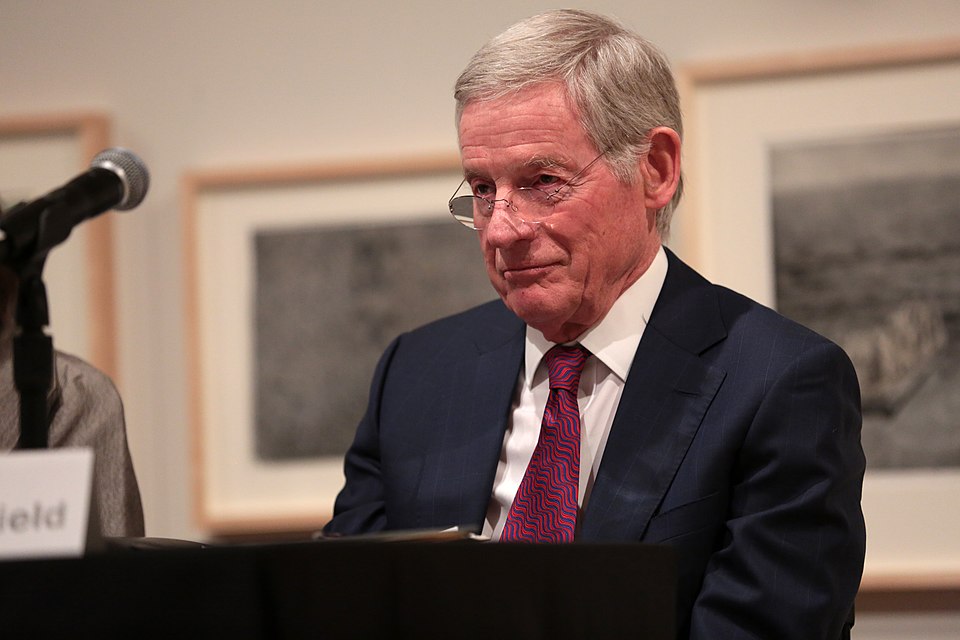
At age 93, the magisterial Harvey Mansfield of Harvard has given us a splendid new book, The Rise and Fall of Rational Control. The title will be perplexing to most people. “What is ‘rational control’?” they will ask. And “how can such a thing, whatever it is, ‘rise and fall’?” Professor Mansfield provides a hint in the work’s subtitle: “The History of Modern Political Philosophy.”
Mansfield’s thesis is that modernity, at least in the intellectual domain, the domain of thought, has a determinate beginning—indeed it has a founder. It begins with the late 15th- and early 16th-century Florentine thinker Niccolo Machiavelli—”Old Nick,” as Mansfield cleverly refers to him in a subtle pun (“Old Nick” being a nickname in Christian tradition for the Devil). Machiavelli scandalized the devout in his own time, as he does in ours, by his defense—indeed his advocacy—of the necessity of resorting to injustice and other types of evildoing (what Mansfield refers to as “dirty tricks”) for reasons of state.
Machiavelli’s break with his ancient and medieval predecessors, who had invented political philosophy and directed it to understanding justice so that justice could be done—what Mansfield describes as Machiavelli’s “revolution”—must be understood as going deeper, though, than his pragmatic immoralism. It is, Mansfield teaches, about the very role of reason (thought, reflection) in human affairs. Machiavelli introduces the novel idea of rational control: “reason is to be used not merely to understand our problems but to control them.” In other words, reason’s role is fundamentally instrumental. It is to enable us to be “effective” in solving problems, fixing things, getting stuff done, obtaining what we want.
As Mansfield points out, “rational control’’ is, for us today, most evident in biology (and medicine), chemistry, physics, and the other natural sciences, and in social sciences, such as economics, sociology, and “political science,” that model themselves on and ape the methods of the modern natural sciences. He notes, though, that it all began with Machiavelli’s “invention of the idea” and his introduction of it into thinking about politics.
If Mansfield is right, and I myself find his analysis persuasive, Machiavelli’s project—his revolution—was to overthrow the tradition that went from figures such as Socrates, Plato, Aristotle, and Cicero forward to St. Thomas Aquinas, a tradition dedicated to figuring out what the right thing to do is so that one can do it and do it because it’s the right thing to do (what Mansfield calls “classical justice”), and replace it with a kind of proto-pragmatism. That’s what rational control is in the domain of government or statesmanship. It is “improving things” by means that are most likely to be “effectual”—even if they are “dirty tricks.”
Each of the eight chapters of The Rise and Fall of Rational Control is devoted to the intensive study of a major figure in modern political philosophy, beginning with Old Nick himself. The other seven are considered in relation to him and his revolution. Some are presented as fundamentally working within the Machiavellian paradigm—they are, in one sense or another, rational control theorists: Hobbes, Locke, Rousseau (with qualifications having to do with his introduction of history into the idea of reason), Kant, and Hegel. The two others—Marx and, especially, Nietzsche—while not escaping the paradigm, are presented as questioning it or pushing against it. This is not to say that any of these figures share Machiavelli’s political philosophy or would advise princes as Old Nick would advise them. But they are operating in the intellectual framework (“modernity”) that he, above all others, secured in place. They are, in a sense, proceeding on the basis of his fundamental assumptions about nature and role of reason, not those of, say, Aristotle or Aquinas.
It would be merely tedious to ask why, say, Hegel was chosen for inclusion, but Burke was not, or why Kant and not Montesquieu or Mill. Authors of works such as this one need to make choices, and Mansfield’s are perfectly reasonable. Of course, one would love to see his analysis in this context of other notable political philosophers, but takers of his cues can without much difficulty work out for themselves what a Mansfieldian analysis of, say, Burke or Montesquieu or Mill would look like.
The origins of The Rise and Fall of Rational Control are interesting and, indeed, noteworthy. Every other year for 54 years, until his retirement in 2023, Professor Mansfield taught the course on the History of Modern Political Philosophy in Harvard’s Department of Government. In alternate years, another professor in the department was assigned the course. (There were many over the decades, including my friends Michael Sandel and Peter Berkowitz.) In the years Mansfield taught it, he developed the lectures that have now been published in the form of this book. They have been road-tested, as it were, on generations of Harvard undergraduates. The reader will be struck—I certainly was—by how refined they are. Well, they are refined because he refined them over half a century.
Every chapter is penetrating and illuminating. To me, though, the most important chapters are the first—on Machiavelli—and the last—on Nietzsche. In Mansfield’s telling, Nietzsche, though modern, brings down the curtain on modernity. It is he, who by undercutting the key assumptions of rational control, while not fully escaping them himself, ushers in postmodernity and postmodernism. Even more than Marx, Nietzsche calls modern liberalism (what we might call “rational control liberalism”) and the political order bearing its name radically into question, setting the stage for the irrationalism, the “eclipse of reason”—even in the instrumentalized modern sense of “reason”—that was to come in the 20th and 21st centuries.
Mansfield’s ambitions in The Rise and Fall of Rational Control are fundamentally descriptive. He’s offering a history rather than proposing a moral and political philosophy of his own or recommending one. Still, he doesn’t leave us in doubt about what he believes to be the best way forward in a post-postmodern intellectual world. In the spirit of the late Leo Strauss, who Mansfield identifies as “the inspiration for my thinking and the source of many particular insights in the transcripts of courses he gave at the University of Chicago,” he calls, in the end, for a return to the premodern—the classical and medieval—thinkers and their richer, less instrumentalized understanding of reason.
Mansfield does not, however, give up on liberalism or even, in a sweeping sense, “rational control.” Rather, he calls for a “liberalism” in which “the exercise of rights calls upon one’s sense of honor, rather than gain, and thus for virtue rather than survival.” And he concludes that to pursue this more robustly rational “liberalism,” we need to return to Tocqueville’s Democracy in America and Aristotle’s Ethics. What’s more, he urges us to “fix our attention” on the American Constitution “as a model for modern liberal government.”
To all that, I—a student of Harvey Mansfield, though I never sat in his classroom—say “Amen.”
The Rise and Fall of Rational Control: The History of Modern Political Philosophy
by Harvey C. Mansfield
Belknap Press, 336 pp., $35
Robert P. George is McCormick Professor of Jurisprudence at Princeton University.
The post Do the Ends No Longer Justify the Means? appeared first on .
Read the full article here