




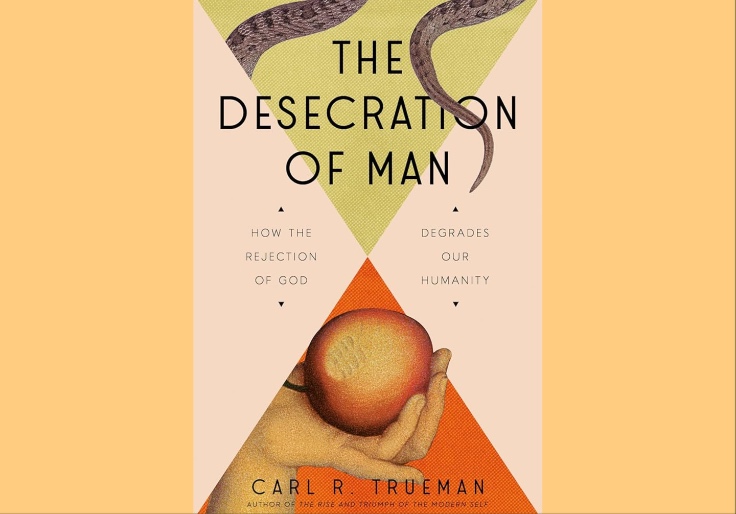
In this compact, highly readable book treating issues about which he has also written elsewhere, Carl Trueman examines how it is that, at least on his telling, our world has become one in which limits are no longer meaningful moral boundaries but, rather, obstacles to be overcome. What we have lost, he says, is the sense that every human being is made in the image of God. But it is not as if this belief has just slipped away gradually, no longer making sense in a disenchanted world. Trueman’s claim is stronger. Our culture now takes delight in surpassing and setting aside old limits that were thought to characterize our humanity. The problem is not disenchantment but desecration—the transgressing of older moral limits.
Although the book begins with several chapters that seek to explain how we have come to this point, it may be helpful to begin with later chapters that discuss some of the ways in which the image of God in humanity has been set aside. Unsurprisingly, near the top of the list is the sexual revolution. “The idea that all are made in the image of God places upon each person the obligation to treat others as persons, as those intrinsically worthy of acknowledgment as subjects, as ends in themselves.” And this, Trueman argues, is precisely what has been lost in the way many in our culture now think about sexual activity. It used to be thought, as Christian tradition had taught, that the sexual relation between a man and a woman was one in which each answered to deep human needs of the other—and that their mutual self-giving might, in the providence of God, also gives rise to the next generation. Thus, there was important human meaning in the sexual relation—meaning so central to human life that it needed to be embedded in and protected by the covenant of marriage.
When, however, sex becomes largely recreational, the satisfaction simply of individual desire, it turns out to undermine itself. Trueman unpacks several ways in which this has happened, first in the changing relation between men and women, and then more generally in our political life. The end result, he believes, is that what “promises to liberate us as individual agents … ends up creating a world where we are doomed to experience life as objects,” rather than as those who are “ends in themselves.”
Something similar happens to the children who are produced in a world that constantly seeks to overcome older moral limits. Although these children will generally be loved and prized, they nevertheless become “things that can be treated as commodities.” In a world where assisted reproduction has become increasingly common, what was once called and thought of as procreation has now become something rather different—reproduction, manufacture. Prior to the development of assisted reproduction technologies, conception of a child was always “somewhat beyond the control of the participants” and “could not be willed.” If the self-giving of a man and woman to each other in coitus resulted in the conception and birth of a child, that child was not a product they had planned but, rather, a blessing bestowed on their mutual self-giving. Assisted reproductive technologies change that.
Even more striking is the fact that, with the advent of in vitro fertilization, sexual intercourse between a man and a woman is no longer necessary for the creation of a child. And, increasingly, children can be made to order. Pre-implantation diagnosis of embryos can weed out and discard those that may carry inheritable, undesired defects. One might even argue that if the production of children is increasingly to take the form of manufacture, it would be irresponsible not to engage in a kind of quality control. “Things that are made can be made to order. And who wants to settle for second best?” This makes clear why Trueman believes the image of God in human beings has been desecrated. Assisted reproduction is a striking demonstration of human power over nature, shattering old limits that had once seemed fixed. But, conversely, the result is that these newly created human beings become “just one more commodity that can be produced on demand. We have desecrated ourselves.”
As at the beginning of life, so also at its ending. On the one hand, Trueman suggests, as have many others, that our society has sought to hide death, “shunting it from the home to hospice and the hospital.” (This is, I think, something of an overstatement. At least at its best, hospice is not an attempt to hide death but to enable us to face it and deal with it in a way that respects and honors our humanity.) On the other hand, and closer to Trueman’s central concern, death is “domesticated” when we treat assistance in dying as just another form of medical care for those who are disabled or depressed. The language of rights, so common now in our public discourse, is used to undergird appeals to both assisted suicide and euthanasia. We are on the verge of losing the sense that a funeral is a place “to acknowledge our weakness and our fragility and our common mortality.”
The opening chapters of the book, more philosophical in character, seek to explain how it is that our society has come to this point. Trueman’s account underscores two changes in what, following Charles Taylor, he calls “the social imaginary” (the untheoretical ways in which ordinary people imagine their everyday world). The first is that striking advances in technology have brought us to the point where the human body can be reshaped in accordance with our desires. The second is the expressive individualism that encourages us to liberate ourselves from natural “givens” or moral boundaries.
Trueman paints with a broad brush here, but his basic point is clear. In refusing to recognize traditional moral boundaries, in thinking of the body as raw material to be reshaped in accordance with our desires, we are turning against the idea that human beings are made in the image of God. The claim is not hard to understand, and there is surely something to it. Nevertheless, “image of God” language, though largely undefined by Trueman, is doing a lot of work here. When he does unpack the language, it often sounds at least as Kantian (human beings as “ends in themselves”) as biblical. Perhaps, though, he believes that these languages meet and concur in believing that our humanity has been degraded by some of the changes discussed above.
In the face of such desecration of our humanity, how should we respond? “Go to church and worship” is a very simple way to characterize Trueman’s recommendation. I do not say this to make light of it, for his is actually a very serious response. If desecration is our current condition and our problem, what we need is reconsecration. That is what the Church offers in its creed, cult, and code. The beliefs confessed in its ancient creeds, the communal life given shape in the Church’s liturgical worship, and the understanding of what it means to be human articulated in its moral code combine to tell a story that gives “a comprehensible shape to the world” and thereby, he suggests, may begin to reconsecrate the Christian understanding of what it means to be human.
The Desecration of Man: How the Rejection of God Degrades Our Humanity
by Carl Trueman
Sentinel, 256 pp., $29
Gilbert Meilaender is a senior research professor at Valparaiso University.
Read the full article here