


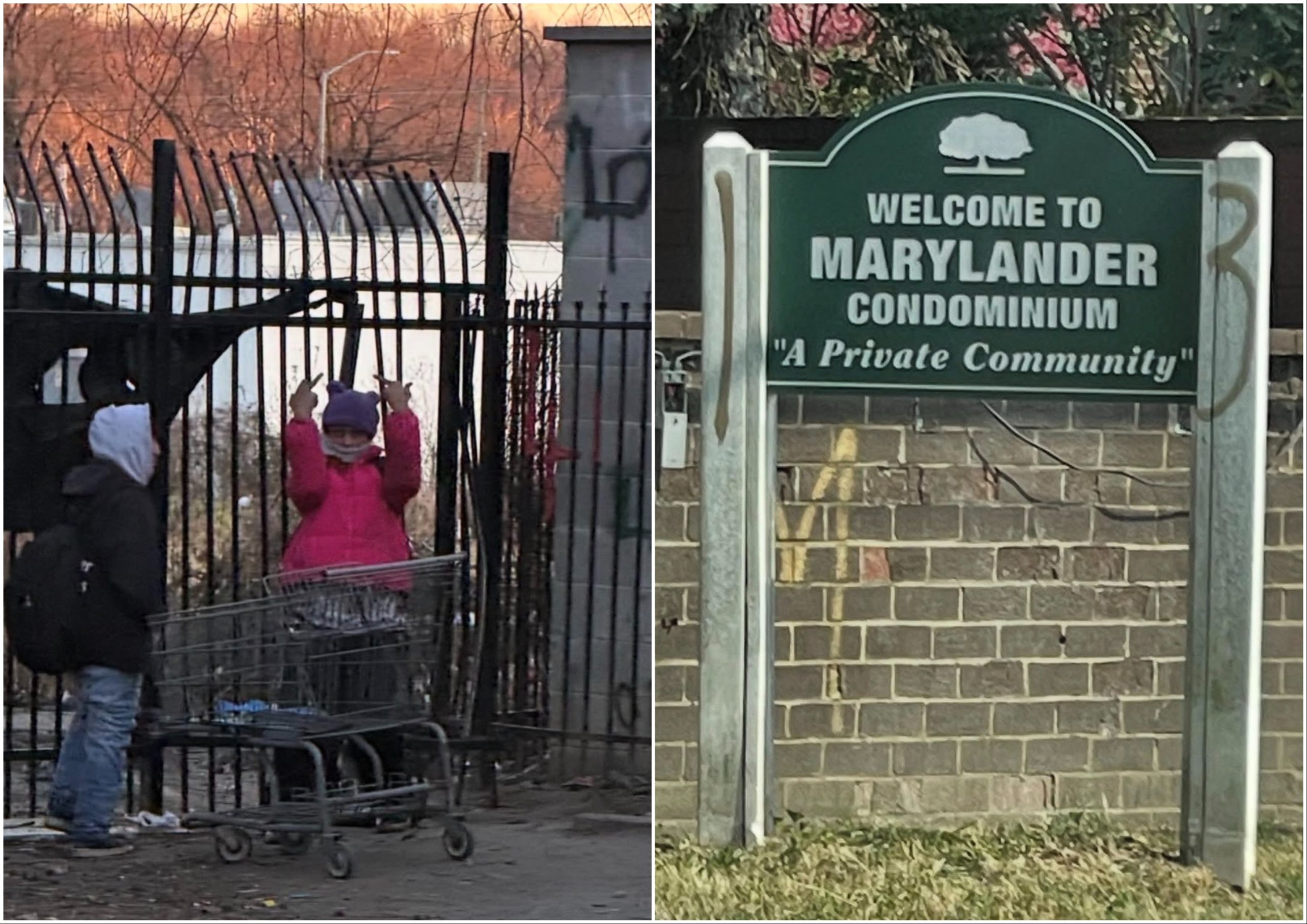
HYATTSVILLE, Md.—The Marylander Condominiums are in limbo after residents of a nearby homeless encampment allegedly vandalized the boiler room, leaving half of the complex without heat and under evacuation orders from a local judge. Some families have already fled to hotels in order to escape the cold. Other residents of the condominium, located in Prince George’s County, Md., could be evicted at any time.
The encampment, though, is still going strong. And unlike the moribund condominium, it is getting plenty of help from private charities.
The Washington Free Beacon identified nearly a dozen church groups, activists, and local businesses that deliver food to the camp on a regular basis. The meals are distributed at the entrance of the encampment, in the parking lot of a nearby McDonald’s, without any pushback from the county, which runs its own on-site delivery program through the Department of Social Services.
The victims of that humanitarian free-for-all have been the condo’s law-abiding residents, many of them low-income minorities. Property managers say the steady supply of food encourages the homeless to remain behind the complex, which has sustained so much damage from the encampment that many condo-owners are on the brink of homelessness themselves.
“If private or faith-based groups are distributing aid absent coordination with enforcement and housing authorities, such actions may inadvertently contribute to the camp’s permanence,” said Phil Dawit, the managing director of Quasar Real Estate, the condo’s property management firm. “Compassion without coordination can unintentionally entrench unsafe conditions—both for individuals living in the camp and for neighboring residents who have experienced repeated trespassing, property damage, drug activity, and criminal conduct.”
This story is based on video footage of food deliveries, social media posts by local activists, and interviews with camp residents. It sheds new light on the constellation of forces, public and private, that have enabled the encampment, even after the county’s half-hearted and unsuccessful attempts to clear it.
Authorities tore down most of the structures in late January ahead of a town hall meeting with condo residents. But when the Free Beacon visited the Marylander on Feb. 21, at 5:30 p.m., nearly 40 people had returned to the area and begun rebuilding the camp.
The reconstruction has been eased by what one homeless person described as daily food deliveries to the camp. In the past two months alone, the camp has received meals from a laundry service, a tax preparation firm, two chicken restaurants, and at least three different churches, one of which distributes “care kits” to people on the street. The kits, produced by Maryland’s Union Church, include granola bars and QR codes for the church’s website.
As this reporter opened one kit, a homeless man sat three feet away smoking crack. He had received a full meal earlier that day from a local TikTok influencer, “Alberto,” who frequently posts videos of himself delivering food to the encampment. Several videos thank churches or businesses for their donations, providing a granular look at the charitable network feeding the camp.
The Free Beacon was unable to identify Alberto’s last name but reached out to him via TikTok. Neither he nor Union Church responded to requests for comment.
At least a few meals have also come from the county, which has been known to deliver food to the camp through social workers and police officers. One homeless man claimed that two police officers had dropped off “cookies” and “candies” to the camp as recently as Feb. 17—two days before a judge authorized the county sheriff to evict residents of the Marylander—and that the officers indicated they would “come back for more.”
Chris Barber, whose family has owned a unit at the Marylander for more than 40 years, said he was at a loss for words.
“County police are basically catering to the homeless more than us as homeowners,” Barber said. “We pay our condo fees and property taxes, and what do we get? Just a community hearing.”
A spokesman for Prince George’s County Police Department, Brian Fischer, denied that any officers had delivered food to the camp, attributing the Feb. 17 delivery to “an organization that feeds the homeless, not us.” Asked to name the organization, Fischer said he had “no idea” what it was.
No matter who delivered food that day, residents of the camp say that the lion’s share of deliveries comes from churches rather than the state. The dynamic raises a troubling question about the tension between private charity and public accountability: What happens when Good Samaritans, operating without democratic oversight, pit one group of vulnerable people against another?
“This is not a debate about whether individuals are hungry or in need,” Dawit said. “The issue before us is that an unmanaged encampment operating steps from residential buildings has produced documented public safety consequences and measurable harm to families.”
The camp’s resilience reflects what critics say is the potential of street feeding to keep homeless people on the street. It’s not just that food deliveries “incentivize the unhoused population to return,” as police told property managers in December. Service providers also flock to encampments because they are an efficient way to reach homeless people, who show up in greater numbers once they hear about the food.
The result is a self-reinforcing equilibrium that makes camps even more attractive to charities, said Judge Glock, a senior fellow at the Manhattan Institute. With food delivered to their doorsteps, campers have less incentive to go to shelters that provide more comprehensive support.
“A lot of people are subsisting almost entirely off free meals in these encampments, who would otherwise be getting free food in a shelter,” Glock said.
Academic research bears this out. A 2014 study by the University of California, Los Angeles’s Chris Herring analyzed the “adaptive strategies” of 12 homeless encampments in eight cities. It found that “church groups and charities would begin serving food within the camps” once they reached a critical mass, which “would then lead to greater numbers of campers and even greater provision of services” as people realized that “congregation improved access to food.”
“[C]amps organized through toleration often create … ‘service-dependent ghettos,'” Herring wrote. “[A]reas with concentrations of socially marginal people … once in place, tend to be reinforced.”
That dynamic is one reason cities tolerate encampments to begin with. When budgets are tight or shelter beds scarce, officials can count on church groups, charities, and other non-governmental organizations to intervene, effectively offloading service provision to the private sector.
“[C]ity officials have come to regard [camps] as innovative cost-efficient and even humane policy solutions,” Herring wrote in a 2015 paper. In 2013, for example, Seattle’s Department of Planning and Development described tent cities as a “lower cost alternative to more permanent and costly housing options.”
It is not clear if such thinking influenced Prince George’s County’s approach to the camp. But the county faces the sort of resource constraints that have spurred other regions to embrace tent cities as an ersatz form of welfare.
One county housing plan states that “resources are extremely tight and are not available to meet the long-term housing needs” of homeless adults without children, and shelters for families are typically at capacity.
The camp’s residents say they are not interested in shelters anyway. Most are addicted to substances that are not allowed in shelters, and drug dealers flock to the encampment for the same reason charities do: a large concentration of potential clients.
One camp resident said the influx of drugs made it hard to stop her homeless neighbors from harassing the condo.
“We try to control this,” she told the Free Beacon. But “I can’t control fentanyl. I cannot hide the sun with one finger.”
Read the full article here