



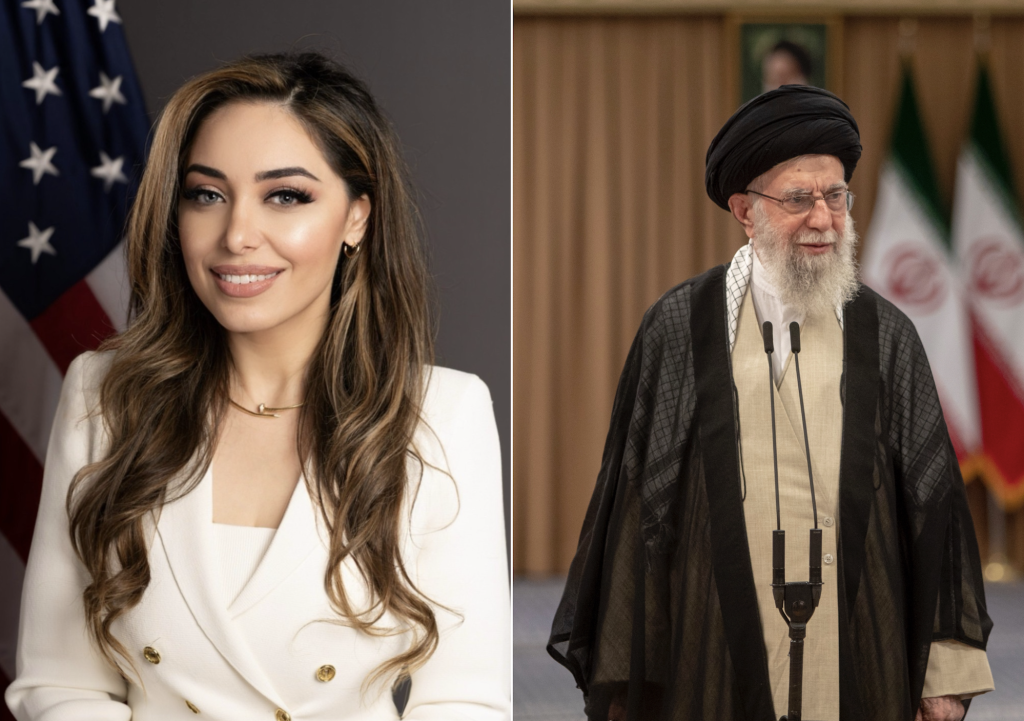
The Iranian regime is waging an online disinformation campaign against the Trump administration’s most senior-ranking Persian-American official, Mora Namdar, painting her as a pro-regime stooge and opponent of the dissident movement, according to four administration sources briefed on the matter and a Washington Free Beacon review of social media posts and accounts. The operation, the sources said, is meant to sow discord within the State Department and the Iranian dissident community at a time when the hardline regime is fighting to stay in power.
Several small X accounts began accusing Namdar—then the Near Eastern Affairs agency’s senior bureau official—of serving as an Iranian regime spy within the Trump administration late last year. Their campaign metastasized across X, Instagram, and other social media sites in the ensuing months as Namdar transitioned into her current role as assistant secretary of state for consular affairs, a position that allows her to restrict U.S. visas for Iranian regime allies. The cyber operation, one senior Trump administration official said, is a clear bid by the Iranian regime to tarnish Namdar’s reputation and “take her off the board.”
“This has all the hallmarks of an IRGC disinfo op across social media platforms meant to sow discord in admin and among dissident and anti-regime communities,” the official told the Free Beacon. “It’s clearly meant to divide. We’ve seen this before. Their fingerprints are all over this.”
The “bot armies,” which the administration believes are controlled by the Iranian state apparatus, have attempted to paint Namdar and other U.S. officials of Middle Eastern descent as Islamic Republic agents, enemies of popular opposition figure and son of the last shah of Iran, Reza Pahlavi, and even Kurdish separatists. The allegations have gained traction within the Iranian dissident community, suggesting that Tehran has found success in creating chaos among the wide swath of groups that would like the hardline regime to fall.
News of the cyber operation comes after a weekslong protest movement that rocked the Iranian regime and a deadly response from the government that saw the Islamic Republic kill as many as 30,000. During the uprising, Pahlavi emerged as a figurehead in the West for the opposition to the regime, leading Tehran to launch a separate online campaign aimed at discrediting him. While President Donald Trump engages in negotiations with Iranian leaders and weighs a potential military strike—with large amounts of U.S. military assets in the region—the regime has attempted to create chaos among the opposition to use as a life raft.
Officials first spotted the smear campaign in mid-November, when an X account purportedly affiliated with the Pahlavi movement, @Gmod_irian, published a lengthy diatribe accusing Namdar of using her senior role at the State Department to undermine Iranian dissidents fighting the regime. While that account poses online as an anti-regime activist, open source information confirmed by Trump administration officials indicates that its owner is an Islamic Republic affiliate.
The post alleged that Namdar hijacked the State Department’s official Farsi-language account to boost Iranian regime officials and paint their reformist opponents as a “benign opposition.”
“The point of connection” in this supposed plot, the account said, is Namdar, who also held senior roles in the first Trump administration within the State Department and U.S. Agency for Global Media. Her goal, the post claimed, is the “complete elimination of nationalists and real opposition.”
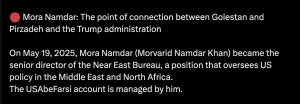
A senior Trump administration official briefed on the situation said many of the accounts involved “are Iran regime operatives posing as opposition—in this case monarchists—to divide and conquer.”
In the months following the initial post, the allegations ricocheted across online corners of the dissident community, bolstered by a network of bots controlled by the Iranian regime. They cast Namdar as a leading anti-opposition voice who planted sympathizers at U.S. government agencies to hamper Western support for Pahlavi and other opponents of the Islamic Republic. The accounts also spread false claims that Namdar—a Texas native of Persian descent—is “Iranian Kurdish” born, with some even using AI to place her standing in front of a Kurdish flag.
Other posts claim Namdar is using her role at the State Department to pursue regime-friendly policies.
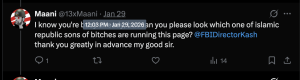
“It is suspected that a reformist from the body of the Islamic Republic has infiltrated it,” one X account claimed in late January, sparking bizarre calls from others for the FBI to “look which one of islamic republic sons of bitches are running this page.”
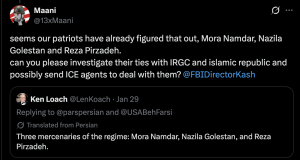
“Seems our patriots have already figured that out” that Namdar is behind the effort, another account wrote on a thread tagging the FBI. “Can you please investigate their ties with IRGC and islamic republic and possibly send ICE agents to deal with them.”
As a Trump administration official told the Free Beacon, the attacks have no basis in fact.
“These attacks against Mora are 100 percent false and completely distort her long held record of working against the regime and her support for the Iranian people,” the official said.
The State Department first indicated it was aware of the Iranian regime’s role in the cyber campaign soon after it began in late November, when the Farsi-language account responded to mounting attacks on its credibility. X’s move to unmask user locations, the State Department said, helped expose “bots and fake accounts, including the vast network of bots supporting the Islamic Republic regime that pose as opposition groups to spread misinformation and sow division among the people.”
Months later, though, the misinformation campaign is still ongoing and has reached legitimate elements of the Iranian opposition, like popular Iran analyst Babak Taghvaee. Taghvaee wrote in a January 29 post on X that Namdar is “an Iranian Kurdish individual who appears to have a personal problem with #RezaPahlavi,” highlighting just how far regime-backed propaganda has spread.
In other cases, various accounts have gone after Namdar’s father and generated threats to her family, the sources said.
“I think it’s clear that the regime wants to stir division amongst Iranians and the diaspora alike, that’s why they have the bot armies fighting tooth and nail to go after the legitimate opposition figures inside the country,” said a third senior Trump administration official tracking the matter. “It’s sad that certain members of the diaspora are falling for the regime-produced propaganda.”
Iran analysts also told the Free Beacon that the online rumblings contain many hallmarks of an Iranian disinformation operation. Richard Goldberg, who served in both Trump administrations and is a senior adviser to the Foundation for Defense of Democracies, said “the regime’s bots are all about sowing confusion and dissent in every way possible,” particularly when it helps undermine an opposition that has inched closer than ever to deposing Tehran’s hardline rulers.
“It’s an influence campaign to weaken their opponents, whether that be undermining the president inside his political base or stirring up fights between dissidents and opposition camps,” Goldberg told the Free Beacon. “Pahlavi is an important voice with real support inside Iran. Other diaspora voices are important too. The focus should be on collapsing the regime, not the opposition to the regime.”
Read the full article here