






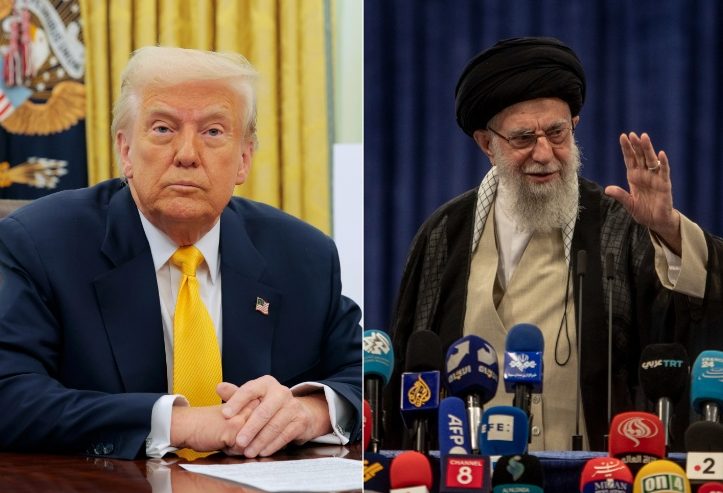
The announcement comes as President Donald Trump reportedly considers ‘decisive’ action against the Islamic Republic
Iran claimed this week to have successfully tested its first long-range intercontinental ballistic missile (ICBM), a capability that would enable Tehran to strike the eastern seaboard of the United States, according to regime-controlled outlets.
The regime purportedly conducted its missile launch from an Islamic Revolutionary Guard Corps base in the city of Semnan, firing toward Serbia with the approval of the Russian government. The missile would have traveled up to 3,700 miles to reach its target, though video of the supposed launch only shows an airborne projectile soaring through the clouds. The footage was initially posted on social media on Monday by an Iranian professor and subsequently amplified by the regime’s press organs, which claimed the missile is capable of traveling up to 6,200 miles.
Even an unsuccessful test—like the failed ICBM launch in September 2025—is likely to advance Iran’s technical knowledge, and the timing of this particular test suggests the Islamic Republic’s leaders are attempting to stave off a U.S. strike that President Donald Trump indicates is still on the table. Trump issued his strongest statement to date against the Iranian regime last weekend, saying, “It’s time to look for new leadership in Iran.” In the meantime, the United States has begun positioning an array of military assets in the region—including the USS Abraham Lincoln aircraft carrier and its strike group—as Trump considers “decisive” action against the regime, according to the Wall Street Journal. The president reportedly called off a strike last week after Israel and other regional allies warned about the Islamic Republic’s ability to respond with missile fire.
Iran has in the past sought to aggressively publicize its missile tests, and the largely quiet nature of the Monday launch outside regime news sources means the Islamic Republic may be serious about refining its ICBM technology and eventually using the missiles on the battlefield.
“There’s no shortage of attempts by Tehran’s theocrats to engage in hyperbole and bluster to bolster their deterrence, but usually these displays are public,” said Behnam Ben Taleblu, senior director of the Foundation for Defense of Democracies’ Iran Program. “Yet when the regime shores up and tries to bolster its military prowess without media spotlight and braggadocio, that’s when there is room for real concern.”
The missile shown in this week’s footage appears to be a version of the domestically produced Sejjil MRBM, an advanced solid-fuel medium-range projectile that Iran used against Israel during the 12-day war. A successful test at the distances Iran claimed, Ben Taleblu said, “should be taken with more than just a grain of salt,” but would be “historic if true” and “constitute a veiled threat against the U.S. homeland.”
The U.S. intelligence community’s current assessment holds that Iran has not yet deployed any functional ICBMs, but “the Iranian regime has been using its satellite launch vehicle program as cover towards developing an ICBM development capability, as both incorporate similar technologies,” Jason Brodsky, policy director at United Against a Nuclear Iran, told the Washington Free Beacon.
The Defense Intelligence Agency (DIA) concluded in May that though Iran has not fielded a long-range ICBM, it is rapidly approaching that benchmark and could possess up to 60 by 2035, surpassing North Korea’s arsenal. The DIA further noted that the “majority of systems” posing a threat to the U.S. homeland “have nuclear-capable variants” technology that Iran has both tested and imported via illicit trade with North Korea, Russia, and other allied countries.
Iran has tested ICBM technology since at least 2004, using its space program as cover, and has spent upwards of $1 billion on the project, according to the Middle East Media Research Institute. Iranian leaders say they are not afraid to deploy this arsenal if Trump green-lights a strike against the regime, with foreign minister Abbas Araghchi vowing on Wednesday to shoot “back with everything we have if we come under renewed attack.”
For Ben Taleblu, Iran’s ballistic missile arsenal remains a pressing threat not only to the region but to the West as well.
“Iran,” he said, “is working to improve the range, precision, survivability, and lethality of its missiles, which means both Europe and America will have to be on high-alert in the coming years.”
Read the full article here