





The Minnesota chapter of White Coats for Black Lives, a medical student group, greeted the October 7, 2023, Hamas-led terrorist attack on Israel by saying that Palestinians should “free themselves from their oppressors by any means necessary.”
In 2024, the Oregon Medical Board proposed including “microaggressions” in the category of “unprofessional misconduct” for which doctors could be punished up to losing their licenses. Among the examples of microaggressions mentioned by one of the state’s experts is saying “America is the land of opportunity” or “I believe the most qualified person should get the job.”
The Ohio State University College of Medicine instructs students and faculty not to ask black colleagues “How are you doing?” It’s not an appropriate question, the college explained, because “Black People (and all People of Color) … experience racism every day.”
At the University of Minnesota Medical School, new students “are forced to recite” a pledge “to honor all indigenous ways of healing that have been traditionally marginalized by western medicine.” They also must declare that they “recognize inequities built by past and present traumas rooted in white supremacy, colonialism, the gender binary, ableism, and all forms of oppression.”
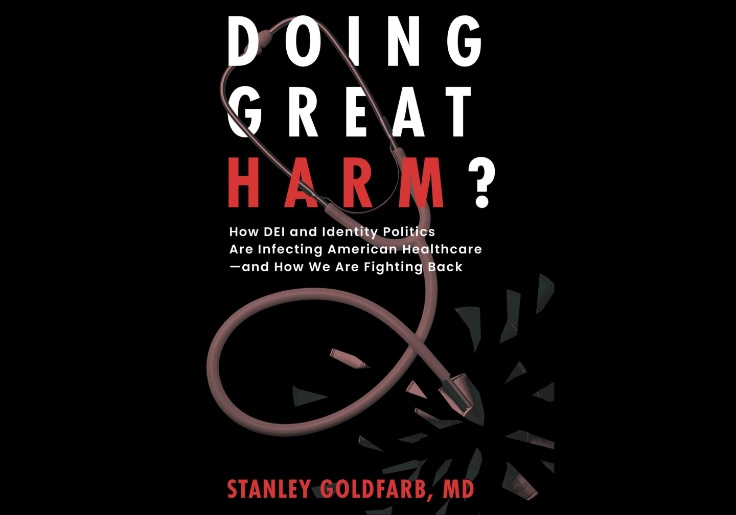
These are just a few of the many examples mentioned by Dr. Stanley Goldfarb in his new book Doing Great Harm? in service of his argument that “Medical schools increasingly are preparing physicians for social activism at the expense of medical science.”
For pointing out declining academic standards and rising “leftist indoctrination,” Goldfarb (the father of Washington Free Beacon chairman Michael Goldfarb) was canceled—fired from a job as an editor of a medical reference and purged from a website at the University of Pennsylvania, where he had served as a nephrologist and as a professor and dean at the medical school.
Instead of slinking off to retirement or apologizing and hoping for rehabilitation, Goldfarb fought back. In 2022 he founded Do No Harm, a research and advocacy group. Do No Harm has since attracted more than 15,000 members. It uses litigation, legislation, and the press to push for a medical education system that produces doctors who are “supremely confident,” not “sanctimoniously woke.”
Doing Great Harm? is the second book to emerge from Goldfarb’s efforts on this front; the first was Take Two Aspirin and Call Me By My Pronouns: Why Turning Doctors into Social Justice Warriors is Destroying American Medicine, which came out in 2022.
The evidence marshaled is sufficient to support Goldfarb’s contention that “we are sending some incompetent doctors out into the world.” If anything, at times he comes off as overly tentative. The book title would work without the question mark at the end.
Two chapters of the book address what Goldfarb calls the “chemical and surgical mutilation of confused children.” Goldfarb describes a connection between diversity, equity, and inclusion and childhood gender transition: “[B]oth are manifestations of identity politics. Confused kids are told by counselors or doctors at gender clinics that they are trans, and all of a sudden they belong to an oppressed category.”
Goldfarb captures the effort by activists to foreclose discussion of this issue: He quotes “the deputy director for transgender justice at the American Civil Liberties Union—the ACLU!” tweeting about Abigail Shrier’s book Irreversible Damage: The Transgender Craze Seducing Our Daughters, that “Stopping the circulation of this book and these ideas is 100% a hill I will die on.” When executives at the ACLU are publicly campaigning to stop the circulation of a book, it’s worth a skeptical look.
This book’s publication date was Sept. 30, 2025, and while it is too early to declare a full victory against either diversity, equity, and inclusion ideology or childhood gender transition, one gets the sense now that both phenomena are in retreat. Trump is president, Bari Weiss is in charge of CBS News, and even the New York Times is under attack for “spreading anti-trans disinformation,” that is, merely covering British pediatrician Hilary Cass’s landmark review of gender-related medical treatment for children. The job outlook for would-be DEI consultants is so grim that, so far as I can tell, the Department of Labor doesn’t even list it as an occupation.
An unanswered question is whether these trends are gone permanently, like floppy discs, or just temporarily out of fashion and poised for an eventual comeback, like, say, flannel shirts.
Goldfarb declares on the penultimate page of the book that he is 81 years old. His advice is to “keep fighting,” “even if we can’t achieve total victory.” Where are the next battlegrounds?
One approach would be to attempt to replicate the Do No Harm effort in medicine in other fields, such as, say, journalism. Goldfarb notes at one point that “When a journalist quotes an ‘expert,’ it is always, without fail, to confirm the opinion of the journalist.”
Another possible direction would be to move the medical-focused effort beyond the defenses against diversity, equity, and inclusion and against childhood gender transition, toward attempts to advance quality, outcomes, and productivity in medicine. Goldfarb writes that when he was a medical student, “there was generally a 30-40 percent mismatch between autopsy results and clinical diagnosis. So in about a third of the cases which required an autopsy, the doctors had gotten it wrong.” He adds that “Today, despite far superior technology, the misdiagnosis rate remains about the same as it was half a century or more ago.”
When you think about it, “do no harm” is a low bar. The great potential of the movement Goldfarb founded is that if the doctors spend less time on social activism, they might actually be able to deliver more to patients in medical progress. In the end, the best thing medical schools can provide to Palestinians and people of color and to everyone else for that matter is producing doctors with the skills to cure diseases and improve health.
Doing Great Harm? How DEI and Identity Politics Are Infecting American Healthcare―and How We Are Fighting Back
by Stanley Goldfarb
Post Hill Press, 256 pp., $30
Ira Stoll is senior writer at the Washington Free Beacon and edits The Editors on Substack.
Read the full article here