






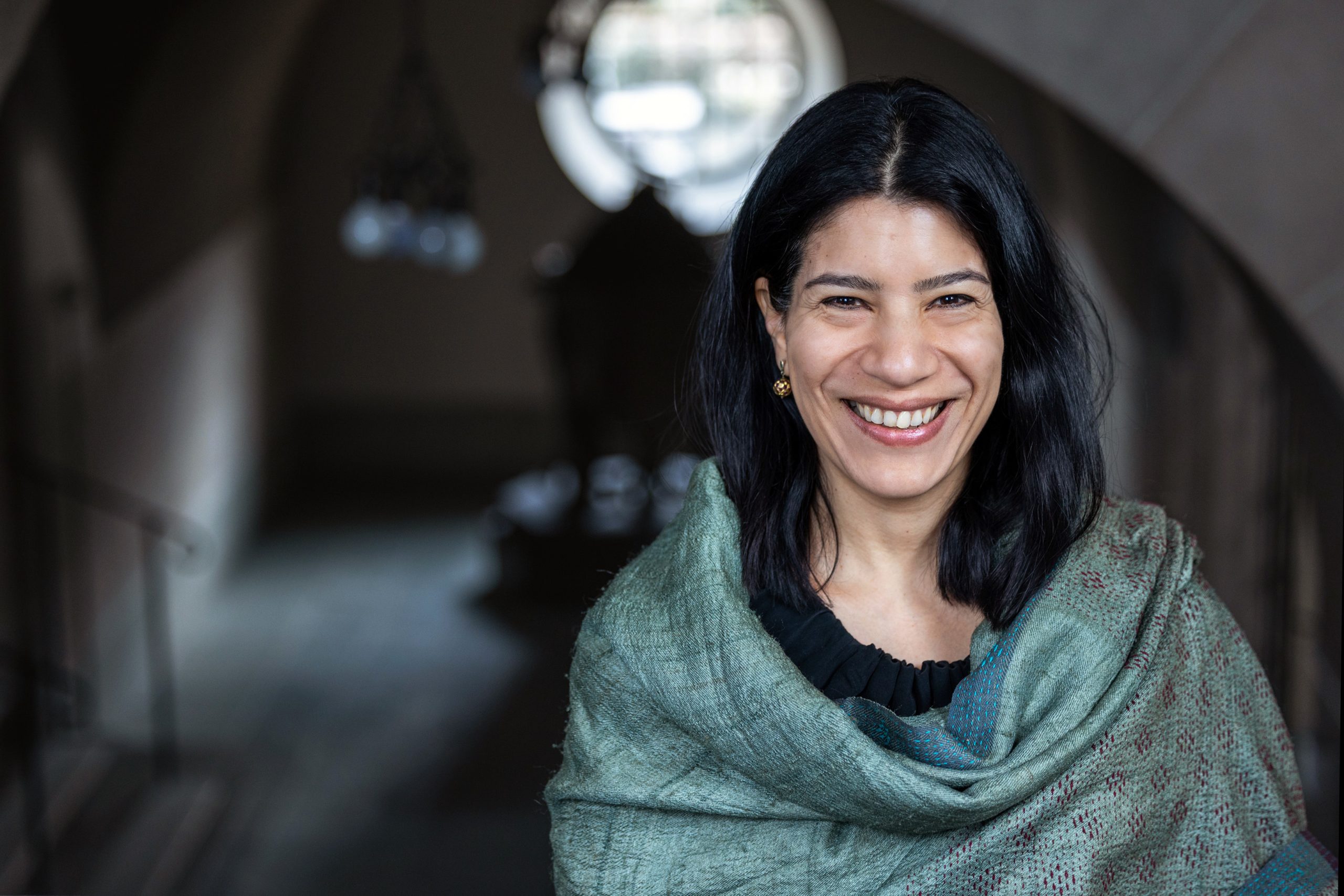
Harvard is poised to name as the next chair of the history department a professor who said she brought oranges and bananas to the anti-Israel protesters who erected an encampment in Harvard Yard in violation of university policies. The professor also marked the anniversary of the Sept. 11 terrorist attack by “reflecting on the terror this country wrought on others,” and she called for President Donald Trump to be subjected to “prosecution for negligent homicide and reckless endangerment.”
The professor, Maya Jasanoff, is on leave for the 2025-2026 academic year, but a Harvard source told the Washington Free Beacon that she is expected to take over as the department chair on July 1 from Daniel Smail, who has been serving as the interim chair.
In November 2020, Jasanoff greeted the election results by posting an image of a sign that said, “America’s nightmare is over. The narcissist white supremacist habitual liar lunatic LOST. It’s a beautiful day!” She also posted that she had “stayed offline” until she was alerted by “cheers on the streets,” and included emojis of a bottle of champagne and a toast. “#finally Stayed offline until cheers on the street alerted me! 🥂🍾”
The previous chair, Sidney Chalhoub, recently boasted of having transformed the department from what he inaccurately described as a “white male affinity group” into a veritable United Nations, with “faculty native to more than fifteen countries around the world.” A current faculty member, James Hankins, is leaving for the University of Florida. Hankins explained his departure in an article, “Why I’m Leaving Harvard,” that described how his colleagues had lowered standards to hire more women and how he’d been told in 2021 that he could not admit a white male graduate student.
Personnel choices have been a tension point between Harvard and the Trump administration. The federal government demanded in April that Harvard commit to “reducing the power held by faculty (whether tenured or untenured) and administrators more committed to activism than scholarship” and that Harvard “adopt and implement merit-based hiring policies, and cease all preferences based on race, color, religion, sex, or national origin.” Harvard responded by filing a lawsuit against the government, denouncing what Harvard called “assertions of power, unmoored from the law, to control teaching and learning at Harvard and to dictate how we operate.”
In the conflict between the federal government and the Trump administration, Jasanoff has been dismissive of concerns about Harvard’s anti-Semitism. In a May television appearance, Jasanoff said, “what we are seeing from the Trump administration is a wholesale attack. … to try to knock down this bulwark of American democracy, of American liberal society.” When an MS Now personality asked Jasanoff about what he called Israel’s use of pagers against “innocent Lebanese people”—the pagers actually targeted Hezbollah terrorists—Jasanoff replied, “I very much appreciate your question,” and denounced “the way in which anti-Semitism was instantly wielded as a charge against these protesters.” She defended the anti-Israel protesters, saying, “it must be noted that they themselves were victimized by all kinds of doxxing and other assaults on their freedom.”
“Not only Jewish students, but of course Muslim students, Arab students, pro-Palestinian students were also being thrown into positions of great politicized persecution in the wake of the October 7th attacks,” Jasanoff said.
Jasanoff is a member of the American Association of University Professors (AAUP), a group that in 2024 reversed its longstanding position and endorsed the use of academic boycotts as a weapon against Israel. As an AAUP member, she participated in a 2025 lawsuit on behalf of Mahmoud Khalil, a prominent leader of the anti-Semitic Columbia University Apartheid Divest who served as a lead negotiator with Columbia during the illegal 2024 encampments. “The ideological-deportation policy has harmed Jasanoff’s ability to hear from her noncitizen colleagues and students. She has recently observed that noncitizen colleagues and students are reluctant to speak publicly about politics and world affairs out of concern that they will be targeted for ideological deportation,” the suit claimed.
Jasanoff’s mother is Sheila Sen Jasanoff, who is Pforzheimer Professor of Science and Technology Studies at the Harvard Kennedy School. Her father is Jay Jasanoff, who is Diebold Professor of Indo-European Linguistics and Philology, Emeritus in the Harvard Department of Linguistics. Both parents got bachelor’s and doctorate degrees from Harvard, and Jasanoff graduated from Harvard College in 1996. A Harvard Magazine article about them was headlined, “It Runs in the Family: Three Jasanoff Professors at Harvard.” It’s not Maya Jasanoff’s fault who her parents are, yet at the same time, Harvard’s habit of preferring Harvard candidates for jobs is widely mocked at other universities, which see it as a kind of unhealthy inbreeding more appropriate to downwardly mobile European royalty than to a meritocratic modern research university. (One Harvard medical school professor was a descendant of four generations of Harvard medical school professors, including one who served as dean from 1864 to 1869.) Jasanoff told Mary Julia Koch of the Harvard Independent in a 2021 interview that ending up as a Harvard faculty member was “a total fluke” and that she’d been “extremely lucky.”
Daniel Pipes, whose own father was Harvard history professor Richard Pipes, cited Jasanoff as an example in a fall 2021 article attributing Harvard history’s decline to an excess of endowed chairs: “Many university-based historians have no need to attract students or readers. Assured funding from endowed chairs liberates them from having to address anyone other than fellow professional historians. Deans do not demand they fill classrooms; spouses do not clamor for royalties.” At the time, Jasanoff had three endowed chairs: “Simultaneously the X.D. and Nancy Yang Professor, the Coolidge Professor of History, and Harvard College Professor. Jasanoff emulates the late sultan of Oman, for he served as prime minister, minister of defense, foreign affairs, and finance, and supreme commander of the armed forces and police.”
The Spring 2026 Harvard history course catalog lists classes about “the rise of mass incarceration” and “systemic problems of capitalist society,” along with an “immigrant justice lab” devoted to training and supporting “teams of undergraduates to contribute research and writing for asylum applicants.” It also includes a class in which students contribute to “a ten-year urban rewilding plan for Harvard.” There’s no course offered on the American Revolution.
In 2024, Jasanoff was involved in an effort to resurrect an introductory history survey course, History 10. The Harvard Crimson quoted her at the time as saying, “One of the fundamental things about history as well is there’s no right answer, and there’s no single answer.” The Crimson also quoted her as saying, “The idea that we would require everyone to do a European history survey just seems like a thing very much of an earlier generation. … So that went away.”
I emailed Jasanoff to ask, “What are your plans and priorities for the department? What do you make of the criticisms that have been leveled by Professor Hankins? How do you plan to reverse the decline in students choosing the concentration?”
I also asked, “Your social media has been very critical of Trump and of Israel and you also reportedly brought fruit to the Gaza encampment. Do you stand by those actions and statements or do you have any regrets about them? How do you balance your own free political speech against giving students and the world the impression that Harvard is focused on research and scholarship rather than strident activism or partisan politics?”
And I asked, “What is your view of the academic boycott of Israel? Do you favor or oppose and why?” She did not answer any of my questions. Maybe she was busy reflecting on the terror America has wrought on others, or maybe she was fruit-shopping so she is prepared the next time an anti-Israel protest breaks out on the Harvard campus.
She sent a response that was only partially responsive. It said, “My top priority is quite simply to support the teaching and study of history in all forms–about all times, places, and themes. I would love for every Harvard undergraduate to take and learn from a course taught by our faculty, from broadly-conceived introductory or Gen Ed classes (of a sort I myself have long been engaged in mounting) to small seminars involving focused research.”
She went on, “As co-chair with David Laibson of the FAS Classroom Social Compact Committee in 2024-25 I had the chance to delve deeply into teaching and learning in Harvard College, and I would refer you to our report as indicative of my (and the institution’s) principles—notably that ‘Education should lead learners to cultivate many tastes: a spirit of intellectual exploration, a willingness to exchange ideas openly with others, an appreciation for the value of in-depth learning, curiosity to pursue knowledge that might challenge preconceptions, and a willingness to change one’s point of view based on new knowledge. A successful education is only possible when teachers make important pedagogical commitments by modeling many habits of mind: how to identify robust, unbiased insights; how effectively to deploy that knowledge; how to discuss ideas in thoughtful, critical, rigorous, and open-minded ways; and how to change their own mind as new evidence becomes available.'”
She said, “In my own course on the history of the British Empire, for example, I cover a wide spectrum of opinion and perspectives: David Livingstone and Mahatma Gandhi, Niall Ferguson and Priya Satia. For some years in fact I co-taught a course with Prof. Ferguson with the goal of modeling constructive intellectual debate.”
“As far as my personal commitments go, my Bengali and Jewish parents named me ‘Maya Ruth’—names from different languages and traditions that both mean ‘compassion.’ I strive to approach other people in and beyond my community with understanding and compassion, whether or not we think alike,” she said.
Actually, in Hebrew, the names Maya and Ruth do not mean compassion. Jasanoff’s response carbon copied a Harvard Faculty of Arts and Sciences communications staffer whose X bio proudly describes him as “media relations and comms for @Harvard” and also as an old guard member of @ayananapressley’s squad, a reference to the extreme anti-Israel member of Congress from Massachusetts. So for all of the talk of co-teaching with Niall Ferguson—who has since left Harvard for the Hoover Institution, the Free Press, and CBS News—the point that gets made is that Harvard is so deeply entwined with far-left-wing anti-Israel Democratic politics that even their own communications people don’t consider it a liability.
If Harvard thinks this particular appointment will help with the reset to focus on research, teaching, and learning instead of activism, partisanship, and identity politics—well, miracles sometimes happen, but, given Jasanoff’s track record, that’s about what it would take for her to emerge as a leader in any turnaround at Harvard or its history department.
Read the full article here