




For those who need reminding, the late 1970s were a truly awful stretch for the United States of America: from stagflation at home to the Soviet Union and friends on the march in Afghanistan, Africa, and Central America, to the Khomeini revolution in Iran. David Frum’s account of the period, How We Got Here, should be required reading for anyone under 40 now complaining that Ronald Reagan’s conservatism didn’t amount to a hill of beans in staving off national disaster. We were, as they say, thisclose.
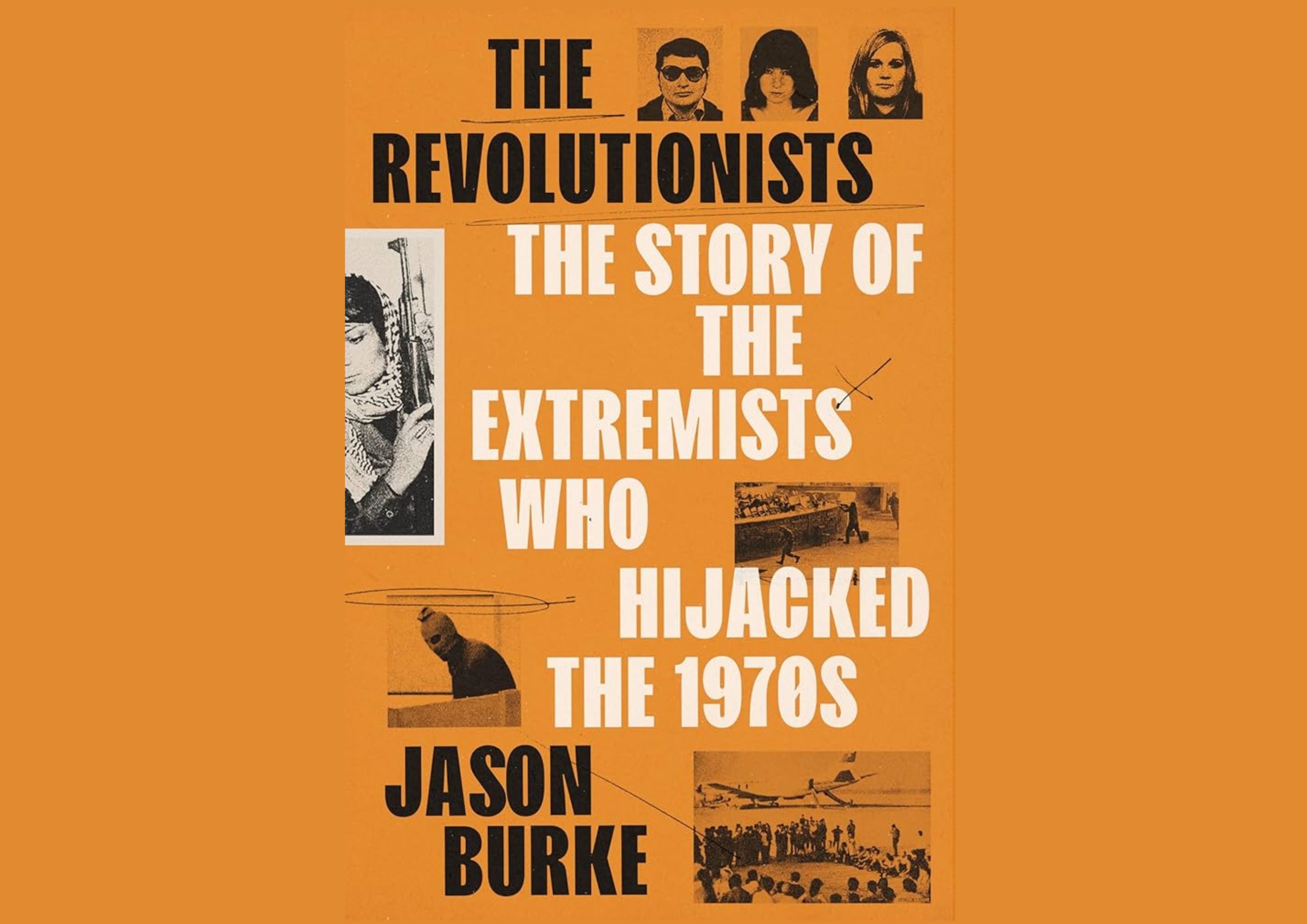
Now comes Jason Burke, a veteran journalist for the United Kingdom’s Guardian, with a timely reminder that the early 1970s also stank. The Revolutionists is an extensively reported chronicle of the leading figures of the time in violent pursuit of radical change, whether communist revolutions in Europe and elsewhere or the eradication of the state of Israel. Burke makes a plausible but understated case that the terrorism problem that seized the world by the lapels on September 11, 2001, has to be understood in the context of its origins and evolution over the previous 30 years.
Burke’s subtitle is “The Story of the Extremists Who Hijacked the 1970s.” The operative word is “hijacked,” not in a metaphorical sense but literally, as in smuggling guns and bombs aboard commercial airplanes, commandeering them shortly after takeoff, forcing pilots to fly to hijacker-friendly Middle East destinations, and demanding of governments the release of previously captured and incarcerated extremists plus millions in ransom. Mostly, the hostages survived, but only after being thoroughly terrorized by the hijackers’ threat to blow up the airplane and its passengers, sometimes seat-belted for days in their own excrement on a blisteringly hot tarmac with little food or water, sometimes subjected as well to deranged lectures on the justice of the Palestinian cause or the class conflict leading inevitably to proletarian revolution. It is astonishing now to read of the seeming ease with which armed extremists passed themselves off as ordinary passengers through minimal security.
There were literally hundreds of such attempted hijackings, the vast majority of them successful, in the period from 1968 to 1980—that is, in the wake of the stunning Israeli victory over massed Arab armies in the 1967 Six-Day War, which landed Israel control of the West Bank, Gaza, the Sinai Peninsula, the Golan Heights, and Jerusalem. In Burke’s telling, Palestinians who cheered the onset of the war wept at its conclusion—feeling “grief equivalent to a bereavement,” as he writes. One was Leila Khaled, who would go on to join George Habash’s Popular Front for the Liberation of Palestine, where she won fame as an early female perpetrator of hijackings and other terror attacks in Europe. The “armed struggle” was on.
Without making a polemic of it, Burke destroys any lingering doubt about the interconnectedness of the violent extremists of the time. Most terrorists in the Palestinian cause were homegrown, but their training camps and havens in the Middle East hosted communist radicals from West Germany, Central America, and Japan. Fusako Shigenobu, leader of the communist Japanese Red Army, became so concerned about security in her homeland she moved her base of operations to Beirut under the PFLP umbrella. The notorious “Carlos the Jackal” was born Ilich Ramírez Sánchez from Caracas, Venezuela. In the Arab world, he was known as Saleem Mohammed. His surge to global notoriety began in London in 1973 with his assassination attempt on Joseph Edward Sieff, the Jewish president of the retail chain Marks & Spencer.
Meanwhile, both Arab states and those of the communist bloc played complex games of support for the revolutionists. There’s no doubt where their sympathies reposed: Anything that targeted Israel or Jews was in principle worthy, as was anything that could weaken Western Europe and the United States. But tactically, how exposed Arab states and the East Bloc wished to be in support of violence was a trickier question. It’s striking from Burke’s telling how isolated the Palestinians working for “liberation” felt from even fairly radical Arab regimes. For example, the terrorist group Black September, itself by no means disconnected from other violent Palestinian organizations, garnered worldwide attention by taking Israeli athletes hostage at the 1972 Munich Olympics, eventually murdering 11. By the standards of the “armed struggle,” this was success. By the standards even of those states merely feigning decency, it was a horrific act.
Western intelligence services, for their part, also found themselves driven by contradictory impulses. On one hand, they wanted to keep an eye on the armed militants. On the other, they wanted to ward off attacks on their territory. Thus was born a formula that has disfigured impressions of the “armed struggle” and what to do about it ever since: the search for more “moderate” revolutionaries and liberationists with whom one may do business.
In the view of many intelligence officials, Americans included, Yasser Arafat, the head of Fatah and the Palestine Liberation Organization, emerged in the early ’70s as just such a “moderate,” earning him a headline speaking slot at a United Nations General Assembly session on “The Question of Palestine” in 1974. True, he said he sought peace. But he also affirmed the armed struggle against Israel he would pursue until his death 30 years later. That others may have been worse didn’t make Arafat “moderate.”
One of his top lieutenants, Ali Hassan Salameh, offers another example of what looks like a recurring hope-driven gullibility in official circles. Salameh, a leading figure in Black September, was Arafat’s quasi-official advance man in 1974 and chief of his personal security force. When he wasn’t living the life of a playboy—in 1978, he married the 1971 Miss Universe, Georgina Rizk, a Lebanese Christian—he was meeting periodically with a senior CIA contact in Beirut. The information Salameh shared was no doubt carefully curated, but the CIA sufficiently valued him as an asset to pick up the tab and host him on his honeymoon to Hawaii, New Orleans, and Disneyland. Israel’s Mossad, not lacking in moral clarity, put an end to him with a car bombing in Beirut in 1979.
The search for dubious moderates and informants went hand in glove with the desire to find a rug under which to sweep the problem. In France, Burke writes, the government negotiated “a series of quiet understandings …. based on the simple premise that if foreign extremists did nothing to endanger the lives of French citizens or seriously harm the country’s broader interests, their activities would be tolerated.”
These are all tales well told. There is, however, an insoluble problem with Burke’s approach. It’s that a degree of wistful romanticism, if not swashbuckling glamor, inevitably attaches itself to the subjects whose stories he tells. The cases of Salameh and Carlos the Jackal represent the problem at its most acute. They cut quite the figure, these men. As did Leila Khaled and Ulrike Meinhof of Germany’s Red Army Faction. This impression is perhaps abetted by the failure of almost all of their revolutionary aims. They sound vaguely ridiculous, spouting their Marxist or liberationist rhetoric. But that’s okay, because in hindsight their fever dreams came to naught.
It’s not okay. To a one, they were advocates and practitioners of killing. They were fanatics and often deranged, for example in their perception of fascism in West Germany and Japan or the possibility and desirability of the eradication of Israel. They lived their lives for evil. They were its human face.
Evil always comes with a human face.
The Revolutionists: The Story of the Extremists Who Hijacked the 1970s
by Jason Burke
Knopf, 736 pp., $40
Tod Lindberg is a senior fellow at the Hudson Institute.
Read the full article here