




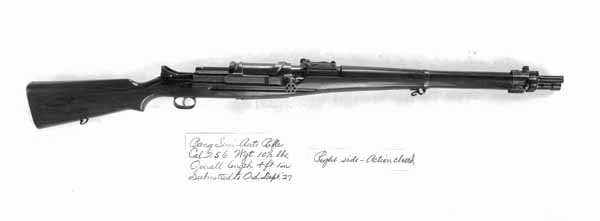
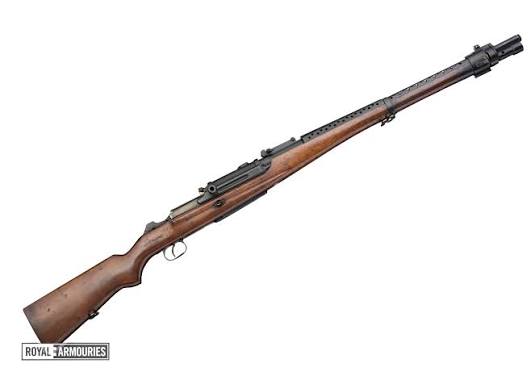
The Bang rifle, holy hell, what a name for a gun. It almost sounds a bit like a joke, but it’s a very real rifle designed by a very real person. The rifle shares its name with its designer, Søren Hansen Bang, who is likely the best-named gun designer. The Bang rifle was first designed as far back as 1909 as a semi-automatic rifle platform. The gun received rave reviews for the most part, but never saw any massive success.
The Bang rifle was sent to both American and British forces for evaluation. Within both forces, the gun received high marks, but was not adopted by either. The Bang rifle uses a fairly interesting operating system. Today, we are going to “bang around” with the Bang Rifle and get down to business.
The Bang Rifle: It Blows Forward
A semi-automatic rifle firing a full-powered cartridge in 1909 was quite the feat. This was an era when direct blowback guns ruled the semi-auto world, and a direct blowback .30-06 would likely chew itself to pieces. The Bang rifle used a locked breech design that was gas-operated.
Advertisement — Continue Reading Below
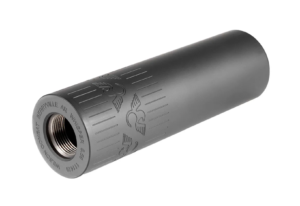
The system developed by Bang would be called the Bang “Blow-Forward” gas system and was first developed in 1903. The system used a sliding muzzle cup. When the cartridge is fired, it travels down the barrel, and the muzzle cup is locked in front of the barrel. Imagine the muzzle cup a bit like a baffle in a suppressor. The cup has a hole to allow the bullet to pass through, but the gas strikes the cup.
The gas fills the muzzle cup chamber and pushes the muzzle cup forward. As the muzzle cup moves forward, it’s pulling on a piston connected to a rotating bolt. This unlocked the bolt and pushed the bolt back, allowing it to reciprocate and cycle the action. This system was never widely used.
Advertisement — Continue Reading Below
The Puteaux Model 1905 machine gun used the system but was never a successful machine gun. Another French machine gun, the St. Étienne Mle 1907, was never successful either. The German Gewehr 41 used the same system, but the G43 quickly surpassed it.
The system is somewhat complex, especially when long-stroke or short-stroke systems are an option. The muzzle cup can become fouled and less effective over time. It’s a little sensitive and ultimately not suitable for a military firearm.
Advertisement — Continue Reading Below
The Bang Rifle In Action
When the Brits were searching for a semi-auto rifle, they formed the Automatic-Rifle Committee. The Bang rifle went to the land of tea and crumpets, and the rifle was chambered in the 6.5x55mm and the 7.65x54mm cartridges. The Committee, over tea and crumpets, decided that the Bang rifle was the best of the entries.
And then nothing happened. The Brits clung to the Lee-Enfield into World War I and World War II.

Advertisement — Continue Reading Below
The Bang rifle was entered into an American competition to replace the M1903. One of the early requirements of this contest required rifles to weigh no more than the M1903. The Bang rifle submitted in .30-06 featured a light barrel and hollow stock.
The United States praised the Bang rifle, and from 1919 onward, the rifle was developed and experimented with. Ultimately, it couldn’t beat the M1 Garand. The rifle would overheat, and wasn’t as reliable as the U.S. Army wanted.
The End of the Bang Rifle
The Bang rifle never saw any massive adoption, and it wasn’t exactly successful, but for 1909, it was fairly innovative. Few were produced, and they are extremely rare today. For a better visual guide, check out this video by Forgotten Weapons.
Advertisement — Continue Reading Below
Read the full article here