



The president threatened to ‘obliterate’ the Islamic Republic’s power plants after Tehran closed the Strait of Hormuz
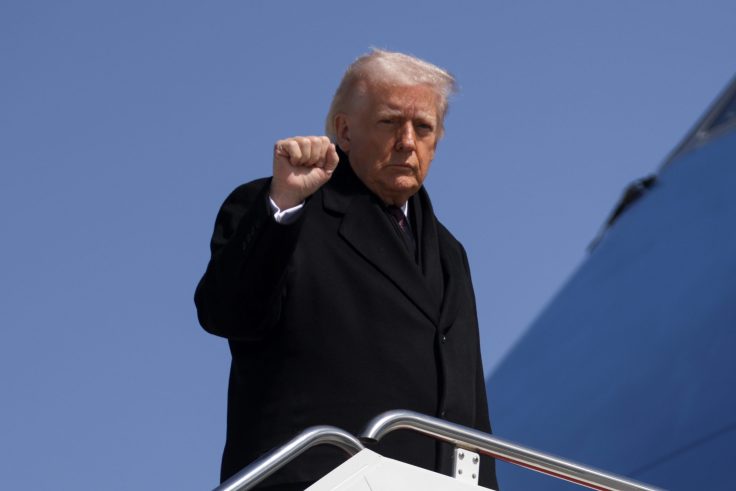
President Donald Trump announced that he will postpone U.S. airstrikes on Iranian energy infrastructure while the two sides engage in talks aimed at ending the ongoing military engagement, indicating later Monday morning that “a very serious form” of regime change is coming to Iran.
“I AM PLEASED TO REPORT THAT THE UNITED STATES OF AMERICA, AND THE COUNTRY OF IRAN, HAVE HAD, OVER THE LAST TWO DAYS, VERY GOOD AND PRODUCTIVE CONVERSATIONS REGARDING A COMPLETE AND TOTAL RESOLUTION OF OUR HOSTILITIES IN THE MIDDLE EAST,” Trump wrote in a Monday morning Truth Social post. “BASED ON THE TENOR AND TONE OF THESE IN DEPTH, DETAILED, AND CONSTRUCTIVE CONVERSATIONS, WHICH WILL CONTINUE THROUGHOUT THE WEEK, I HAVE INSTRUCTED THE DEPARTMENT OF WAR TO POSTPONE ANY AND ALL MILITARY STRIKES AGAINST IRANIAN POWER PLANTS AND ENERGY INFRASTRUCTURE FOR A FIVE DAY PERIOD, SUBJECT TO THE SUCCESS OF THE ONGOING MEETINGS AND DISCUSSIONS.”
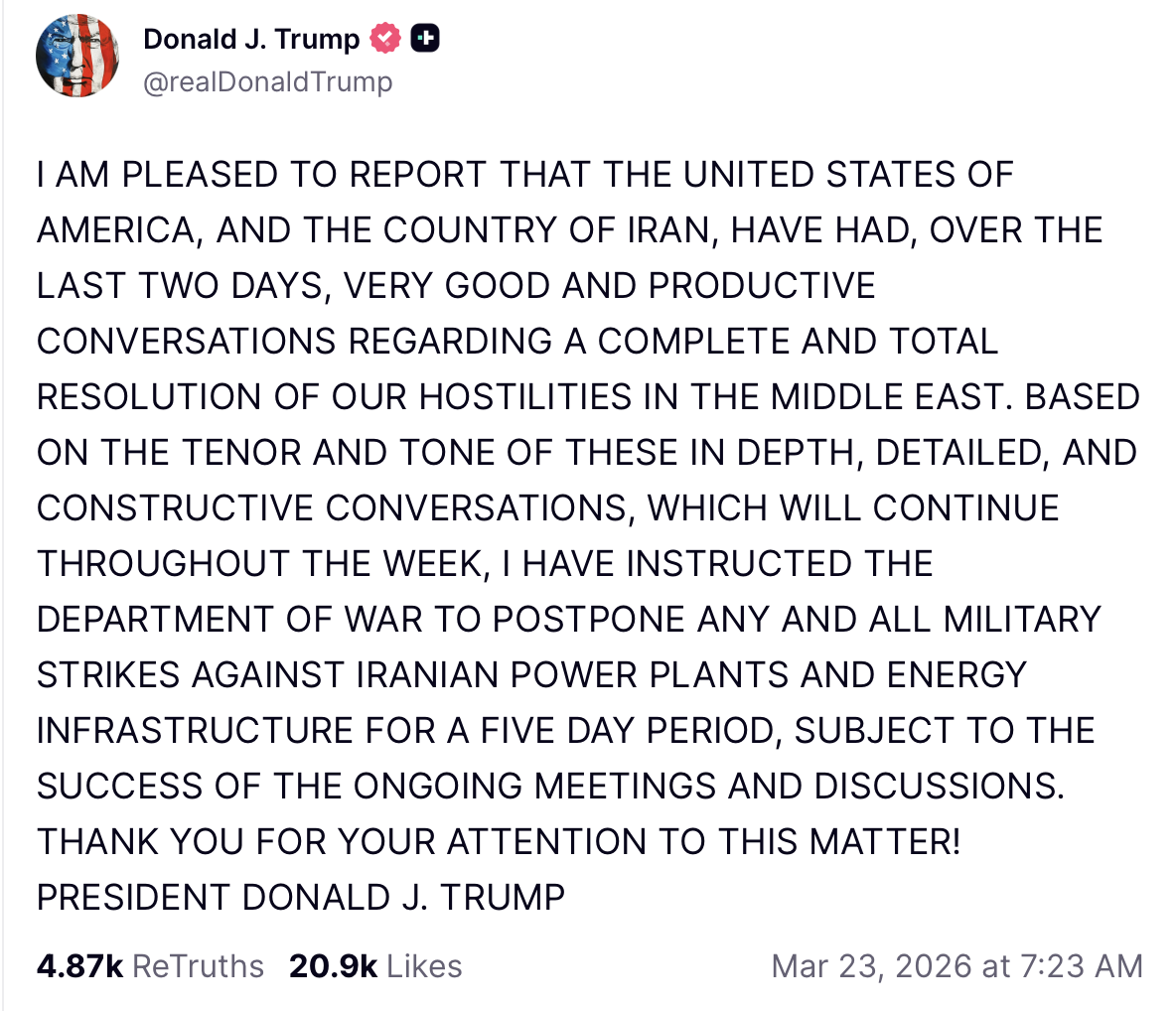
Trump elaborated on the Truth Social post while talking to reporters later Monday morning, saying Middle East envoys Steve Witkoff and Jared Kushner held “very strong talks” with representatives of Iran on Sunday.
“We want to see no nuclear bomb, no nuclear weapon—not even close to it—low-key on the missiles, we want to see peace in the Middle East,” the president said of his demands. “We’ll see where they lead. We have major points of agreement.”
Trump did not name the Iranian officials on the other side of discussions, but reporting from Israeli outlets indicates that the United States has been talking with the speaker of the Iranian Parliament, Mohammad Bagher Ghalibaf. Ghalibaf denied those reports, saying, “All Iranian officials stand firmly behind their supreme leader,” and claiming that “no negotiations have been held with the US.” Trump did state that the Islamic Republic’s new supreme leader, Mojtaba Khamenei, is not a major player. He was reportedly injured in the opening round of strikes that killed his father, Ali Khamenei, and has not been seen in public since.
“Nobody heard of the second supreme leader, the son,” Trump told reporters. “We have not heard from the son. … We don’t know if he’s living.”
The president also discussed the possibility of sending U.S. troops into Iran to recover the regime’s stockpile of enriched uranium, believed to be enough to construct nuclear weapons. Trump said it would be “very easy” for the United States to do so if negotiations end favorably.
“If we have a deal with them, we’re going down and we’ll take it ourselves,” he said.
Trump’s announcement came after he threatened on Saturday to “obliterate” Iran’s energy sector in response to its closure of the Strait of Hormuz shipping corridor, giving a two-day deadline.
“If Iran doesn’t FULLY OPEN, WITHOUT THREAT, the Strait of Hormuz, within 48 HOURS from this exact point in time, the United States of America will hit and obliterate their various POWER PLANTS, STARTING WITH THE BIGGEST ONE FIRST!” Trump wrote in that Saturday Truth Social post.
Iran’s state-controlled Fars News Agency, citing an unnamed official, disputed Trump’s Monday morning claims about peace talks, saying, “There is no direct or indirect connection between Tehran and Trump.” Iran’s foreign ministry also said that “no dialogue” is taking place between the sides, according to CNN.
Qatar over the weekend also rejected allegations that it is quietly mediating peace talks. A diplomat told CNN that Doha is only “focused on defending our country” from Iranian attacks on its gas facilities.
The U.S. military conducted a widespread operation at Kharg Island earlier this month, hitting the site where 90 percent of Tehran’s oil exports originate. Trump said last week that the military “literally destroyed everything on the island except for the area where the oil is.” He added that the remaining sites can be hit “on five minutes’ notice” should he give the green light.
Israel last week struck Iran’s South Pars gas field, the world’s largest natural gas reserve. The facility produces around 70 percent of Iran’s gas and has helped power the hardline regime’s economy. The Israel Defense Forces also hit “Iranian targets in the Caspian Sea for the first time” last week, according to PBS News.
Israel has also reportedly agreed to pause strikes on Iran’s energy sector to boost U.S. diplomatic efforts.
Trump’s announcement that he would halt strikes on Iranian energy infrastructure also follows a threat from Iranian military spokesman Gen. Abolfazl Shekarchi. Shekarchi said last Friday that the Islamic Republic would target “parks, recreational areas, and tourist destinations” in response to the U.S.-Israeli military campaign.
Update 12:10 p.m.: This piece has been updated with information about Mohammad Bagher Ghalibaf.
Read the full article here