




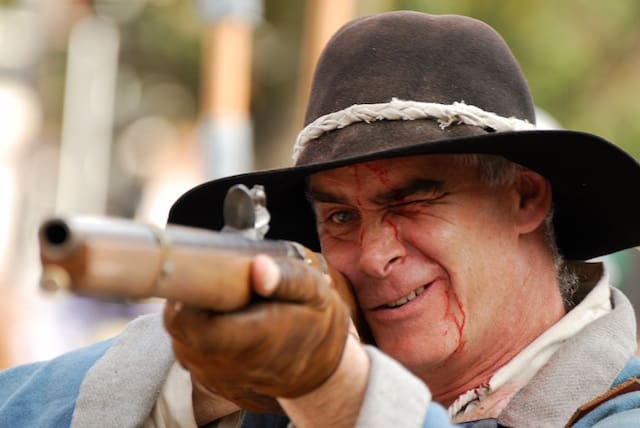
With the 250th anniversary of American independence less than two months away, Revolutionary War reenactors are loading their flintlocks for events that will run from now through July 4 and beyond. They’ll do most of it without filling out a single Form 4473.
Under federal law and the laws of most states, the muskets, flintlocks, and percussion-cap firearms used in 1776, and the modern replicas of those guns, aren’t legally classified as firearms at all. The exemption, written into the Gun Control Act of 1968, has been on the books for nearly six decades. It’s getting fresh attention this spring as the America250 commemoration ramps up nationwide reenactments and historical events tied to the founding.
The Gun Control Act of 1968
The federal statute that establishes most of modern gun law, contains a specific definition of what counts as an “antique firearm” and therefore what falls outside the act’s reach entirely. Under 27 CFR § 478.11, an antique firearm is any weapon with a matchlock, flintlock, percussion cap, or similar ignition system manufactured in or before 1898, as long as it has not been modified to fire modern fixed cartridges. Modern replicas of those weapons are also exempt, provided they remain mechanically faithful to the original ignition systems and use black powder or a black powder substitute rather than modern smokeless powder.
The provision was championed by Sen. John Tower (R-Texas) during the 1968 debate. Tower argued that treating Civil War-era muskets and reproduction flintlocks the same as modern semiautomatic rifles would unfairly burden “serious collectors of antique firearms and for historians and museums,” and that the regulated items had “little, if any, practical use as a firearm in the modern connotation.”
The practical effect: a Brown Bess flintlock musket of the type carried by British regulars at Lexington and Concord can be ordered through the mail, owned by someone otherwise prohibited from possessing firearms in many states, and used at reenactments without the federal regulatory infrastructure that governs cartridge firearms. In an interview with the Associated Press, Second Amendment scholar and gun-rights attorney Dave Hardy, himself the owner of two Civil War-era long guns, observed that the average judge would likely be surprised to learn the scope of the exemption.
State-level variation
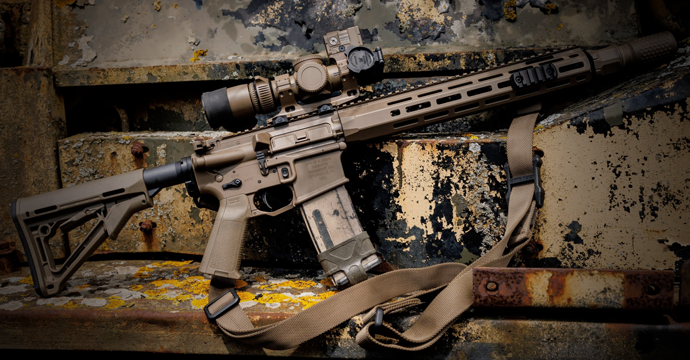
While most states have adopted the federal antique-firearm language either verbatim or by direct reference, a handful have not. Hawaii, Ohio, and North Dakota treat smoothbore muskets and other antique-design firearms the same as modern AR-15s and AK-pattern rifles — applying full background-check and registration requirements regardless of ignition system or manufacture date.
Jason Monhollen, an active-duty U.S. Army officer who portrays a private in the 2nd North Carolina Regiment at Revolutionary War reenactments, told the AP the parity in those states amounts to “comparing apples and oranges.” Monhollen carries a French Charleville musket, the standard issue weapon of French troops who fought alongside the Continental Army.
“It seems silly to put restriction on something that would be such a terrible weapon if you wanted to, you know, kill people,” Monhollen said. “There’s just much better things. You can kill more people quickly with a car than you can with a musket.”
The state-level patchwork creates particular complications for reenactors who travel for events. Patrick Luther, a Marine veteran who runs the milsurpia.com military surplus reference site, described his experience buying a Civil War musket in New York: the purchase process resembled buying a modern firearm, while the black powder to load it required no more paperwork than a t-shirt.
New York’s 2022 gun law overhaul initially required background checks for transfers of antique firearms and barred them from “sensitive places” including parks and museum sites — many of the same locations where reenactments traditionally take place. The state later carved out an exemption for “historical reenactments, educational programming involving historical weapons of warfare, or motion picture or theatrical productions” after pushback.
Justin Costantino, adjutant of the Long Island Companies of the 3rd New York Regiment and a graduate student in history, told the AP that out-of-state reenactors still worry about traveling into New York with muskets, despite the exemption. “If the New York State Police department wants to charge me with weapons possession while I’m wearing a cocked hat and carrying around a Charleville ’66, then please, don’t call my lawyer,” Costantino said. “Call the New York Post!”
The exemption isn’t absolute
The antique-firearm exemption removes black-powder weapons from most federal regulation, but it doesn’t make them legally invisible. Three meaningful limits remain.
First, federal location-based restrictions still apply. The Gun-Free School Zones Act and similar federal statutes don’t exempt antique firearms, meaning a reenactor carrying a flintlock through a school zone is still subject to those provisions. Austin Gunderson, counsel for the North Dakota Legislative Council, confirmed this to the AP: “Federal law does not exclude antique firearms from location-based restrictions.”
Second, state-level laws can criminalize use in ways that effectively cover antique firearms even where ownership is unregulated. Local ordinances, including the one in Wake County, North Carolina, typically prohibit the discharge of “any barreled weapon capable of discharging projectiles” within municipal limits, with no carve-out for ignition type. In most jurisdictions, brandishing even a toy gun at someone can be charged criminally.
Third, some states have responded to specific incidents by tightening their antique-firearm laws. Maryland passed Shadé’s Law in 2019 after a convicted sex offender killed his ex-girlfriend with a six-shot .44-caliber cap-and-ball revolver, a percussion-cap firearm covered by the federal antique exemption, that he had purchased online. The Maryland law now prohibits people convicted of certain violent crimes from acquiring black-powder firearms. West Virginia has a similar exception for people under active protective orders. Most other states do not.
Why the exemption has survived
The antique-firearm exemption has remained largely unchanged through every major federal gun control debate since 1968, including the Brady Act, the 1994 assault weapons ban, and the post-Bruen rulemaking activity of the past several years. The reasoning Tower offered in 1968, that collector items with limited practical modern use don’t warrant the regulatory framework designed for cartridge firearms, has held up across half a century and multiple political coalitions.
Part of the durability is practical. Flintlock and percussion firearms are slow to load (typically 15-30 seconds for an experienced shooter), single-shot, dependent on dry powder and reliable ignition, and inaccurate beyond 100 yards in most configurations. They were the most advanced infantry weapons of their era, but the era ended around 1870. The practical case for regulating them identically to modern semiautomatic rifles is difficult to make on public safety grounds alone, a point Monhollen’s “much better things” comment captures.
Part of the durability is symbolic. The flintlock and the musket are central artifacts of the American founding. They appear in the seals of states and military units, in the iconography of the National Rifle Association and Second Amendment Foundation, and in the historical reenactments that will define much of the Freedom 250 commemoration over the next year. Regulating the Brown Bess like an AR-15 would carry political costs that have, so far, kept the exemption intact.
The late actor Charlton Heston memorably hoisted a flintlock over his head at a 2000 NRA event and told Democrats they’d take it “from my cold, dead hands.” As it turned out, no serious legislative effort to take it has ever materialized — at least at the federal level.
What to watch for in 2026
As Revolutionary War reenactments scale up toward the July 4, 2026, anniversary, expect three things:
Increased state-level legislative attention. With more reenactors traveling across state lines for major commemorative events, the patchwork between federal and state law will create more friction points. Maryland’s Shadé’s Law approach — exempting black-powder firearms from background checks but excluding people convicted of violent crimes — represents one model that could spread.
Renewed academic and legal attention. The antique-firearm exemption sits at an interesting constitutional intersection. Under the Bruen standard, courts look to the historical tradition of firearm regulation around the time of the Founding. The fact that the Founding-era firearms themselves remain largely unregulated under federal law strengthens arguments about what kinds of regulation are constitutionally permitted on their modern equivalents.
Visible reenactor activity. Major Revolutionary War commemorations are scheduled in Boston, Philadelphia, Charleston, and across Virginia, including Mount Vernon’s “George Washington: A Revolutionary Life” exhibition opening in June. Reenactors with replica flintlocks will be present at most of them, exercising rights under the 1968 exemption that the broader public may not realize exists.
For a country marking 250 years of independence won in significant part by armed civilians with flintlocks and muskets, the legal status of those same weapons today carries a certain irony and a certain logic.
Read the full article here