




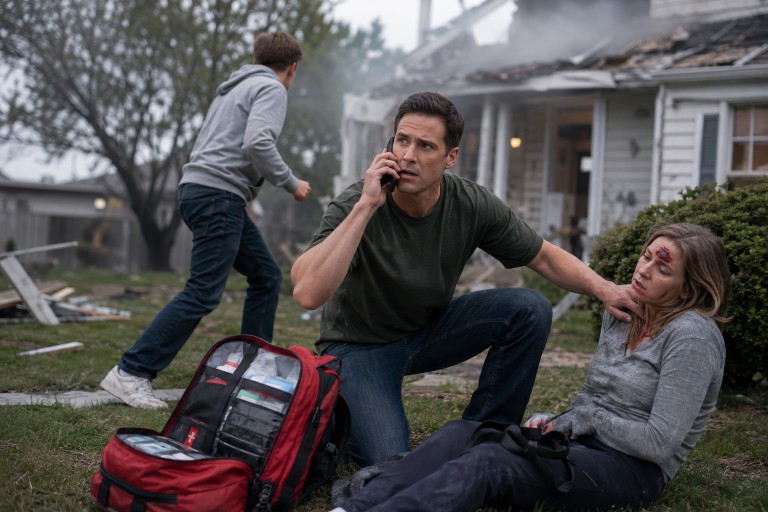
Most preparation happens before an emergency, some happens during the emergency, and some happens afterward. Saving a checklist of immediate actions in case of emergency, and training with it, can help move you from the 80% of survivors who stand around like deer in the headlights, to the 10% who take action to improve the situation. (Leach, 1994) If your training is any good, it will kick in, in an emergency, and you will do what you trained to do. The last 10% of survivors panic and exhibit behaviors that are counterproductive. They may attempt to open the door of an aircraft while it is flying, inflate a life raft before tying it off or pull a rescue swimmer under water.
Checklists serve the important purpose of making sure that survivors don’t forget important training under the stress, confusion and discomfort of a survival ordeal. They can also provide focus and a default set of immediate actions for survivors who many have failed to size up the situation and come up with a plan. Checklists also promote economy of action.
Such a list is necessarily comprised of survival heuristics or “rules of thumb” that apply most of the time but are not laws of science, and should not be applied as such. Even the best rules of thumb may not be applicable, especially under the most extreme circumstances, so despite their usefulness, it is also important to apply reason to the problems you face during a survival ordeal and be able to identify when it is necessary to “break the rules”, and go off script, and have the confidence in your logic take action contrary to the rules of thumb, what you read in survival manuals, and sometimes even the voice over the intercom, giving you instructions that are supposed to be life-saving.
You may have to adjust the order of any such list to meet the dynamic and unique survival needs of your particular survival ordeal. For example, you may better served by issuing an SOS or grabbing a survival kit before exiting a sinking aircraft or watercraft.
So, a list of immediate actions is a list of common actions and rules of thumb based on survival needs, not a list of laws or commandments that universally apply to every possible survival ordeal.
1. Provide Leadership and Put a Stop to Panic
In my experience, most people’s response to an emergency is to attempt to process what is happening. What that looks like varies from one person to another. They may start shaking, be unable to speak, stand with their hands in their pockets or even run in circles, until they are given a task to perform.
While these descriptions may sound humorous, every one of them is quite literal. I have personally witnessed every one of these behaviors. If you possess leadership skills and the ability to a cool head in emergencies, the other 90% of people need someone to take control and tell them what to do.
If any survivors fall into the 10% of people who panic, talk them down. Get them to slow their breathing. If they continue to endanger others, you may have to restrain them with the help of others.
2. Neutralize Immediate Threats
Sometimes the first indication of an emergency is the sound of gunfire. Sometimes it is getting slugged, shot or stabbed.
In a self-defense ordeal, it may be necessary to identify and then neutralize any immediate threats to life as quickly as possible. This involves a quick threat assessment. Back when I received my training, we were taught to identify ability (the weapons or tools to get the job done), intent (assailant continues to advance despite a verbal challenge, and opportunity. Scan the waists and hands of strangers near you for weapons.
3. Get to Safety and Bring Survival Equipment
In a crash, your first notion of an emergency may come in the form of the world rushing past, then an impact, followed by snapping branches and twisting metal. In the immediate aftermath of a vehicle crash, you may find yourself in danger of falling, in danger of burning, or underwater.
In these situations, or in the aftermath of an attack, your tendency may be to self-triage or triage a loved one such as a child or spouse, but the immediate priority is to first ‘Get off the “X”’ in the old Wile E. Coyote and Road Runner cartoons.
This can mean getting out of the water, getting off unstable ground to solid ground, or getting out of a heavily damaged building that could be in danger of collapsing.
The rule of thumb in such situations is generally to move outside of heavily damaged structures, uphill, and upwind of the primary disaster site. This will generally get you upwind of smoke and uphill of chemical and fuel spills.
In the event of a structure fire, it means getting out of the structure and to meeting at a predetermined family meeting place, such as a neighbor’s home or a store that is open 24 hours a day.
When sailor Steven Callahan awoke to his small wooden sailboat sinking in the Atlantic Ocean, he risked his life, leaving the safety of his inflatable life raft, to return to his partially submerged cabin to get his survival gear, an action he believes saved his life.
Bring your survival gear if you think you can safely do so.
4. Call for Help
Getting out an SOS radio transmission, activating a PLB, or getting a phone call through to emergency services can greatly reduce the length of a survival ordeal, and improve outcomes. To be effective, emergency communications must be received, and they must contain the information rescuers need to help you. This varies somewhat depending whether you using a radio in an aircraft or at sea or using a cellular telephone. At a minimum, they need:
- Nature of the emergency – This helps them know what resources to allocate.
- Location of the emergency – If you hiked out to a trailhead or drove to a highway to make a call, dispatch needs the location of the emergency, not the device you are using to make the call!
- Callback Number – In case you are disconnected.
- Number of injured and their conditions – Dispatch needs to know how many ambulances are needed and if they need any special equipment. They also need to know how many patients need immediate transportation and how many can be delayed and how many have minor injuries.
5. Make Sure You are OK
If you’ve flown on a commercial flight, you know to don your own oxygen mask before attempting to put masks on others. This is because without it, you may pass out, and at that point, you will just be another victim, and then you won’t be able to help anybody. So, if you’ve just been in an accident or catastrophe, perform a quick self-assessment and stabilize any serious injuries before you charge on to help others and you may be a bigger help that if you bleed out from a wound that you missed. The process of self-assessment is somewhat easier if you carry small mirror but you can also conduct triage by feel, patting down an area of your body and then looking to see if there is blood on your hand.
6. Make Sure Others are OK
Take a head count. Make sure all members of your household are accounted for and assess others and stabilize their injuries focusing on the Three Killers:
- Airway & Breathing – Clear the airway and establish breathing.
- Bleeding & Circulation – Treat any uncontrolled hemorrhage.
- Shock – Perform a perfusion test to determine capillary refill rate. If longer than 2 seconds, treat for shock by placing patient in the recovery position, elevating the feet and covering with a blanket. (If the patient is pale, raise the tail.)
Assess injured as:
- Minor (Green) – Walking wounded. Minor injuries. Status unlikely to deteriorate over days.
- Delayed (Yellow) – May have serious injuries but transport can be delayed. Status not expected to deteriorate significantly for several hours.
- Immediate (Red) – Can be helped by immediate intervention and transport. Requires treatment within one hour. May have compromised breathing, circulation or airway.
- Expectant/Deceased (Black) – Unlikely to survive given the severity of injuries and/or the level of care available.
7. Size Up the Situation
Before you plan and execute, you must first understand the nature, scope and intensity of the problem. For example, in the aftermath of an earthquake, this may involve doing a 360° survey by taking a walk around your home to inspect it for damage, water leaks, gas leaks, and fire before reentering it.
- Environment
- Status
- Equipment & Supplies
8. Make a Simple Plan
This may be to perform a search for missing household members, turn off water or gas, treat injured survivors, shelter in place, or bugout. If everyone is OK, it may be to help your neighbors, fill water jugs, or gather other supplies you may need. Your initial plan should not be elaborate. Just get everybody working on the problems and improving your situation. Once everybody is on task, you can evaluate your progress and make another, slightly more detailed plan.
9. Execute the Plan
Set the plan in motion. Make sure survivors have the protective equipment, tools and resources that they need to safely do their jobs. Help them past any obstacles.
10. Evaluate Progress
Is your initial simple plan working? Improvise, adapt and overcome as you revise the plan and reassign personnel to the problems that require the most manpower.
11. Repeat
Go back to the beginning of the checklist:
- Is everybody working the problem? Make sure nobody is slipping into panic.
- Have any new threats manifest? If so, neutralize them.
- Is everybody still “off the ‘X’?” Is anybody getting too close to hazards?
- Repeat Your SOS or check on the status of responders.
- Re-triage any injured. Have anyone’s injuries become more serious? If so, attempt to stabilize them and move them from Minor to Delayed or from Delayed to Immediate.
- Size up the situation again.
- Modify the existing plan or make a new one.
- Execute the new plan.
Summary
This simple universal checklist is designed to stop panic, quickly assess the situation, protect people, and take effective action in any crisis. It is a guide for the 10% of people who are able to take effective action in a crisis and a tool to enable the 80% who would normally stand around and watch to move themselves into the former group and make themselves useful. If you can buckle down and follow a checklist, then you can help others in an emergency.


References
Leach, J. (1994). Survival Psychology. London: Macmillan Press Ltd.
Read the full article here