





There’s a word for what it’s like to become a mother, matrescence, which describes the way a woman’s brain and body reorient themselves around providing comfort, sustenance, and safety for a newborn child. There is no word for what happens to a mother when that child is gone.
Various small comforts abound: the brilliant scientific find that a child’s cells live on in her mother’s bloodstream, the stacks of memoirs and self-help books on losing a loved one, and the knowledge that you may now help someone else experiencing great tragedy.
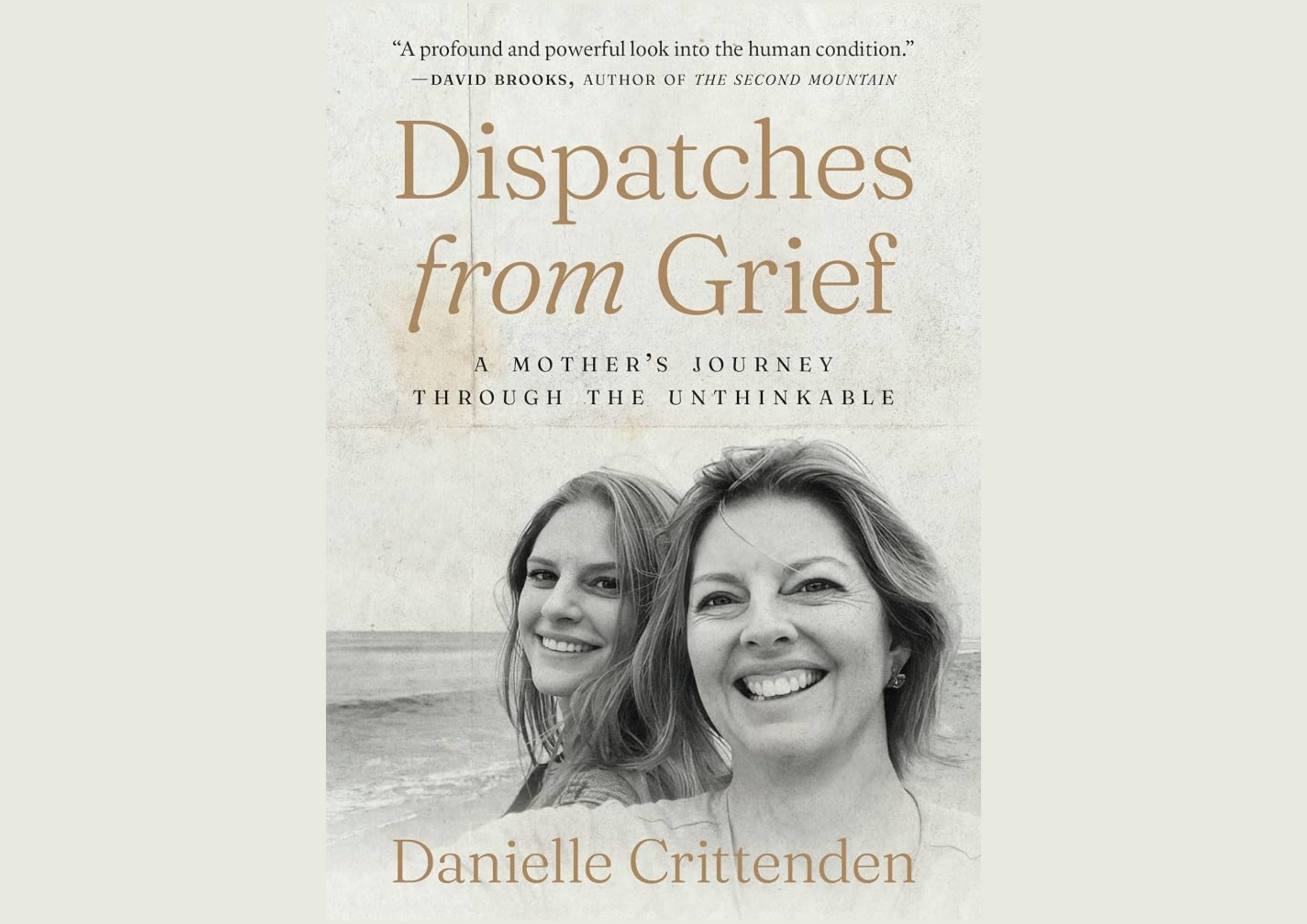
But losing a child never gets “better.” This is journalist Danielle Crittenden’s conclusion in her memoir, Dispatches from Grief: A Mother’s Journey Through the Unthinkable. When her eldest daughter Miranda died at age 32, Crittenden permanently entered an “Alternate Universe.”
“The loss of a child upends the natural order, a meteor crashing into your personal galaxy,” she writes. “The universe as you knew it is destroyed forever. Even the laws of physics are scrambled: Maybe feathers weigh more than bowling balls. Maybe the moon appears at dawn and the sun rises at midnight. Nothing means what it meant before.”
For a story about death, Crittenden’s book is surprisingly easy to read. She says she did not write it “to offer help” and claims she is “not yet skilled at offering hope,” but for those who have lost a child, Dispatches from Grief might just offer both.
Crittenden’s last interaction with Miranda was a text. Getting ready for a party, Miranda sent a selfie. “Stunning!” her mother replied, asking for another photo, as mothers do. Miranda promised to do her best. Within two days, in the middle of the night in February 2024, she fell dead in her apartment, likely from taking the wrong dosage of medication she used after successful brain tumor surgery.
Grief is like motherhood—an experience that you may share with millions, yet your own version of it feels simultaneously so cliché and unique to you. Grief, in particular, comes with its own lexicon. There are the obvious questions: How could I have stopped this from happening? Why her? How could God let this happen? What am I supposed to do with this sadness pressing in on me for the rest of my life? Then there are the platitudes others impose upon you: You’ll feel better with time. She’s in a better place. And, perhaps worst of all, the implausible it could be worse…
Crittenden bristles at “happiness hucksters” and pat answers to unanswerable tragedy. She takes great comfort in the Jewish traditions surrounding grief and burial, which acknowledge the fragile state of the mourner and the dignity of the dead. But it’s a Christian author who gives her the most solace. I expected her to pay more homage to Joan Didion’s The Year of Magical Thinking. It is, after all, also an unsentimental book by a journalist about the death of her daughter. But of all the grief literature she consumed, Crittenden writes, “only Lewis told the truth.”
In C.S. Lewis’s A Grief Observed, she found “no platitudes about healing. No pat assurances. No promises of eventual peace. Just seventy-three pages describing the unrelenting torture of sudden loss.”
As a new entry into the grief canon, Crittenden’s book is short and cogent. Her incisive observations will ring true for anyone who’s been through similar pain. Dispatches from Grief reads how you might expect from the title, like a reporter’s account of unimaginable personal suffering. Its prose is sparse but pungent: “The pain simmered in my chest like a covered pot. Then, several times a day and without warning, it would boil over.”
It’s an account of the way things are or have been, but it offers, intentionally, very little in the way of how things could or should be. When your child dies, she explains bluntly, you will mourn her and the person you used to be, someone you will never know again.
From the “fellow travelers” in the world of tragedy, she writes, “we learned what no grief manual will tell you: The person you were died with your child. There is no ‘healing.’ No journey back to yourself—that map burned with everything else. On that February morning, we became entirely different people wearing the same faces.”
Crittenden describes in detail her daughter’s free spirit, which led her to struggle in school but travel the world in adulthood. “Looking back, I realize there was not a single day of Miranda’s life when I didn’t worry about her,” she writes, echoing mothers everywhere.
As Crittenden slogs through the “Bureaucracy of Death,” making burial preparations and surreptitiously cleaning and organizing her daughter’s apartment (technically illegal until the court probates Miranda’s will), she describes the misery of the recently bereaved: “When people asked how I was feeling, I’d compare myself to a prisoner adjusting to life without parole.”
The book isn’t without its humorous moments. Crittenden describes a trip her other daughter took to Musée de l’Orangerie. Monet’s water lilies reminded her of her sister, and she began to sob. A security guard, sick of lifeless selfie-taking tourists, “nodded approvingly.”
Eventually, Crittenden begins to discover what “moving on” looks like for her. It means not drinking to forget but having a glass of wine with dinner to participate in the rituals of the living. It means trying EMDR (eye movement desensitization and reprocessing) therapy, which helps participants cope with trauma.
There may be ways to get by, but there is no “good” to come from Miranda’s death, Crittenden writes. “I’ve joined the centuries-long chain gang of human misery, yes. But let’s not dress it up as enlightenment. Miranda’s death is not my spiritual gain.”
While well-wishers and members of grief support groups offer trite comforts, Crittenden seems to find the only real goal is to keep living. “I have to remember that Sean’s life was a gift,” another mother says of her 32-year-old son. “And also that my life is a gift.” It’s that last part that sticks with Crittenden, who expected to be offering guidance to a newly bereaved mother and instead received it.
“‘Miranda wouldn’t want you miserable’ is not enough,” she writes. “Trying to honor her memory is not enough. I need to embrace my own gift of life to move forward.”
To become a mother is to expose yourself to the possibility of immense pain—pain that, in order to survive, Crittenden says, you must imagine will never come your way. But if it does, there is a community of mourners waiting to greet you.
Dispatches from Grief: A Mother’s Journey Through the Unthinkable
by Danielle Crittenden
Infinite Books, 208 pp., $27.95
Madeline Fry Schultz is a writer and editor based in the Washington, D.C., area.
Read the full article here