





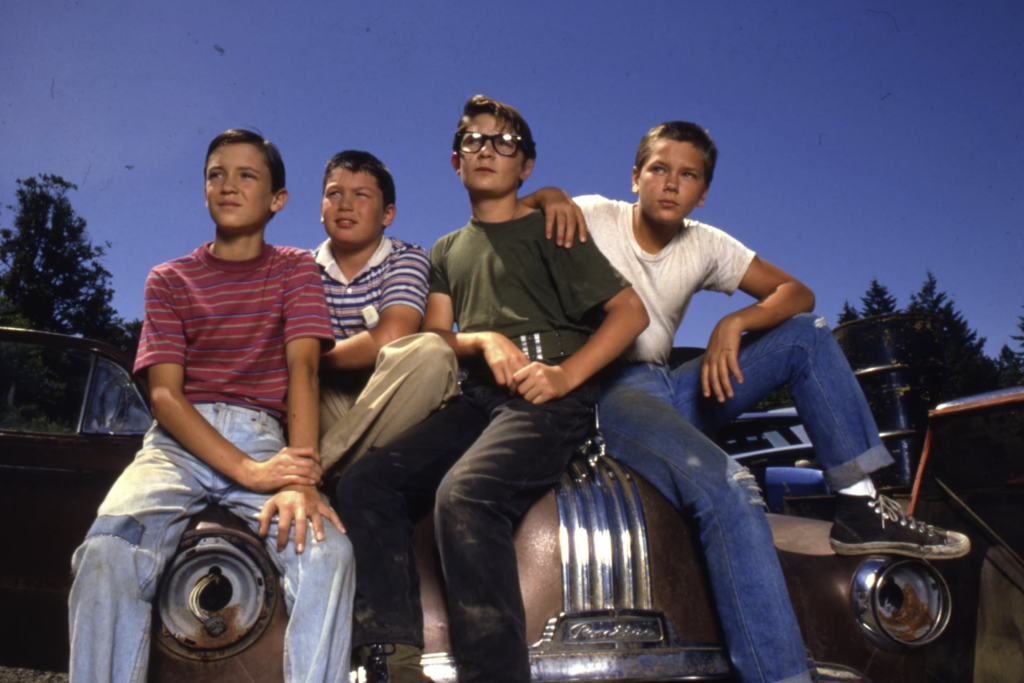
Among the many gifts of the 1980s was an abundance of coming-of-age dramas and comedies. Today, the genre has nearly disappeared from theaters, but the Reagan era was filled with films depicting the freedom, innocence, and struggles of America’s youth. These films provided a window into suburban America and introduced the world to American culture with young actors who became cultural icons.
While most of these films depicted contemporary times, a few films set in the 1950s and ’60s attach themselves to the memories and experiences of multiple generations at once. Of those, Rob Reiner’s Stand By Me (1986) is particularly noteworthy with its structure, theme, and aesthetics.
Reiner’s film, set in 1959, bridges two distant generations: the Baby Boomers and Generation X. This is because an American child born in the 1980s has more in common with a child born in the 1950s than either has with the modern generations (Z or Alpha). Stand By Me works within this dynamic for the same reason Back to the Future works. A small-town child in 1985 had minimally more technology than a child had in 1955. The two generations experienced a remarkably similar childhood. Modern teens, by comparison, struggle to understand the screen-free, technology-free world of payphones, phonebooks, and paper maps.
Stand By Me evokes nostalgia for that simpler time and layers it with a narrative about adolescence, adulthood, and responsibility. While the setting makes the viewer crave a lost innocence, the story drives the sentiment further. The four main characters, each dealing with various types of trauma, find courage in the bonds of friendship.
The title song and the theme—based on a hymn that references Psalm 46—are a call for stability and security in the uncertainty of the world. As the boys walk toward adventure—the search for a rumored dead body—and the uncertainty of adulthood looms, they rely on each other to overcome immediate and more distant fears.
Throughout the film the boys are contrasted by an older version of themselves: an older gang of criminals who stalk and torment the younger group. The boys fear both the immediate presence of the older gang, but also what they represent—a future of continued suffering and failure. Adulthood to them is a place filled with sadness and regret. It’s a world of absent, abusive, or depressed parents and angry bullies. At 12, the boys are in a brief stage of independence and innocence that they recognize is fading.
Reiner depicts this all beautifully throughout, highlighting the dynamics of the story within the beauty of small-town, rural America. The scenes are often a back-and-forth between close-in shots of the boys—insinuating the intimacy of their friendship—and far-away landscapes—a nod to the idea that the wider world dwarfs any of their present troubles and trauma.
The film, shot mostly in Oregon and Northern California, contrasts the harshness of life with an abundance of beauty. The boys have true freedom on their journey, and they can use it to be self-destructive like the older gang, or to seek a more virtuous existence.
The closing narration from the main character, Gordie, happens from his spacious home with two loving children asking for him to come outside. Gordie has achieved a better life than the one he had at 12. Chris, his onetime best friend, although dead, also chose a life of virtue. Neither gave in to the fears or anxiety but instead relied on the courage they developed through the course of the film.
It is also impossible to look past the story of River Phoenix, who plays Chris, and how it mirrors the narrative in the film. Phoenix, who was a teenage heartthrob in the 1980s, died of a drug overdose in his early 20s on the street outside a club in Hollywood. His career never achieved what it should have. As a modern viewer, watching River portray Chris is heartbreaking, reliving the sense of hope for this talented young man.
Stand By Me is timeless for all this and more. The theme song, the actors, and the story (based on Stephen King’s novella The Body) work together to remind viewers of what once was: a time in America where children were free to be children. It helps the viewer remember the friendships that formed us into adults. For Generation X, who are now well into parenthood, it highlights the promise ahead for our children and reminds us that a childhood free of technology is likely the better option.
Editor’s note: This retrospective review is one in a series celebrating 1986, arguably the greatest year in movies—inarguably if you’re Gen X.
Garrett Exner is a former Marine, Hudson Institute fellow, and father of two children who understand the greatness of Ronald Reagan and ’80s cinema.
The post REVIEW: ‘Stand By Me’ appeared first on .
Read the full article here