




Reading this book will improve your life. No kidding whatsoever. Indeed, just getting a copy from your local library and spending 90 minutes with it will improve your life.
Nicholas Epley, a distinguished behavioral scientist at the University of Chicago’s Booth School of Business, commutes by train every workday to Hyde Park for 30 minutes from south suburban Flossmoor. One day some years back a middle-aged black woman wearing an elegant red hat took the last available seat, next to Epley. All the commuters were silent, most staring into their phones, until Epley decided with some trepidation to compliment the lady on her headgear. “I love your hat,” he said with a smile, and she smiled back. Epley followed up with a generic question that morphed into long conversation until the train pulled in to 59th Street Chicago.
“My memory of how the conversation made me feel is crystal clear,” Epley recalls in his deftly, winsomely written A Little More Social. “It was great. Perhaps more important, it was surprisingly great.” It made him realize that his pessimistic expectations about how a complete stranger would react to being spoken to—and which “normally led me to keep to myself”—were very wide of the mark.
That experience led Epley, along with a bevy of collaborators, to pursue similar social outreach experiments on Chicago and London public transit, among other venues, all of which yielded consistently identical results: Strangers enjoyed a fellow stranger taking the initiative to speak to them. “Man is by nature a social animal,” the Greek philosopher Aristotle observed well over 2,000 years ago, and while A Little More Social keeps it brief on the wiring of the human brain, Epley writes, “an outsize cerebral cortex specifically built to understand other people” will “reward us with a chemical bath of happiness at any hint of a positive social connection.”
Thus “connecting with other people—even strangers—is one of life’s most consistently enjoyable experiences.” Epley reports that exploring these dynamics “has changed the way I live my own life.” It’s “made me sociable—friendlier, kinder, and more open and honest with other people—than I would be otherwise.” Overcoming “our overly pessimistic expectations about how others will respond” is the key initial step, for “we tend to underestimate how positively the social interactions that enhance our well-being are going to turn out.” As a result, “all too often we mistakenly choose to make ourselves unhappily alone,” and multiple large surveys confirm that social isolation is an almost epidemic problem.
Epley cites 2020 data showing more than 27 percent of Americans live alone, and a late 2021 survey found 79 percent of 18 to 24 year-olds reported feeling lonely. What’s worse, other research has concluded that “roughly 10 percent of Americans suffer from Social Anxiety Disorder,” an extreme and dangerous level of fear of contact with others.
The extensive research that A Little More Social relates in great detail does not stand alone, an August column by the Wall Street Journal’s Elizabeth Bernstein indicated. Bernstein interviewed Gillian Sandstrom, a University of Sussex professor of “the Psychology of Kindness” whose book Once Upon A Stranger: The Science of How ‘Small’ Talk Can Add Up to a Big Life came out months before Epley’s, and presented similar insights. “We’re happier when we talk to an array of different types of people,” Sandstrom told Bernstein, for such experience “makes us more trusting and increases our perception that other people and the world are kind and good.” And “the easiest thing is to offer someone a compliment,” just as Epley recommends “passing along a genuine compliment to a stranger” as he did with the lady in the lovely red fedora.
Epley acknowledges the “infinite hours of isolation” a book author experiences “sitting alone writing in front of my computer,” and Sandstrom too highlights how “we’re doing so many things through a screen now.” With “more people working from home” the result is “we have fewer opportunities to talk to an actual person.” Similarly, Epley argues for “the surprising power of spoken conversation,” contending that “your voice communicates your thoughts more clearly” than do written words. To a writer, that seems like a highly dubious proposition, and to someone whose communications occur more than 95 percent via email Epley’s further contention that “text-based interactions are subtly dehumanizing” seems wrong.
But there’s no arguing with Epley’s overarching emphasis that “extroversion is strongly correlated with happiness” and “is positively correlated with every other measure of subjective well-being.” One can experience that on a city bus—Pittsburgh’s are free for those of us over 65—and at most any craft beer brewery or family-owned tavern, as well as with workers at your neighborhood grocery store. As Epley reiterates, the opportunities are extensive once one realizes verbally greeting others brings emotional rewards, not pain.
Yet the very day before Bernstein’s Wall Street Journal column featured Sandstrom, a front-page Journal story highlighted how one fellow from Philadelphia had come up with an even better method for initiating contact with strangers than the psychologists. Seeking human interaction early in the pandemic, 42-year-old Fin Colleton fashioned himself a sign asking “How’s your day going?” and took it to a city park. Just as you now expect, “strangers stopped and talked,” he told Journal writer Mathylda Dulian. “In order to meet people, I didn’t have to walk up to people. They would walk up to me.” He’d vary the question on his sign, and in time chairs and eventually a table were added to his endeavor. Colleton continued his hobby after moving to New York City in 2023, and, as Dulian reports, his efforts eventually evolved into a larger conversational project now known as American Dialogues, as Dulian details.
Just like Epley’s A Little More Social, Dulian’s superb story, citing a 2024 Harvard survey, warns how “one out of five American adults report serious, frequent loneliness, with adults 30 to 44 reporting the highest rates.” The clear lesson here, from Epley to Sandstrom to Colleton, is an obvious one: To be a happier person, get a life, not a phone!
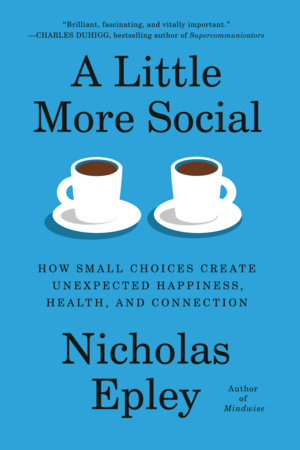
A Little More Social: How Small Choices Create Unexpected Happiness, Health, and Connection
by Nicholas Epley
Knopf, 299 pp., $32
David J. Garrow’s books include the Pulitzer Prize-winning Martin Luther King Jr. biography Bearing the Cross and Rising Star: The Making of Barack Obama.
Read the full article here