




In his 1994 survey of Lincoln in American Memory, Merrill D. Peterson identified five themes which have summed-up the meaning of Abraham Lincoln for Americans since Lincoln’s death in 1865. Those five themes hold little surprise—Lincoln as Savior of the Union, Lincoln as the Great Emancipator, Lincoln as the Man of the People, Lincoln as the First American, and Lincoln as the Self-Made Man—and they are mirrored perfectly by the Lincoln who sits in the majestic chair of state in his Memorial (which, by the way, appears on the dustjacket of Peterson’s book).
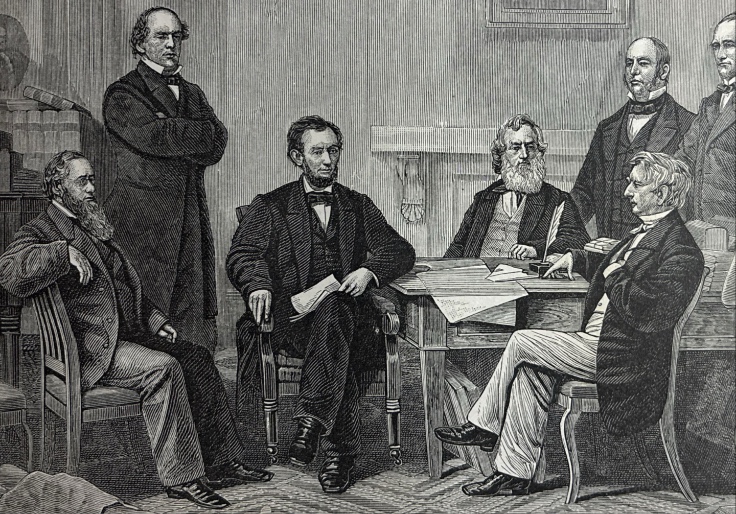
What was missing from Peterson’s enumeration was one theme that should have been obvious, and that was Lincoln the Politician. After all, Lincoln did more than utter eloquent addresses, or emancipate three million slaves, or make himself something out of nothing. He navigated the turbulent waters of a democracy that was being ripped apart by civil war, brought that war to a successful conclusion, and cajoled friends and enemies alike into following his direction. “The Tycoon,” as his secretary John Hay called him in the summer of 1863, “is managing this war, … foreign relations, and planning a reconstruction of the Union, all at once. I never knew with what tyrannous authority he rules the Cabinet, till now. The most important things he decides and there is no cavil.”
Of course, we prefer to remember Lincoln the Statesman rather than Lincoln the Politician. Statecraft embodies nobility of purpose, shrewdness of insight, and prudential management of public affairs. But we are not doing sufficient justice to either Lincoln or ourselves if we forget how very much Lincoln was a career politician, in the fullest sense of the word. “Politics were his life,” insisted his longtime law partner, William Henry Herndon, “and his great ambition his motive power.” His confidence in his own judgment sometimes reached the borders of arrogance, and when John Hay tried to show him articles in the journals of the day “on some special subject,” Lincoln dismissed him out of hand: “I know more about it that any of them.”
It also does no justice to either Lincoln or ourselves to ignore the Politician, if only because in a democracy, politics is precisely what makes the world go round. Politics is universally tedious, routinely self-interested, and frequently corrupt, but in a polity where the citizenry are the sovereigns, there is no escaping it. So we can be grateful that Matthew Pinsker, who teaches at Dickinson College in Pennsylvania, has at last frankly told us the story of Boss Lincoln, and in much of its massively democratic details.
Party organization was Lincoln’s life, Pinsker states at the outset, and in particular Lincoln was “a party builder,” with a “particular talent for party management,” something which “was the driving force in his political career.” This was no small task in Lincoln’s America, since political parties had only the most rudimentary official structures and, what is even more difficult to imagine, no registration lists, voter surveys, or professional staffs. In Lincoln’s day, one did not actually join a party; one identified with, or affiliated with, a party. Party labor and loyalty were rewarded with patronage; party information was disseminated by newspapers whose editors never blinked in the direction of something called “journalistic objectivity.” He may not entirely have been a boss in the wicked sense associated with William Tweed or Richard J. Daley, but he was a politician to his fingertips.
And Lincoln loved every minute of it. His law practice paid the bills, but it was also valuable for earning him voter visibility across Illinois. He drew up precinct and municipal strategy plans, and the two political mobilization plans which survive in his hand (from 1840 and 1843) show he was quite adept at “how to create effective county-level committees … raise funds, and even preserve local harmony.” He expected patronage rewards, and at one point even bought part-ownership in a German-language newspaper in Illinois to influence immigrant voters. He did not like to lose, and in 1848 he walked away from Henry Clay, the man he called his “beau ideal of a statesman,” and endorsed the vaguer but more successful presidential bid of the unmemorable Zachary Taylor. “The election for him,” Pinsker remarks, “was about winning.”
That should not be heard as a denigration of Lincoln; and it will only sound that way if we misunderstand how politics functions in a democracy. The great ideals about liberty which Lincoln served would have gotten him, and the country, exactly nowhere without the political will and skill to make them succeed. And so Pinsker threads the needle of Lincoln as sometimes a party loyalist, sometimes a fusionist trying to reconcile factions that have at least one principle in common, sometimes a great organizer but never (until 1860) the technical head of a party, a designer of a common-front National Union Party in 1864 but utterly unwilling to retreat an inch from his Emancipation Proclamation.
Strictly speaking, Pinsker’s Boss Lincoln is not the first “political” Lincoln. James H. Read’s Sovereign of a Free People: Abraham Lincoln, Majority Rule, and Slavery (2023) was a tour-de-force analysis of Lincoln’s skill in policy coalition-building in the 1850s, and Fergus Bordewich’s Congress at War (2020) anticipated Pinsker as the first serious attempt to explain Lincoln’s efforts at managing the wartime Congress.
Nor should Boss Lincoln be read as the last word on Lincoln the Politician. Fully half of the book is devoted to Lincoln’s rise to political dominance in Illinois before 1860. These are the years when Lincoln served as the paladin of Henry Clay’s Whig Party, and though Pinsker certainly introduces us to a very determined ladder-climber among the Illinois Whigs, we are not given very much sense of what it meant for Lincoln to be a Whig in Illinois in those years. We want, in other words, to see how Lincoln participated in what the late Daniel Walker Howe called the “political culture” of Illinois, and whether that made any difference in the man’s political skills in contrast with, say, an Illinois Democrat like Lincoln’s bête noire, Stephen A. Douglas.
The Whig Party died after the 1856 elections, partly due to its fracture into northern and southern wings, but even more to its depressing ineffectiveness at winning elections. Pinsker gives as good an account, and better, of Lincoln’s shift to the new antislavery Republicans as we have anywhere. But he also comes up somewhat short in helping us understand Lincoln’s skill in managing a Republican Congress once he is elected president in 1860. Even Lincoln’s fellow Republicans learned to be wary of how the commander in chief’s “executive magnet had reached some members” of Congress, and Ohio senator Benjamin Wade, who did not have the happiest of relations with Lincoln, complained particularly about the president’s “back-kitchen way” of doing political business in Washington. Wade was enraged at Lincoln’s skill in charming certain senators to go “mousing around the President” and then “come back here to speak authoritatively in the Senate what the opinions of the President are.” That is a story which deserves a more involved telling, and perhaps it is one which Pinsker will yet give us.
Understand these faults, though, only as a measurement against the rule of perfection. The reader of Boss Lincoln will meet a very different Lincoln than we meet in Daniel Chester French’s national deity who presides in the temple—yes, it is literally described as a temple on the wall behind French’s seated Lincoln—beside the Potomac. But it will still be a Lincoln we can embrace, and a Lincoln we can, in the most practical sense, be thankful for.
Boss Lincoln: The Partisan Life of Abraham Lincoln
by Matthew Pinsker
W.W. Norton, 576 pp., $39.99
Allen C. Guelzo is a professor of humanities at the Hamilton School of Classical and Civic Education at the University of Florida and the author, with James Hankins, of The Golden Thread: A History of the Western Tradition, Volume II: The Modern and Contemporary West.
Read the full article here