




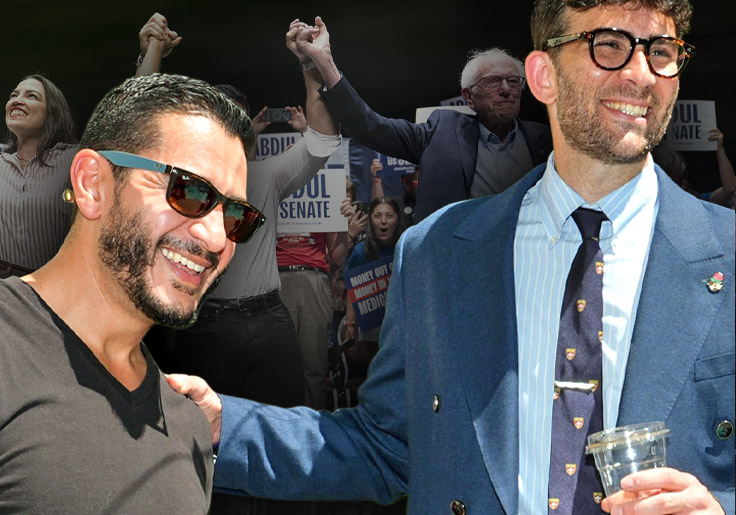
The Democratic establishment took another loss on Tuesday. Michigan primary voters rejected their preferred Senate candidate, Haley Stevens, in favor of Abdul El-Sayed, the radical left-wing challenger backed by Hasan Piker, the Turkish-American influencer known for praising Hamas and Mao Zedong.
It was not a decisive victory by any means. Most observers had expected an El-Sayed blowout based on recent polling, which showed him leading by double digits. He led by less than 1 point when the Associated Press called the race Wednesday morning. Mallory McMorrow, who dropped out of the race in early July, was on track to get 4 percent of the vote.
El-Sayed is the first left-wing Senate candidate to defeat an establishment-backed opponent in 2026 despite not having a Nazi tattoo—though, to be fair, he did hold a fundraiser with a lesbian trial lawyer who celebrated her grandfather’s World War II military service in the German Army. He also appeared alongside a pro-Hamas cleric who said the Holocaust “has been exaggerated.”
On Monday, El-Sayed joined Piker at a pre-election pool party in Detroit, where he posed playfully with female admirers. The candidate’s wife, Sarah Jukaku, who is not allowed to show her hair at mixed-gender public gatherings, did not attend. He is the first Democrat to win a statewide primary after sharing a stage with Piker, who has used his platform to promote candidates who espouse his anti-American views.
Melat Kiros, for example. The 29-year-old graduate student was spotted at El-Sayed’s election night party in Detroit. She is almost certain to win a seat in Congress after beating a 15-term Democratic congresswoman in Colorado. Kiros and Piker, who was also in the crowd on Tuesday, have both argued that the Sept. 11 terrorist attack was an inevitable (and arguably justified) response to U.S. foreign policy.
El-Sayed’s primary win is the clearest sign yet that the Democratic establishment has lost its grip on the party. Voters keep electing candidates who badmouth capitalism while suggesting all our problems could be solved by ending U.S. military aid to Israel and curbing the nefarious influence of the “Jewish lobby.”
Zainab Bibi Ahmed, a local university employee who wore a keffiyeh to El-Sayed’s party on Tuesday, told the Washington Free Beacon she never even considered voting for Stevens because of the candidate’s support for “sending weapons and giving Israel funds on our U.S. tax dollars.”
Some partygoers had a harder time explaining their vote for El-Sayed. Hannah Berry, a seemingly tipsy 36 year old who claimed to be in charge of “public art essentially throughout the state of Michigan,” rambled on about the need to create a “utopian society” like the one portrayed in The Giver, a dystopian novel commonly taught in middle school.
“If I was to explain the word diversity, it was explained to me, and it’s what I take with everything. If you’re going to think of a waterfall, when the waterfall dries up, it’s done,” Berry told the Free Beacon. “But diversity is the waterfall, when it’s free flowing, and it keeps going, that’s when you make change.”
An international landlord with a collection of luxury watches, El-Sayed was backed by socialist Sen. Bernie Sanders (I., Vt.) and Sen. Elizabeth Warren (D., Mass.), aka Pocahontas, the anti-capitalist crusader who still lists pronouns on her X account. El-Sayed was also endorsed by Hassan Qazwini, a Dearborn Heights imam and prominent LGBT rights opponent Sanders once denounced as a “toxic” purveyor of “anti-semitic conspiracy theories.” It’s a big tent.
Deborah Kingery, a 72-year-old adjunct faculty member at Wayne State University, told the Free Beacon that El-Sayed’s multiple overseas rental properties did not concern her. “He never said he was not a capitalist,” she said. “He’s a democratic socialist. It doesn’t mean they don’t adopt capitalism. Too many people pay attention to that second word.”
Husham al-Husainy, a pro-Hezbollah imam who endorsed Donald Trump in 2024 because he thought (incorrectly) that Trump would ban gay marriage, was also there to support El-Sayed on Tuesday. In an interview, he condemned the assassination of Iranian supreme leader Ali Khamenei, whose death El-Sayed was reluctant to comment on because many of his target voters were “sad.”
“Killing is not the solution,” al-Husainy told the Free Beacon. “They assassinated … Malcolm X. They did kill him and they assassinated Kennedy.” Asked to clarify what he meant by “they,” he said it was not the U.S. government, but rather a “special interest group … could be money people, business people, could be special, special faith.”
The outcome was a disappointing blow for Stevens, whose positions aligned with El-Sayed’s on most issues apart from Israel and socialized health care. She fared only slightly better than Janet Mills, the establishment-backed Senate candidate in Maine who suspended her campaign to avoid getting trounced by left-wing dirtbag Graham Platner. Last-minute endorsements from Gov. Gretchen Whitmer (D., Mich.) and the Congressional Black Caucus failed to move the needle in Stevens’s favor.
Across the country, the Democratic Party’s leftward lurch has been fueled by a distinct cohort of voters—mostly white, mostly college-educated. Radical Chic rides again. A poll taken days before the Michigan primary showed El-Sayed up by more than 30 points among white voters and college graduates, which mirrored his projected margin of victory in the predominantly white college town of Ann Arbor. Stevens performed well in black and working-class areas such as Wayne County.
The same was true in Maine. Platner, who attended an elite prep school but routinely cast himself as a working-class champion, was not especially popular with working-class voters. A poll taken shortly before he quit the race—in response to a credible rape allegation—showed Platner trailing GOP senator Susan Collins by 21 points among non-college-educated voters.
The intraparty realignment has caused some friction, to say the least. Democratic infighting in the run-up to Election Day in Michigan has resembled the Republican Party’s Trump-induced squabbling in 2016.
Stevens backers have called El-Sayed an “obnoxious, boorish, and insufferable grandstander” who is doomed to lose the general election. Some Democrats have refused to support him if he wins. In response, El-Sayed’s left-wing allies have urged the establishment hacks to “drop the act and just become Republicans.” The candidate himself has made clear that Sen. Chuck Schumer (D., N.Y.) and other party elites should consider him “dangerous.”
El-Sayed called Stevens “the least capable candidate in America” and suggested that her Israeli puppet masters should have picked a different candidate who could “string together two coherent sentences.” Stevens blasted El-Sayed as a “communist” who wants to “blame all of [his] problems on Jewish Americans.”
Nevertheless, Stevens has already pledged to support El-Sayed, as has McMorrow. “The goal now is not to dunk on anybody,” El-Sayed said on Tuesday. “The goal now is to come together.”
For better or worse, Republicans appear to have gotten the result they wanted. El-Sayed was widely viewed as the weaker candidate in the general election, but polling suggests the race is a toss-up. His GOP opponent, former congressman Mike Rogers, is a repeat nominee who narrowly lost to Sen. Elissa Slotkin (D., Mich.) in 2024 as Donald Trump carried the state.
Sometimes rooting for the “weaker” candidate works out, sometimes not. Just ask President Hillary Clinton.
Piker, meanwhile, will set his sights on Wisconsin, where he is backing Francesca Hong in the Democratic gubernatorial primary. Hong, a college dropout with bipolar disorder, is heavily favored to win. In addition to hating Israel and capitalism, she has described Thanksgiving as “the original superspreader event that killed Indegenous folx [sic]” and endorsed its cancellation as a national holiday.
“This is just the beginning,” Piker told Politico.
Read the full article here