






Blacks and Hispanics had lower test scores and were two or three times more likely to get in
Duke University School of Medicine “intentionally discriminated against white and Asian applicants by using race and race-revealing proxies in its admission practices,” the U.S. Department of Health and Human Services found after a yearlong investigation.
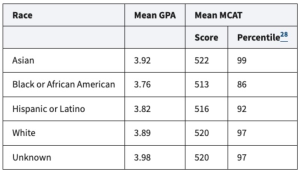
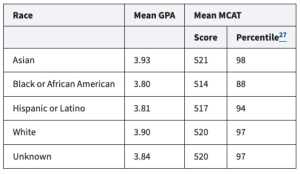
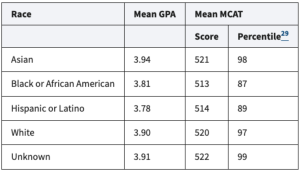
The investigation found “significant disparities” in grades and standardized test scores between black and Hispanic admitted students and white and Asian admitted students. For the 2024-2025 admissions cycle, admission rates for black and Hispanic applicants were two or three times higher than those of white or Asian applicants, even though the blacks and Hispanics, on average, had lower grades and test scores. The government analysis found “3.3% of white applicants and 3.4% of Asian applicants were admitted, while 10.0% of black applicants and 6.7% of Hispanic applicants were admitted.”
That cycle came after the Supreme Court’s 2023 decision in Students for Fair Admissions v. Harvard, clarifying what a lot of people, but apparently not the presidents and trustees of a lot of elite universities, already realized, which is that racial discrimination is unconstitutional and illegal.
Duke could lose its tax-exempt status as early as next year as a result of the finding, according to regulations released earlier this month by Treasury Secretary Scott Bessent and IRS chief executive officer Frank Bisignano. It could also lose federal research funding or access to federal payments for medical services performed in Duke Health hospitals and clinics, which reach into the billions of dollars. In August, a separate Justice Department investigation found similar practices at Duke Law School, where in 2025, “Duke Law’s use of race gave a black applicant a roughly 3.5x higher probability of admission than an equally strong Asian applicant with similar academic credentials.” In July 2025, the Department of Education launched a separate race-discrimination investigation into the Duke Law Journal based on reporting by the Washington Free Beacon.
The cases could also have implications beyond Duke; the government sued Harvard earlier this year over Harvard’s refusal to supply applicant-level data for Harvard College admissions similar to the data used in the two Duke investigations. A hearing in the Harvard case is scheduled for September 24 before Judge Myong Joun of the U.S. District Court for the District of Massachusetts.
At Duke’s medical school, the government found evidence that it said showed Duke had “intent to discriminate based on race” even after the Supreme Court decision. “Documents and communications show Duke SOM admissions committee members and staff using subjective standards like ‘overcoming hardship’ and ‘Social Justice Advocacy’ that allow them to identify applicants by race and reward or penalize them accordingly, in a remarkably consistent fashion, year after year, despite the requirements of SFFA,” the government said in a September 8, 2026 letter to the dean of the Duke University School of Medicine, Dr. Mary Klotman.
The director of the HHS Office for Civil Rights, Paula M. Stannard, said in a release announcing the findings, “OCR found that Duke School of Medicine intentionally discriminates against applicants by granting and denying admission based on an applicant’s race, breaking federal anti-discrimination laws.”
“In the Trump Administration, we are committed to ensuring that every applicant at a medical school is treated equally. Any kind of discrimination through the admissions process is unacceptable,” she said.
In January 2023, Duke withdrew from the U.S. News & World Report rankings of medical schools, a ranking that took the grade point averages and standardized test scores of incoming students into account. In announcing the decision, Klotman cited Duke’s “core values,” including both “excellence” and “Respect for and inclusion of people from all backgrounds.”
The government says it asked Duke School of Medicine for an explanation of the deviations in test scores and grade point averages between racial groups, and that Duke “failed to produce anything in response to those requests.” The school “asserts that race and ethnicity play no part in its admissions decisions” since the 2023 Supreme Court decision, the government says.
The Health and Human Services Department “Notice of Violation” includes tables showing the discrepancies by race in test scores and grade point averages for admitted students over three years. The first year is before the Supreme Court decision and the next two years are after it.
A friend-of-the-court legal brief that Duke and other schools filed in Students for Fair Admissions v. Harvard claimed that “race-neutral alternatives” to race-based affirmative action “would lead to a near 33% reduction in the number of African American students admitted.” It added that “the harms of a ‘race-blind’ review process cannot be fully captured by the numbers.” And it said that “no race-neutral alternative presently can fully replace race-conscious individualized and holistic review to obtain the diverse student body” that Duke said was “essential” to its educational mission.
Spokesmen for Duke and Duke School of Medicine did not respond to requests for comment on the government findings. The federal notice of violation gives the university and hospital system 10 days to respond or risk a referral to the Justice Department and other consequences.
Read the full article here