


Yossi Sheffi is the author of this intensely disturbing book about the experience of American and Israeli Jews on campus at the Massachusetts Institute of Technology in the aftermath of the October 7 massacre. Sheffi holds an endowed chair in engineering systems at MIT and is a member of the faculty in the Civil and Environmental Engineering Department, the Institute for Data, Systems, and Society, and the Operations Research Center. He is a leading expert in supply chain management and the author of nine books in his areas of professional expertise. He has been a member of the MIT faculty for almost 50 years.
Sheffi’s 10th book is also the first of its kind. Sheffi commissioned an unnamed journalist to interview dozens of American and Israeli Jewish undergraduate and graduate students, postdocs, and faculty about their experience on campus following October 7. Based on those interviews, the text of the book consists largely of a chronological narrative of the 2023-24 school year recounting their experience.
As the introduction puts it, “This is the story of what it felt like to those whose lives and studies were turned upside down.” Like Ken Kesey’s fictional One Flew Over the Cuckoo’s Nest, Unsafe at MIT takes us inside the asylum at MIT.
Sheffi’s narrative demonstrates that the anti-Israel and antisemitic inmates ran the asylum. By contrast with One Flew Over the Cuckoo’s Nest‘s Nurse Ratched, MIT president Sally Kornbluth proved herself to be a spineless weasel. Kornbluth’s betrayal of the applicable rules governing student protest on campus is one of the book’s most powerful motifs. Unlike her counterparts at Columbia and Harvard, Kornbluth nevertheless kept her job.
Sheffi himself is an Israeli immigrant to the United States. He was born in Mandatory Palestine. He emigrated to the United States from Jerusalem in 1975 to pursue his graduate studies at MIT. Many of the students and postdocs interviewed are Israelis with a background of service in the Israel Defense Forces. Sheffi does not make a point of it, but MIT appears to be unusual in this respect. The pain of these students permeates the book.
MIT is a magnet for those seeking the development of technical expertise that has made Israel a multidimensional powerhouse. October 7 hit these students hard. MIT provides a window onto the wave of hatred of Jews and the Jewish state that manifested itself on elite campuses following the massacre. It should be noted that the students whose experience forms the core of this story are mostly identified only by first names or pseudonymous first names.
Given his perch at the university, Sheffi also comments in four sections of the book set off from the narrative. He italicizes these sections, such as the introduction, in which he usefully summarizes his own “anger, grief, and disbelief” at “how the institution I have served for most of my life and that has supported my career was hijacked by antisemitic hatred and administrative incompetence.” He continues in a vein that anticipates his narrative:
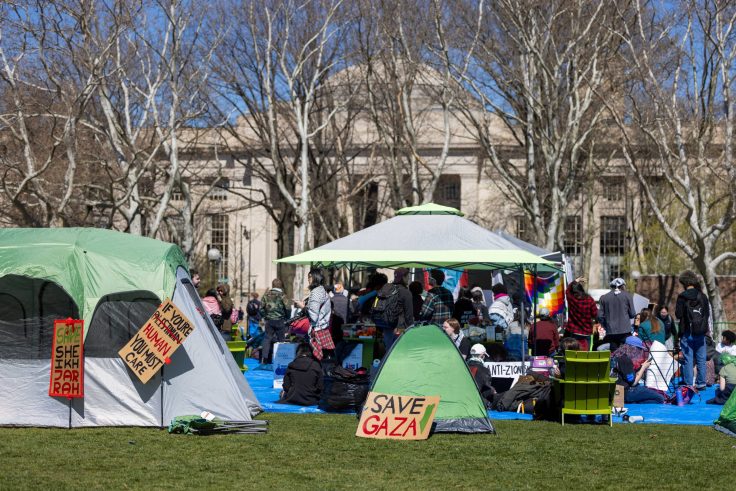
Mobs wielding megaphones marched through the halls and sometimes muscled their way into the offices of Israeli staff and faculty. Keffiyeh-clad masked protesters occupied public spaces, disrupted classes and MIT events, blocked the steps leading to the main entrance, and set up tents for an encampment that quickly—and unabashedly—became a no-go zone for any Jew daring to defend the Jewish state. … If any other minority had been attacked so openly and consistently, nobody would have stood for it.
The antisemitic vitriol began on October 7. The antisemitic harassment and demonstrations followed in due course. Sheffi begins with the date of October 9. He indicts the school’s leadership (and, in his narrative, the school’s DEI bureaucracy). Referring to the calls for “intifada” that immediately echoed on campus, Sheffi writes:
Now, the administration led by President Sally Kornbluth brushed off those calls as nothing more than the exercise of free-speech by peace-loving students. It is impossible to imagine a scenario in which nooses and white hoods appeared all over campus alongside a spike in anti-Black racist rhetoric without clear condemnation, a thorough investigation, and career-ending consequences for the perpetrators.
But in the wake of October 7, the MIT leadership prevaricated, equivocated, and negotiated itself until it became clear that the institute had been taken over by the most aggressive, intolerant minority on campus.
Sheffi’s reference to “the most aggressive, intolerant minority on campus” indirectly raises the question of perpetrators. Who are they? Sheffi names a number of campus groups—chapters of Students for Justice in Palestine and Coalition Against Apartheid (CAA), for example—and occasionally cites Arabic-speaking students, but doesn’t go much beyond that. The CAA appears with the regularity of an adversarial protagonist.
In his conclusion, Sheffi also writes of the “coordinated campaign of delegitimization and intimidation, amplified by social media, shielded by institutional paralysis, and justified by a moral framework that denied Jews the protections routinely extended to other minorities.” One wants to know more about the student groups and the coordinated campaign, but the mission of the book is to provide the perspective of tormented Jewish students. Unsafe at MIT accomplishes this mission in chilling detail.
Sheffi offers an inside look at a story of great public interest. Indeed, in microcosm, it appears to me to suggest the evolution of “the Hamas wing of the Democratic Party, which is in control,” as Louisiana senator John Kennedy recently put it. Thus the required adoption of the shibboleth that Israel is guilty of “genocide.” Members of “the Hamas wing of the Democratic Party” should probably be asked how they view Hamas. To the CAA and other such supporters of these terrorists, “resistance” is the required shibboleth.
Public interest in the issues addressed in the book attracted the attention of the New York Times prior to publication. The Times reported that Sheffi has self-published it. Although Amazon attributes publication to Transoft Inc., the book lacks an index or a guide to the many acronyms employed throughout, such as CAA. The footnotes are printed in a typeface so small as to be barely legible. The book deserves publication and promotion by a commercial publisher.
The Times story quotes MIT spokesman Kimberly Allen defending the school’s record on antisemitism and citing a 2026 quality of life survey showing an improved feeling of satisfaction among Jewish students since 2024. Sheffi himself notes the improvement. He attributes it to federal enforcement actions brought by the Trump administration: “Order returned not because principles were reaffirmed, but because fear and material incentives realigned behavior.” (He gives MIT no credit: “The moral failure remained dangerously unaddressed.”)
The improvement wrought by the Trump administration is one of the few shafts of light that enter the book. Another comes courtesy of the Supreme Court’s decision outlawing racial discrimination practiced in the name of “affirmative action.” Sheffi observes in one of those barely legible footnotes: “In the year after the Supreme Court decision in Students for Fair Admission vs. Harvard, the percentage of Black students enrolled at MIT dropped from 15 percent in the previous year to 5 percent.” In other words, the good news is that MIT appears to be complying with the Supreme Court decision.
Unsafe at MIT: A Chronicle of a Campus War on the Jews
by Yossi Sheffi
Transoft Inc., 280 pp., $25
Scott W. Johnson is a retired Minneapolis attorney and contributor to the site Power Line (powerlineblog.com). He is the father of Washington Free Beacon editor in chief Eliana Johnson.
Read the full article here