





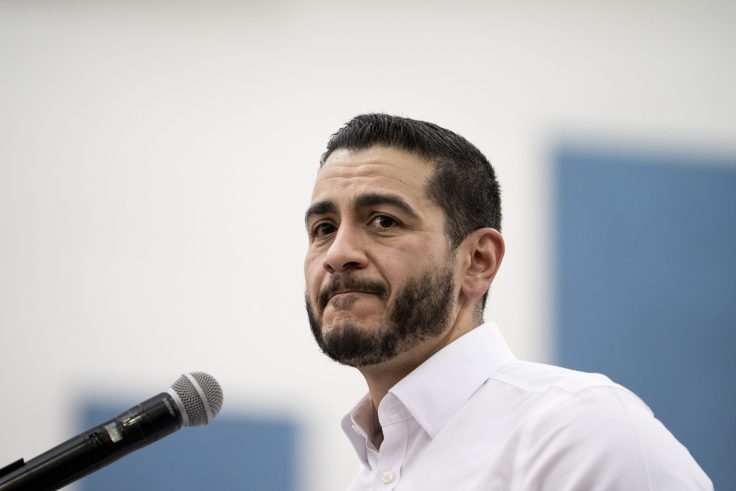
Michigan Senate candidate Abdul El-Sayed (D.), in a CNN essay that called Muslims “another victim of 9/11,” claimed that anti-Muslim discrimination after September 11 led to premature babies and low birthweight among Muslim newborns in the United States. But El-Sayed didn’t mention in his essay that he himself had published research four years earlier that found no such effect.
In a piece marking the anniversary of the September 11 attacks—published on the CNN web page of Fareed Zakaria—El-Sayed argued that the “discrimination and marginalization” that American Muslims and Arabs faced after the attacks produced measurable health consequences.
“We regularly see the toll this climate of discrimination takes upon these communities,” wrote El-Sayed, an epidemiologist at Columbia University at the time.
As evidence, he pointed to a 2006 study published in Demography, which concluded that Arab American women in California were 34 percent more likely to have premature and low birth weight babies following the terrorist attacks. The study’s author argued that “ethnicity-related stress or discrimination” likely contributed to the change. El-Sayed also cited his own 2011 study in the CNN essay that found Arab Americans had lower life expectancy rates than whites.
But El-Sayed’s essay omitted another study—one he coauthored in 2008 while at Columbia—that contradicted the California findings.
Analyzing 129,384 births in Michigan between September 2000 and March 2002, El-Sayed and two coauthors found “no difference” in the rates of premature or low birth weight births among Arab and Muslim mothers before and after September 11.
“Our findings contrast with the only other published study that has assessed the relationship between mass trauma and birth outcomes of a specific group,” the authors wrote in the paper, which appeared in the journal Ethnicity & Disease.
El-Sayed’s study went even further, reporting that Arab and Muslim women were at a “significantly” lower risk of delivering premature or low-weight babies than women overall. Roughly 8 percent of Arab mothers gave birth prematurely during the period studied, compared with about 9 percent of white mothers and 15 percent of black mothers, the study found.
The omission demonstrates how El-Sayed evolved over the years from a scientific researcher publishing peer-reviewed studies in obscure medical journals to a fledgling politician making inflammatory claims in unserious publications like the CNN page of “Fareed Zakaria GPS.”
More specifically, the omission raises an obvious question: Why did El-Sayed, who touted himself as “a scientist” in a CNN interview this week, cite research supporting his argument about the effects of anti-Muslim bigotry while leaving out his own published work that provided contradictory evidence?
El-Sayed has already faced scrutiny for drawing an equivalence between 9/11, in which 2,977 were killed, and the U.S. response to the attacks. On the 20th anniversary of the attacks, he wrote that while he mourned those killed on September 11, he would, the following day, “mourn ~1M lives, millions of injuries, & infrastructural devastation in 3 countries, perpetrated ignorantly in the name of my country.” He has also drawn criticism for appearances with left-wing influencer Hasan Piker, who previously remarked that “America deserved 9/11.”
There are no apparent flaws in El-Sayed’s Michigan study. Indeed, he cited the paper in at least eight subsequent academic articles he published over the years, including a 2021 study in the American Journal of Preventive Medicine. And El-Sayed, who went on to get his Ph.D. and M.D., though he never completed a residency, frequently touts his scholarly work, boasting of “more than 100 peer-reviewed publications that have been cited thousands of times.”
According to his résumé, El-Sayed presented the research at the Michigan Epidemiology Conference in 2008 and won second prize at that year’s annual meeting of the Society for Epidemiologic Research.
Unlike the California paper, El-Sayed’s Michigan study received little public attention. The 2006 Demography study generated national headlines, including a Washington Post story titled “Babies, Bigotry and 9/11,” and continued to be cited years later. WHYY, the Philadelphia NPR affiliate, aired a segment on the study in 2021.
By contrast, El-Sayed’s research remained largely confined to academic literature, perhaps because its muted findings did not make for splashy news coverage.
El-Sayed, now running against Rep. Haley Stevens in the Aug. 4 Democratic primary, more recently sought to reconcile the two studies, writing in his 2020 memoir, Healing Politics: A Doctor’s Journey into the Heart of Our Political Epidemic, in which he sought to establish himself as a serious political figure, that the California study was a catalyst for him to pursue a career in epidemiology. “In that paper, science, social science, and my own life experiences collided in a way I had never known was possible. It was exhilarating and devastating at the same time,” he wrote, indicating that the findings were “stunning” and “blood-curdling.”
“I had found social epidemiology, the discipline that would shape my work for years to come,” he wrote.
Rather than questioning the validity of the California study, El-Sayed argued that Michigan Muslims and Arabs fared better after 9/11 because they were more likely to live in tighter ethnic enclaves, “empowering and supporting them while also shielding them from prejudice.”
But in his research paper, El-Sayed acknowledged that the “difference in birth outcomes observed in California may have been due to chance alone.”
El-Sayed did not respond to requests for comment.
Read the full article here