




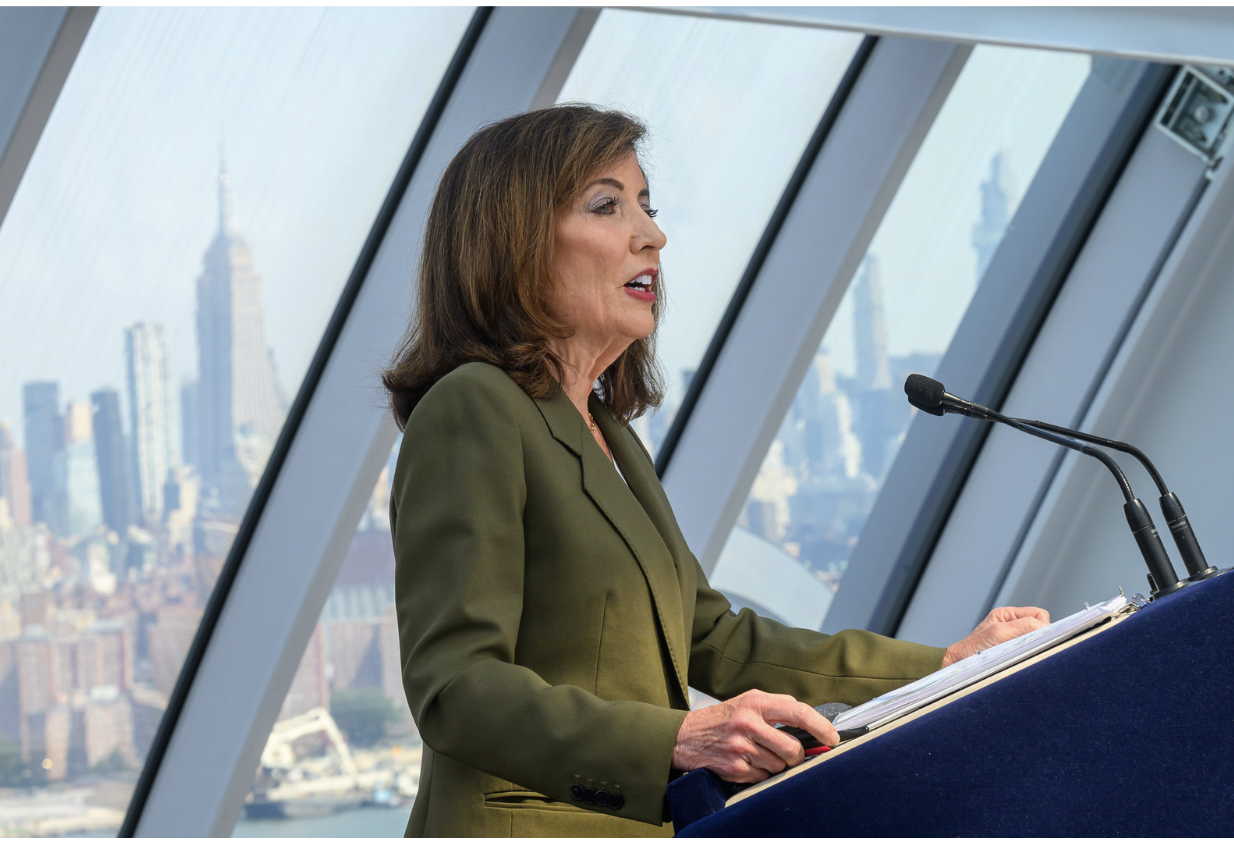
The decision of the governor of New York, Kathy Hochul, to halt data-center development statewide for a year is prompting a backlash from those who say it will further damage upstate New York’s already sagging economy.
It also puts Hochul, a Democrat, crosswise with the founder and CEO of Citadel, Ken Griffin, whose firm has a $6 billion development project in New York City. Citadel said in May that it might cancel the project after New York City’s socialist mayor, Zohran Mamdani, personally demonized Griffin, using him as a poster child for a taxation-without-representation tax increase on apartments owned by those, like Griffin, whose primary residence is elsewhere.
America and China are competing for dominance in AI and in other economic and geopolitical ways, and, as a series of articles in the Washington Free Beacon has reported, China is pouring money into its own technology infrastructure while funding an information and activist campaign aimed at slowing America’s buildout. The decision by Hochul amounts to a setback for the U.S. in that competition.
“We better damn well build the data centers in America because they’re going to get built somewhere in the world. And can you imagine how absolutely inane it would be if we end up having to be dependent on foreign countries for data centers?” Griffin said in a Goldman Sachs podcast released July 9. “Build that damn data center in America. It would kill me if we end up having to pay a bunch of foreign countries tens or hundreds of billions of dollars of money a year.”
Said Griffin, “They’re going to get built. Do you want them built here in America? Or do you want them built abroad? Answer that question.”
Griffin spoke of the “Not in My Backyard” ethos, known as NIMBY. Hochul’s policy goes beyond that, approaching BANANA—Build Absolutely Nothing Anywhere Near Anyone. That’s been New York state policy on most energy projects for decades, sending power bills in the state so high that Hochul is now citing energy costs as a reason for delaying data center construction.
The chairman of the Senate Select Committee on Intelligence, Senator Tom Cotton, Republican of Arkansas, sent a June 10, 2026, letter to the acting attorney general, Todd Blanche, requesting that the Justice Department “investigate foreign influence efforts targeting the buildout of AI infrastructure.”
“Alarming reports indicate that a network of foreign actors, led by the Chinese Communist Party (CCP), is attempting to manipulate U.S. policy and public opinion on data centers,” Cotton wrote. “Maintaining America’s AI advantage is vital to American economic strength, diplomacy, national security, and military power.”
“Albany wants to talk about data centers because Albany doesn’t want to talk about what actually sent electricity rates to the moon, which was largely Albany’s own policies,” a fellow at the Manhattan Institute, Ken Girardin, told the Washington Free Beacon.
Girardin said a 2019 climate law signed by the then-governor, Andrew Cuomo, “imposed renewable-energy subsidies, thwarted new power plants from coming online, and hit the electric utilities with huge costs.” Cuomo also closed the Indian Point nuclear power plant in 2021. The state has also slow-walked or totally blocked proposed natural gas pipelines, including the Northeast Supply Enhancement pipeline and the Constitution Pipeline. Both projects bring gas to New York from Pennsylvania, which has had a far less restrictive and more reasonable approach toward hydraulic fracturing than New York does. The Marcellus Shale extends across the Pennsylvania border into the Empire State, and Pennsylvania’s ability to capitalize on it while New York refuses to do so is an example of how New York’s energy policies have emphasized environmental protection at the expense of energy production. And it’s not even genuine environmental protection, it’s just virtue signaling, because the gas is being produced, just across the border in Pennsylvania rather than in New York.
The general president of the United Association of Union Plumbers and Pipefitters, Mark McManus, denounced Hochul’s policy. “A shortsighted moratorium only accomplishes one thing: it kills good-paying union jobs. Rather than implementing guardrails to build the future of American ingenuity, Governor Hochul is taking her ball and going home,” McManus said.
A pro-growth group, Upstate United, also issued a statement criticizing Hochul’s decision. “While we understand there are some valid concerns around data center development in New York State, many stemming from the state’s self-inflicted power generation shortage, executive action to enforce a moratorium on the development or construction for up to one year sends mixed signals. This will not only prolong uncertainty for companies looking to New York, but ultimately jeopardize potential investment, economic development and skilled jobs,” said Upstate United’s executive director, Justin Wilcox.
“While states like Virginia and Texas are far more likely to be approached by possible developers, the fact of the matter is that a statewide moratorium strips away local control and a community’s ability to decide on projects that could be pivotal to their economic growth and job creation. We simply cannot claim to be a state at the forefront of AI innovation if we preemptively turn down opportunities that would help ensure that to be true,” Wilcox said.
In announcing her decision, Hochul echoed the activist groups that have opposed them. “These hyperscale AI data centers consume enormous amounts of power — truly threatening to outpace our grid’s capacity — and they drive up costs for local ratepayers,” she said. “They occupy massive amounts of land, potentially displacing agricultural space and open spaces. And if you live near one, they emit vibrations and noise.” If preventing vibration were an overriding concern, New York would have never built the subway. And if preventing displacement of agricultural space were a dominant concern, Brooklyn and Upper Manhattan would still be working farmland.
She also spoke of setting up a framework to shake down (my words, not hers) the companies in exchange for permission to operate. “We’re going to explore having hyperscale data centers pay into a larger fund to support our grid statewide,” she said. “The bigger the data center, the bigger the investments that communities can and should expect. We also want to make sure that labor has a seat at the table so projects can include wage standards and labor agreements and prioritize local hiring.”
She said, maybe a little too defensively and inaccurately, “no one can accuse New York of fearing innovation.” She went on, “But that said, a lot of Americans — for a lot of them, the specter of unchecked AI brings up fear, anxiety, a lot of worry. … Their feelings are valid, and we cannot ignore them.”
The New York state motto is “Excelsior,” a Latin word that means “ever upward.” Maybe Governor Hochul and the Democratic Party-dominated legislature can consider changing it to “moratorium,” another Latin word that means “tending to delay.” Or skip the Latin altogether and go with “fear, anxiety, a lot of worry.” If it’s not the state motto, maybe Hochul can use it as the slogan for her reelection campaign.
Read the full article here