




NEWYou can now listen to Fox News articles!
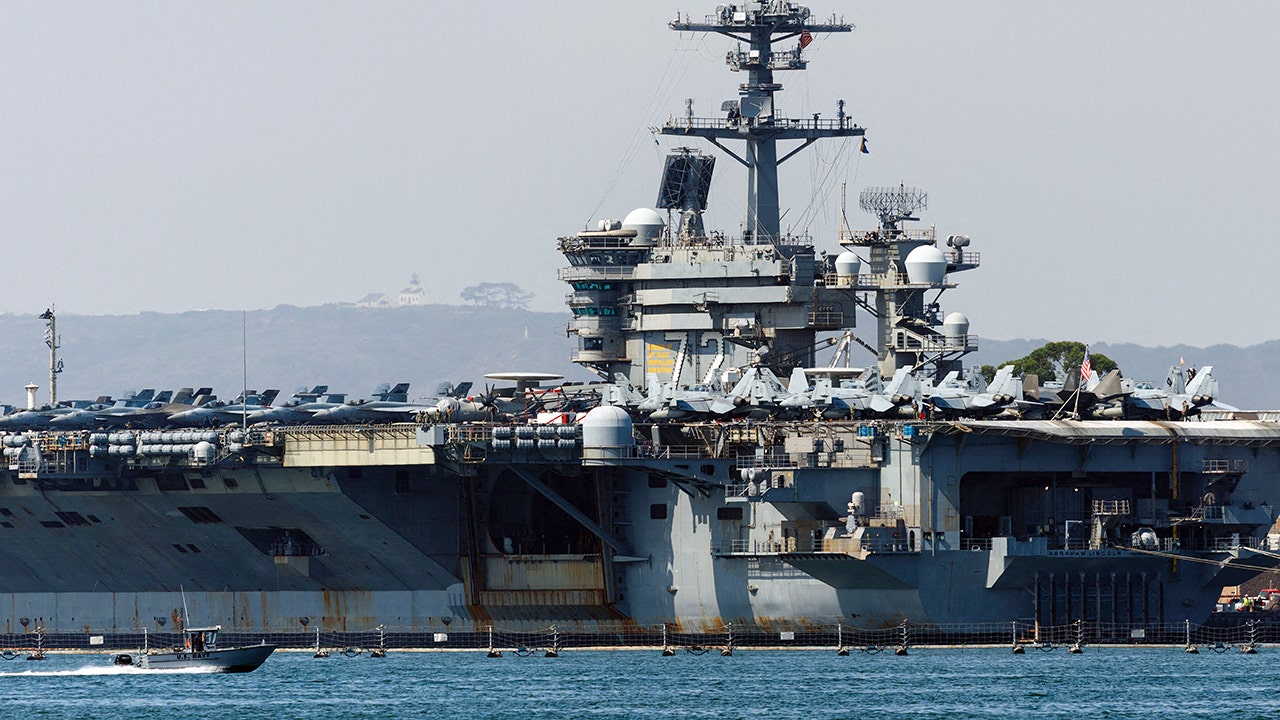
The most strategically revealing military move in the Iran war this week isn’t another strike on Tehran. It is an American aircraft carrier leaving the Pacific. The USS George Washington is heading toward the Middle East to relieve the USS Abraham Lincoln, whose overall deployment has exceeded 260 days, including more than 240 uninterrupted days at sea. The move could leave the Pacific without a U.S. carrier for an unknown period.
That does not mean China is preparing to attack Taiwan. It means the United States is making a real strategic tradeoff: a carrier reinforcing the Middle East cannot simultaneously deter in the Western Pacific. America has global reach, but its forces are not infinite, and geography still imposes choices.
The same point was visible in Adm. Brad Cooper’s just-completed 10-day trip through six Middle Eastern countries. CENTCOM says more than 50,000 American service members are now operating across the region. Iran is consuming ships, aircraft, munitions, logistics and command attention at the same time Washington says the Indo-Pacific must remain a priority.
PENTAGON RACES TO BUY 10X MORE MISSILES AS IRAN WAR DWINDLES ARSENAL, THREATENS READINESS FOR CHINA AGGRESSION
That is the strategic dilemma. The question is no longer simply whether the United States has enough military power to continue operations against Iran. We do. The harder question is whether we are allocating that power in a way that matches our declared priorities.
The 2026 National Defense Strategy is unusually clear on this point. It calls for a strong denial defense along the First Island Chain and places deterring China among the Pentagon’s top priorities, expecting allies to shoulder more responsibility elsewhere. Whatever one thinks of that approach, it is strategy because it makes choices.
Now events are testing whether Washington is prepared to live by those choices.
This is not the familiar debate over whether America can “fight two wars.” That phrase is too crude. The United States remains capable of fighting in more than one theater. The real problem is deterrence: Can we sustain a demanding conflict in the Middle East while keeping enough ready combat power elsewhere to persuade China that this is not its moment to attack Taiwan?
THREE KEY REASONS WHY AMERICA CANNOT AFFORD TO LOSE TAIWAN TO COMMUNIST CHINA
Deterrence does not require an adversary to believe we are invincible. It requires him to believe the cost of acting now is greater than the potential gain. Beijing does not need to conclude that America has become weak. Chinese planners need only ask whether American forces, munitions, maintenance capacity and political attention are tied down enough elsewhere to alter the risk of acting in the Pacific.
Strategic history in the rearview mirror
History offers useful warnings, not because 2026 replays 1941 or 1950, but because strategy has always meant matching ends, ways and means.
Britain learned that lesson painfully before Singapore fell on February 15, 1942. London carried military commitments across Europe, the Mediterranean, the Middle East and Asia while its naval resources were stretched by a global war. British defense planning for Singapore depended on reinforcing the Far East in a crisis, but when Japan struck, Britain was already fighting for survival elsewhere. The lesson wasn’t courage. It was strategic capacity: Britain had accumulated commitments it could no longer defend simultaneously.
The United States chose differently in World War II. Pearl Harbor made Japan the immediate enemy in the American mind, but Roosevelt and Churchill kept the main Allied effort focused on defeating Germany first. They reaffirmed that priority at Casablanca in 1943 while continuing the war against Japan. Strategy required distinguishing the most immediate enemy from the most consequential one.
The lesson isn’t that America needs a simplistic “China First” slogan; strategy cannot be reduced to a bumper sticker. It is that priorities have consequences. A nation cannot call one theater its principal military challenge and then assume repeated emergency commitments elsewhere carry no cost.
The United States remains capable of fighting in more than one theater. The real problem is deterrence: Can we sustain a demanding conflict in the Middle East while keeping enough ready combat power elsewhere to persuade China that this is not its moment to attack Taiwan?
Our Navy makes that cost unusually visible. Airpower can shift between theaters quickly, though the tankers, bases, weapons and support that sustain it cannot. Naval power is less forgiving. A carrier committed to the Middle East is a carrier unavailable in the Pacific.
The Lincoln illustrates the point. Its deployment has stretched past 260 days at sea, and lawmakers have pressed the Pentagon for answers on the strain that extended combat cruise has placed on the ship and its roughly 5,000-person crew. The George Washington rotation is necessary. But necessary rotations still carry strategic tradeoffs.
REP GARAMENDI, SEN KELLY: WE MUST WORK TOGETHER TO MAKE AMERICA A SHIPBUILDING POWER
Nor can the Pentagon solve this quickly by ordering more ships. Congress and the administration should debate the size and composition of the future fleet, but a carrier ordered today will not arrive for years. Shipbuilding capacity, maintenance backlogs and munitions production are decades-long problems. Strategy operates with the force we have, not the force we wish we had.
That distinction matters as the Iran conflict stretches past six months. The larger strategic issue now reaches beyond Iran: What does each additional Middle Eastern commitment cost America’s ability to execute its wider defense strategy? That question only grows more urgent the longer the conflict lasts.
The answer need not be withdrawal. Nor does it require conceding the Middle East to Iran. It requires something Washington often resists: enforcing priorities. Which American interests are vital? Which can be handled primarily by allies? Which military capabilities must be protected for the highest-priority contingency? And what level of risk are we accepting elsewhere each time we surge into this crisis?
Folding Iran into the China threat
The Truman administration confronted a related problem when North Korea invaded the South in June 1950. Korea demanded immediate American combat power, but Washington faced the larger contest with the Soviet Union. NSC-68, issued two months earlier, had already called for a major military buildup to counter that threat. Korea accelerated it. Washington fought the immediate war without losing sight of the larger competition.
US DRAINS CRITICAL MISSILE STOCKPILES IN IRAN WAR AS YEARSLONG REBUILD LOOMS
That is the discipline required now.
The George Washington’s move toward the Mideast should focus attention in Congress and the White House, turning an abstract strategic debate into something visible on a map. One of America’s most powerful warships is leaving the theater our own strategy calls central, headed toward a war we are already fighting.
The lesson isn’t that America needs a simplistic “China First” slogan; strategy cannot be reduced to a bumper sticker. It is that priorities have consequences.
CLICK HERE FOR MORE FOX NEWS OPINION
Perhaps that is the correct decision. But if it is, Washington should acknowledge the risk being accepted and explain how it intends to preserve deterrence in the Pacific. If such tradeoffs become routine, then our stated strategy and our actual force allocation are moving in different directions.
CLICK HERE TO DOWNLOAD THE FOX NEWS APP
America does not lack military power. It lacks the ability to treat every threat as equally urgent at the same time. That is why strategy requires choices. Iran may demand action today; China remains the larger challenge. Washington must weigh what each requires and decide deliberately. If we don’t set our priorities, events eventually will.
CLICK HERE TO READ MORE FROM ROBERT MAGINNIS
Read the full article here