




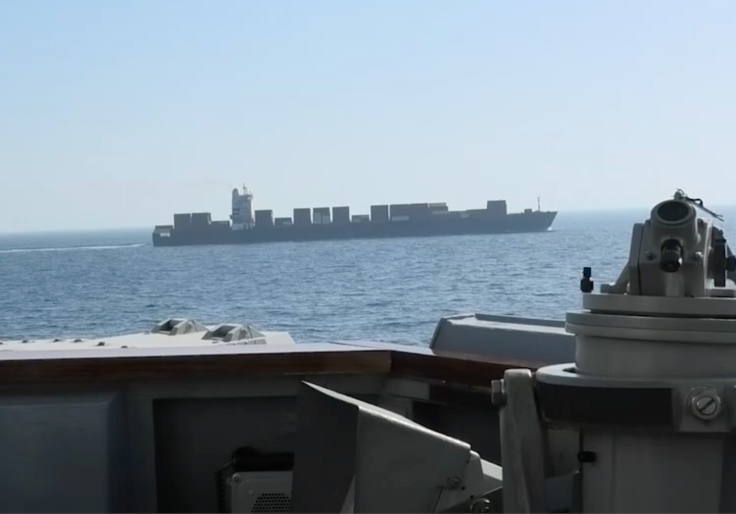
Many of those ships are now headed back toward Iran, where they may attempt to breach the blockade
Iran’s “ghost fleet” of illicit tankers moved 60 million barrels of crude oil worth an estimated $5 billion between the beginning of Operation Epic Fury and the start of the U.S. blockade of the Persian Gulf, according to shipping data analyzed by the United Against a Nuclear Iran (UANI) advocacy group, which noted that the bulk of that oil went to China.
Twenty-six of the ships UANI has monitored originated from Kharg Island, Iran’s main energy hub and the site of multiple U.S. military attacks last month. The Islamic Republic’s wartime exports generated “an estimated revenue of over $5 billion” for the Islamic Revolutionary Guard Corps, which according to UANI “continues to fund Iran’s active missile and drone programs central to the conflict.”
The monetary value of the oil that the ghost fleet moved out of Iran before the blockade came into effect emphasizes the consequences of U.S. action. The United States is not allowing any Iranian oil tankers to leave or return to the Persian Gulf, and the presence of U.S. ships has dealt a significant blow to the Islamic Republic’s finances. The blockade has the potential to deprive Tehran of around $435 million per day, or about $13 billion per month, in “combined economic damage” by stopping both imports and exports. More than 90 percent of Iran’s hundred-billion-dollar yearly oil revenue comes from ships that traverse the Strait of Hormuz, a path the U.S. blockade has effectively choked off.
At least 34 Iranian ships are “anchored or loitering” around Southeast Asia, and these ships will have to face the blockade as they make their way back toward Iran, according to UANI. One Iranian ship, the Sobar, departed Malaysian waters on April 19 and is headed toward the Islamic Republic. Another ship, the Felicity, left the Gulf of Kutch between India and Pakistan on April 18 before turning off its location beacon, a tactic illicit that Iranian ships seeking to avoid detection often employ. UANI reviewed satellite imagery that showed the Felicity making its way back to the Persian Gulf as well.
“Whatever left the barn before the barn doors are closed, is gone already, right?” retired CIA senior operations officer Rick de la Torre told the Washington Free Beacon. “Those ships are headed towards their destination. I suspect they’ll do their transfers. The U.S. military looks like they’re serious about interdiction. They’re stopping these ships, so I don’t believe these ships will be headed back.”
The United States has conducted multiple operations to prevent Iran from carrying out its oil trade. The Pentagon announced early Tuesday that it carried out a “maritime interdiction” of a sanctioned ship called the Tifani in the Indian Ocean. That ship was carrying 1.8 million barrels of Iranian crude and was on course to perform a ship-to-ship transfer with “another tanker bound for China,” UANI noted. The United States interdicted another, the Majestic X, in the Indian Ocean on Wednesday evening, showing that the Pentagon is willing to confront Tehran’s armada outside of the Persian Gulf.
The Touska, an Iran-flagged container ship the United States seized over the weekend, made routine stops at a Chinese port linked to Tehran’s missile supply chain, additional data that UANI compiled show. The Touska, which the Treasury Department sanctioned in 2020, attempted to penetrate the U.S. blockade after routes that suggest it may have been used to transport arms.
Charlie Brown, a senior adviser at UANI who monitors Iran’s illicit shipping operations, said the Touska‘s movements were “not routine commercial activity” but rather a “deliberate attempt to move possible contraband cargo through known logistics nodes despite heightened scrutiny and interdiction risk.”
“By routing through a Chinese port linked to Iran’s missile supply chain and then proceeding toward Southeast Asia, TOUSKA fits a broader pattern: probing for seams in enforcement, using container shipping as cover, and attempting to normalize traffic that may include war effort supporting or other prohibited materials,” Brown told the Free Beacon.
The oil trade, de la Torre said, is not only a cash cow but also a means of bolstering Tehran’s supply of arms.
“It was not uncommon that along with all shipments, would come military components, military parts, everything from conventional weapon systems to electronic warfare systems to ballistic missile technologies,” said de la Torre, who now advises companies on national security as a founding partner of Tower Strategy. “It all ties in together. The oil becomes the currency but also the vehicle for the literal transfer of weapons technologies.”
Read the full article here